1
number theory
easy
Find the HCF of 72 and 128.
Answer: 1
72 = 2³ × 3², 128 = 2⁷. HCF = 2³ = 8.
2
number theory
medium
Find the smallest possible integer n such that 2250n is a perfect cube.
Answer: 1
2250 = 2 × 3² × 5³. To make every exponent a multiple of 3, we need one more factor of 2² and one more factor of 3¹: n = 4 × 3 = 12.
3
percentage
easy
The price of a painting increased by 18% from 2022 to 2023, and then decreased by 5% from 2023 to 2024. The price of the painting in 2024 is x% of the price of the painting in 2022. Find the value of x. Round your answer correct to the nearest integer.
Answer: 3
x = 100 × 1.18 × 0.95 = 112.1, which rounds to 112.
4
sequences
easy
The first four terms of a sequence are shown below.
1, 7, 13, 19
Find the value of the 62nd term in the sequence.
Answer: 2
Common difference = 6, first term = 1. a₆₂ = 1 + 6(61) = 1 + 366 = 367.
5
algebra
medium
The roots of the quadratic equation x² + px + 12 = 0 are 3 and q. Find the value of p and the value of q.
Answer: 1
Product of roots = 3q = 12 ⟹ q = 4. Sum of roots = 3 + 4 = 7 = −p ⟹ p = −7.
6
algebra
easy
Solve the equation −2(5 − 3x) = 32.
Answer: 3
−10 + 6x = 32 ⟹ 6x = 42 ⟹ x = 7.
7
algebra
easy
Solve the simultaneous equations x + 3y = 11 and x − 4y = −3.
Answer: 3
Subtracting: (x+3y)−(x−4y) = 11−(−3) ⟹ 7y = 14 ⟹ y = 2. Then x = 11 − 3(2) = 5.
8
algebra
medium
Solve the inequalities 4x − 11 ≤ 3x + 2 < 5x − 13.
Answer: 1
4x−11 ≤ 3x+2 ⟹ x ≤ 13. 3x+2 < 5x−13 ⟹ 15 < 2x ⟹ x > 7.5. So 7½ < x ≤ 13.
9
indices
medium
(3ˣ + 3ˣ + 3ˣ)/15 = 16⅕. Find the value of x.
Answer: 2
3·3ˣ/15 = 81/5 ⟹ 3^(x+1) = 15×81/5 = 243 = 3⁵ ⟹ x+1 = 5 ⟹ x = 4.
10
indices
medium
Simplify (a²)³ / b⁻³ ÷ a⁴/√b.
Answer: 3
(a²)³/b⁻³ = a⁶b³. Dividing by a⁴/√b: a⁶b³ × √b/a⁴ = a^(6−4) b^(3+½) = a²b^(7/2).
11
algebra
medium
Factorise (x² + 6x + 9)(x² − 9) completely.
Answer: 3
x²+6x+9 = (x+3)², x²−9 = (x+3)(x−3). Product = (x+3)³(x−3).
12
coordinate geometry
easy
A line passes through the points (1,2) and (4,k). If the gradient of the line is 3, find the value of k.
Answer: 3
(k−2)/(4−1) = 3 ⟹ k−2 = 9 ⟹ k = 11.
13
algebra
medium
The minimum point of the graph of y = x² + bx + c is the point (−7, −3). Find the value of b and the value of c.
Answer: 3
Vertex x = −b/2 = −7 ⟹ b = 14. Minimum value = c − b²/4 = c − 49 = −3 ⟹ c = 46.
14
algebra
hard
Express (x−2)/(2x+5) + (3x−5)/(25−4x²) as a single fraction in the simplest form.
Answer: 4
25−4x² = −(2x−5)(2x+5), so the second term becomes (5−3x)/[(2x−5)(2x+5)]. First term = (x−2)(2x−5)/[(2x+5)(2x−5)] = (2x²−9x+10)/[...]. Sum numerator = (2x²−9x+10)+(5−3x) = 2x²−12x+15.
15
geometry
medium
In a right-angled triangle, the lengths of the sides are 24.5 cm, 32.9 cm and x cm. Find the possible values of x.
Answer: 3
If x is the hypotenuse: x = √(24.5²+32.9²) = √1682.66 ≈ 41.0. If 32.9 is the hypotenuse: x = √(32.9²−24.5²) = √482.16 ≈ 22.0.
16
similar triangles
medium
△ABC and △ACD are similar. AB = 75 cm and AD = 27 cm. Find the length of AC in centimetres.
Answer: 45
By similarity (AB corresponds to AC, AC corresponds to AD): AC² = AB × AD = 75 × 27 = 2025 ⟹ AC = 45 cm.
17
mensuration
medium
Two solids are geometrically similar. The ratio of their surface areas is 6 : 13. The volume of the larger solid is 541 cm³. Find the volume of the smaller solid in cm³. Give your answer correct to the nearest integer.
Answer: 170
Linear ratio = √(6/13). Volume ratio = (6/13)^(3/2) ≈ 0.31363. Smaller volume = 541 × 0.31363 ≈ 169.7, which rounds to 170.
18
geometry
medium
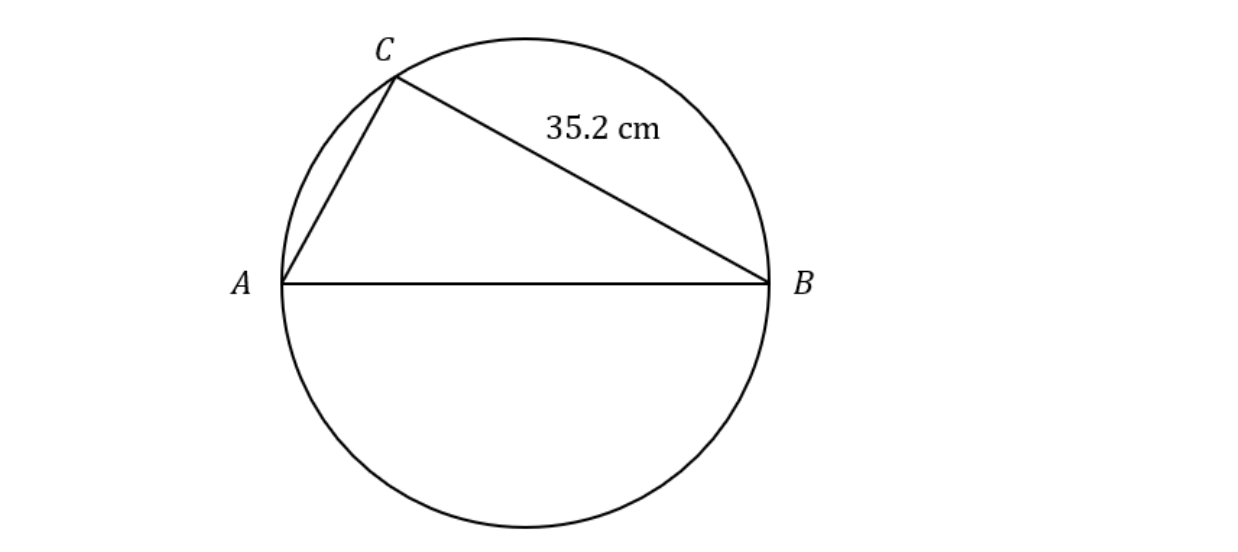
In the diagram, AB is the diameter of the circle. C is a point on the circle such that BC = 35.2 cm. The area of the circle is 2620 cm². Find the length of AC in centimetres. Give your answer correct to the nearest integer.
Answer: 46
r² = 2620/π ⟹ r ≈ 28.879, so AB = 2r ≈ 57.758. Since AB is a diameter, ∠ACB = 90°, so AC² = AB² − BC² ≈ 3336.0 − 1239.0 = 2097.0 ⟹ AC ≈ 45.8, which rounds to 46.
19
mensuration
medium
The perimeter of a sector is 63 cm. The angle subtended by the sector is 48°. Find the area of the sector in cm². Give your answer correct to the nearest integer.
Answer: 207
Perimeter = r(2 + θ) where θ = 48π/180 ≈ 0.83776 rad. r = 63/2.83776 ≈ 22.204. Area = ½r²θ ≈ ½(493.03)(0.83776) ≈ 206.5, which rounds to 207.
20
variation
medium
y is directly proportional to the cube of x. At a particular value of x, the value of y is 205. Find the value of y when this particular value of x increases by 220%.
Answer: 6717.44
New x is 3.2 times the original (100% + 220% = 320%). Since y ∝ x³, new y = 205 × 3.2³ = 205 × 32.768 = 6717.44.
21
circle geometry
hard
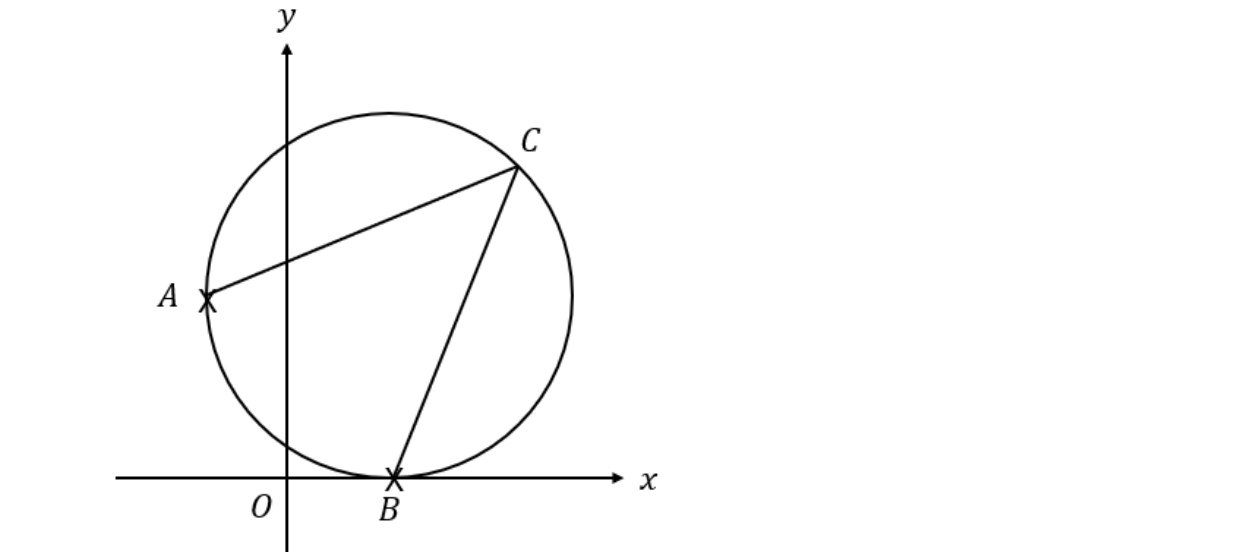
In the diagram, ABC is a circle. A(−2,6) is the left-most point of the circle and B is the point (p,0). ∠ACB = x°. Find the value of p + x.
Answer: 49
A being the left-most point means the centre has the same y-coordinate as A, 6. B is the point where the circle meets the x-axis at the bottom (from the diagram, the circle is tangent to the x-axis there), so the centre's x-coordinate equals p and the radius equals the centre's y-coordinate. Combining both: centre = (4,6), radius = 6, so p = 4. Vectors from the centre to A and to B are perpendicular (dot product 0), so the central angle AOB = 90°. Since C lies on the major arc, the inscribed angle ACB = 90°/2 = 45°, so x = 45. p + x = 4 + 45 = 49.
22
trigonometry
medium
The largest angle of a triangle with sides 15.1 cm, 11.2 cm and 13.7 cm is x°. Find the value of x, correct to the nearest integer.
Answer: 74
The largest angle is opposite the largest side, 15.1 cm. By the cosine rule: cos x = (11.2²+13.7²−15.1²)/(2×11.2×13.7) = 85.12/306.88 ≈ 0.27743 ⟹ x ≈ 73.9°, which rounds to 74.
23
statistics
hard
A data set consists of the following six integers: 7, x, 10, y, z, 15, where the values are arranged in ascending order. The median is 11.5 and the mode is 10. Find the value of x + 2y + 3z.
Answer: 78
Median = (10+y)/2 = 11.5 ⟹ y = 13. For the mode to be uniquely 10, x must equal 10 (giving 10 a repeat), and z must avoid tying another value, so z = 14 (z = 13 or 15 would create a tie). Data: 7,10,10,13,14,15. x+2y+3z = 10+26+42 = 78.
24
statistics
medium
The mean of six positive integers is 7. When two numbers are removed, the mean of the remaining numbers is 8. What is the greatest possible difference of the two numbers that are removed?
Answer: 8
Total sum = 42. Remaining four sum to 32, so the two removed numbers sum to 10. To maximise their difference with sum 10 and both positive integers, use 1 and 9: difference = 8.
25
algebra
medium
The graph of y = (1/3)x² + 2x + 2 and the graph of x + y = 3 are drawn on the same axes. The x-coordinates of the points of intersection of the two graphs are the solutions to the equation x² + bx + c = 0. Find the value of b + 2c.
Answer: 3
Setting (1/3)x²+2x+2 = 3−x gives (1/3)x²+3x−1 = 0, i.e. x²+9x−3 = 0. So b=9, c=−3, and b+2c = 9−6 = 3.
26
mensuration
medium
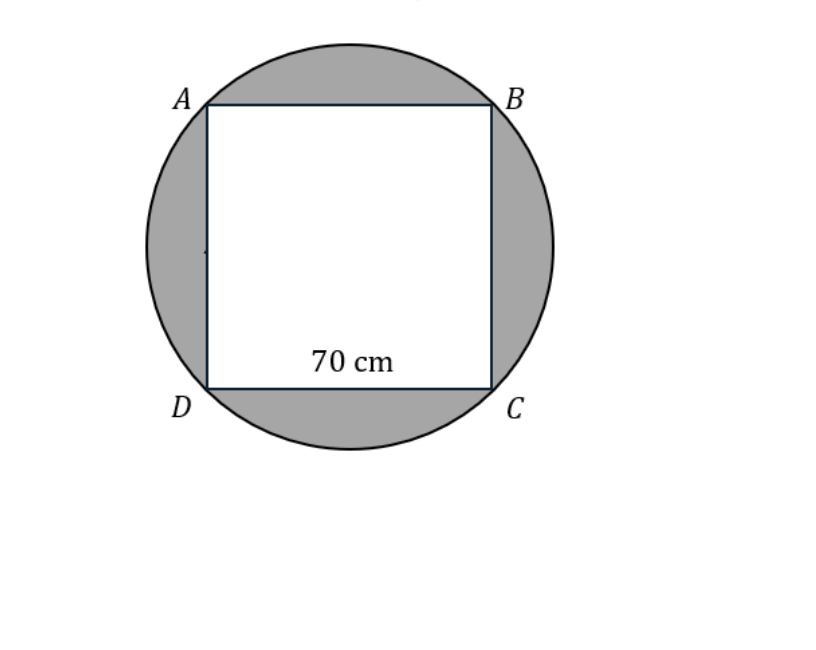
A square is inscribed in a circle as shown. Each side of the square is of length 70 cm. Find the area of the shaded region in cm². Give your answer correct to the nearest integer.
Answer: 2797
Diagonal of square = 70√2 = diameter of circle, so r = 35√2 and circle area = π(35√2)² = 2450π ≈ 7696.9. Square area = 70² = 4900. Shaded area = 7696.9 − 4900 ≈ 2796.9, which rounds to 2797.
27
logic
hard
Daphne chose one number from the following four numbers: 15, 28, 49, 63.
Alice was told whether the number is a multiple of 7.
Bernice was told whether the number is a perfect square.
Carol was told whether the number is even or odd.
They share their facts.
Alice: "I don't know what's the number."
Bernice: "I see. I also don't know what's the number."
Carol: "I did not know the number at the start. But now I know what's the number."
What is the chosen number?
Answer: 63
15 is the only non-multiple of 7; since Alice doesn't know, the number isn't 15 — leaving {28,49,63}. 49 is the only perfect square; since Bernice still doesn't know, she wasn't told 'perfect square' (that would have told her immediately), so the number isn't 49 — leaving {28,63}. Carol didn't know at the start, so she wasn't told 'even' (28 is the only even number, which would have told her immediately) — she was told 'odd'. Among {28,63}, only 63 is odd, so Carol now knows it's 63.
28
geometry
hard
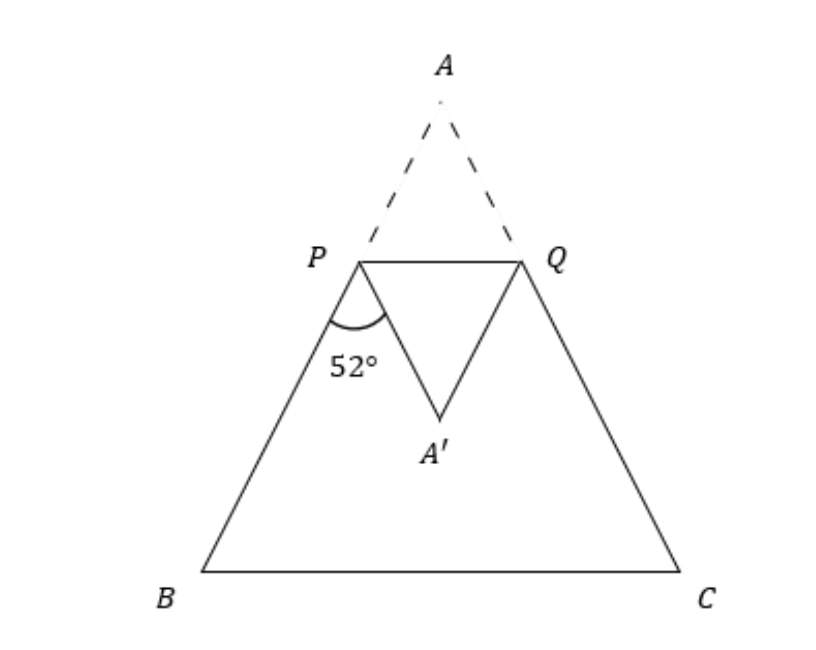
An isosceles triangle ABC with AB = AC is folded along a line DE that is parallel to the base BC, creating a smaller triangle A'PQ within ABC as shown in the diagram. ∠BPA' = 52° and ∠PA'Q = x°. Find the value of x.
Answer: 52
Let ∠ABC = ∠ACB = B. Since DE∥BC, ∠PDE = ∠ADE = B (corresponding angles), and ∠BDE = 180°−B. Folding reflects A to A' across DE, so ∠A'DE = B as well, giving ∠BPA' = ∠BDA' = ∠BDE − ∠A'DE = 180°−2B = 52°, so B = 64°. The apex angle ∠BAC = 180°−2B = 52°, and since folding preserves the apex triangle's shape, ∠PA'Q = ∠DAE = ∠BAC = 52°.
29
geometry
hard
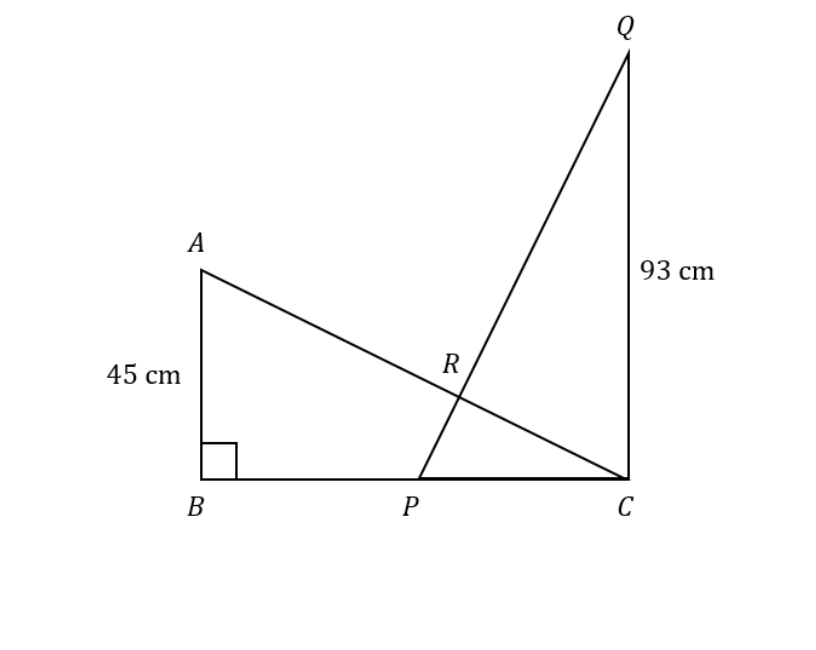
In the diagram, △ABC and △PCQ are congruent right-angled triangles. Given that AB = 45 cm and CQ = 93 cm, find the length of QR in centimetres. Give your answer correct to the nearest integer.
Answer: 84
By the congruence A↔P, B↔C, C↔Q: AB=PC=45 and BC=CQ=93, so BP = BC−PC = 48. Placing B=(0,0), A=(0,45), C=(93,0), P=(48,0), Q=(93,93). Line AC: y=45−(15/31)x. Line PQ: y=(31/15)(x−48). Solving gives their intersection R ≈ (56.54, 17.64). QR = distance from Q(93,93) to R ≈ √(36.46²+75.36²) ≈ 83.7, which rounds to 84.
30
coordinate geometry
hard
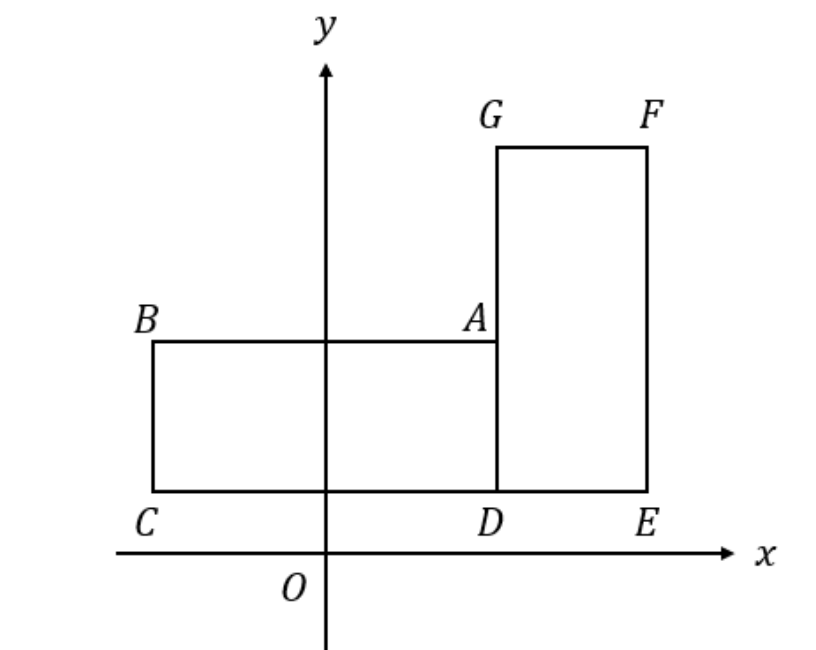
In the diagram, ABCD and DEFG are congruent rectangles. ABCD is symmetrical about the y-axis. CDE is a horizontal line. The coordinates of A are (4,7) and the y-coordinate of F is 14. The distance between points B and G is d units. Find the value of d correct to the nearest integer.
Answer: 11
By symmetry B=(−4,7). Let ABCD have height h, so C=(−4,7−h), D=(4,7−h). DEFG is congruent but rotated 90° (width h, height 8), so F's y-coordinate = (7−h)+8 = 15−h = 14 ⟹ h=1. So D=(4,6), G=(4,14). BG = √((4−(−4))²+(14−7)²) = √(64+49) = √113 ≈ 10.63, which rounds to 11.
31
geometry
hard
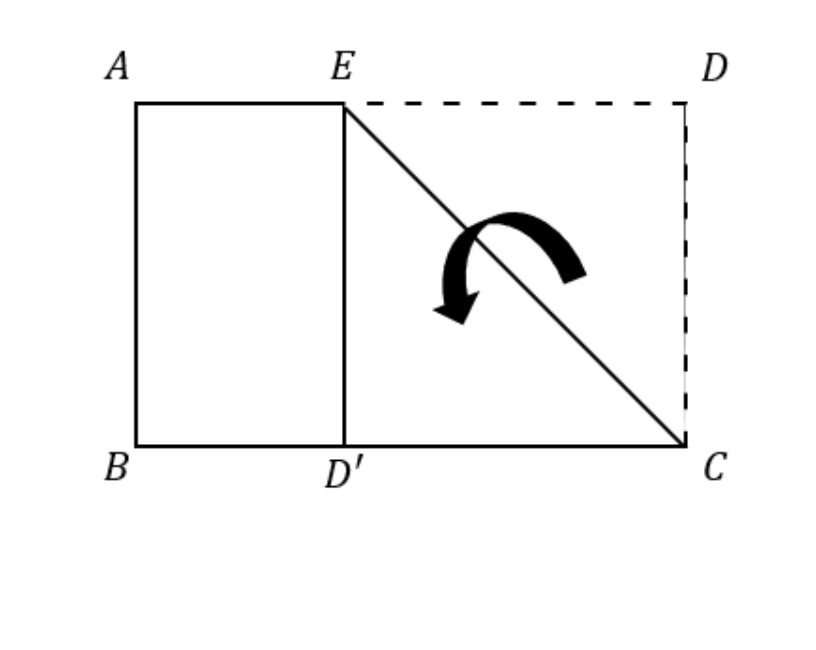
A rectangular piece of paper ABCD is folded along the line EC, such that D is moved to D' on BC. The ratio length of BD' : length of D'C = 2 : 3. The area of ABCE is 672 cm². Find the length of AB in centimetres.
Answer: 24
Let AB = h and BC = w, with B=(0,0), C=(w,0), A=(0,h), D=(w,h), D'=(2w/5,0). Since CD'=CD (fold preserves length), 3w/5 = h ⟹ w = 5h/3. Using ED=ED' (E=(e,h) on AD) gives e = 2h/3. Area of trapezoid ABCE = ½(e+w)h = ½(7h/3)h = 7h²/6 = 672 ⟹ h² = 576 ⟹ h = 24 cm.