1
ratio
easy
Express the ratio 8¼ : 15/8 in the simplest form.
Answer: 3
8¼ = 33/4. Ratio 33/4 : 15/8 — multiply both sides by 8: 33×2 : 15 = 66 : 15 = 22 : 5 (dividing by 3).
2
measurement
easy
Convert 0.0852 km to centimetres.
Answer: 3
0.0852 km = 85.2 m = 8520 cm (1 m = 100 cm).
3
measurement
easy
Convert 3 hours 25 minutes to seconds.
Answer: 3
3 hours = 10800 s, 25 minutes = 1500 s. Total = 10800 + 1500 = 12300 seconds.
4
algebra
easy
Solve for x in the equation (3x − 5)/8 = 2.
Answer: 2
3x − 5 = 16 ⟹ 3x = 21 ⟹ x = 7.
5
ratio
easy
If 3/4 = x/16, find x.
Answer: 2
x = 3 × 16 / 4 = 12.
6
algebra
medium
The expression 2(4x + 5y) − 4(x − 3y) can be simplified to the form ax + by, where a and b are constants. Find the value of a + 2b.
Answer: 4
2(4x + 5y) − 4(x − 3y) = 8x + 10y − 4x + 12y = 4x + 22y, so a = 4, b = 22.
a + 2b = 4 + 44 = 48.
7
speed
medium
A car travels 1340 m in 72 seconds. What is its average speed in km/h?
Answer: 4
Speed = 1340/72 m/s. Converting to km/h (× 3.6): (1340 × 3.6)/72 = 4824/72 = 67 km/h.
8
geometry
easy
Find the height of a triangle with area 96 cm² and base 16 cm.
Answer: 2
Area = ½ × base × height ⟹ 96 = ½ × 16 × h ⟹ 96 = 8h ⟹ h = 12 cm.
9
arithmetic
medium
Calculate the value of (−45 × 6) / (−3)³.
Answer: 3
(−45 × 6) = −270. (−3)³ = −27. −270 / −27 = 10.
10
rate
medium
If the exchange rate is 1 USD = 1.35 SGD, how much is 2800 SGD in USD? Round off your answer to the nearest USD if necessary.
Answer: 1
2800 ÷ 1.35 = 2074.07..., which rounds to 2074 USD.
11
geometry
easy
Calculate the volume of a cube with side length 7 cm. Give your answer in cm³.
Answer: 4
Volume = side³ = 7³ = 343 cm³.
12
percentage
easy
A shop offers a discount of 5% on a headphone originally priced at $160. What is the sale price of the headphone? Round off your answer to the nearest dollar if necessary.
Answer: 1
Sale price = $160 × (1 − 0.05) = $160 × 0.95 = $152.
13
percentage
medium
The price of a book increases from $27.50 to $29.80. Find the percentage increase.
Answer: 2
Increase = 29.80 − 27.50 = 2.30. Percentage increase = 2.30 / 27.50 × 100% = 8.36% (to 2 d.p.).
14
ratio
medium
If a : b = 25 : 6 and b : c = 4 : 7, express the ratio a : b : c in the simplest form.
Answer: 4
Match the b terms: a : b = 25 : 6 = 50 : 12, and b : c = 4 : 7 = 12 : 21.
So a : b : c = 50 : 12 : 21.
15
geometry
medium
For a rectangle, the ratio Perimeter : Breadth is 9 : 1. The length is 28 cm. Calculate the perimeter of the rectangle in centimetres.
Answer: 3
Let the breadth be b, so the perimeter = 9b. Also perimeter = 2(28 + b) = 56 + 2b.
9b = 56 + 2b ⟹ 7b = 56 ⟹ b = 8. Perimeter = 9 × 8 = 72 cm.
16
speed
medium
A car travels 210 km in 3 hours. The car increases its speed by 20%. What is the distance that it will travel, in kilometres, in the next 2 hours at the new speed?
Answer: 168
Original speed = 210 / 3 = 70 km/h. New speed = 70 × 1.2 = 84 km/h.
Distance in next 2 hours = 84 × 2 = 168 km.
17
geometry
medium
An n-sided polygon has interior angles 110°, 92° and 78°, with the remaining angles each measuring 160°. Find the value of n.
Answer: 8
Sum of interior angles = (n − 2) × 180°.
110 + 92 + 78 + (n − 3) × 160 = (n − 2) × 180
280 + 160n − 480 = 180n − 360
160n − 200 = 180n − 360
160 = 20n
n = 8.
18
number theory
medium
Jeremy writes down two whole numbers, x and 96. The HCF of the two numbers is 32, and the LCM of the two numbers is 384. Find the value of x.
Answer: 128
For two numbers, HCF × LCM = product of the numbers: 32 × 384 = x × 96.
x = (32 × 384) / 96 = 12288 / 96 = 128.
Check: HCF(128, 96) = 32 and LCM(128, 96) = 384. ✓
19
geometry
hard
A solid cylinder has a height of 6.3 cm. The ratio of the base area to the curved surface area of the cylinder is 3 : 5. Find the volume of the cylinder in cm³. Give your answer correct to the nearest whole number.
Answer: 1131
Base area = πr², curved surface area = 2πrh. Their ratio: πr² / 2πrh = r / 2h = 3/5 ⟹ r = 6h/5.
With h = 6.3: r = 6 × 6.3 / 5 = 7.56 cm.
Volume = πr²h = π × 7.56² × 6.3 = π × 360.06768 ≈ 1131 cm³ (to the nearest whole number).
20
geometry
hard
An open tank is in the shape of a cuboid with base 96 cm by 136 cm and height 70 cm. Water is filled into the tank such that it is in contact with 50% of the total internal surface area of the open tank. Find the height of the water level in the tank in centimetres. Give your answer correct to the nearest integer.
Answer: 21
Base area = 96 × 136 = 13056 cm². Perimeter of base = 2(96 + 136) = 464 cm.
Total internal surface area (open tank, full height) = base + walls = 13056 + 464 × 70 = 13056 + 32480 = 45536 cm².
Water-contact area at height h = base + 464h. Setting this to 50% of the total:
13056 + 464h = 0.5 × 45536 = 22768
464h = 9712
h = 20.93, which rounds to 21 cm.
21
mixtures
medium
A chemist needs to prepare 500 ml of a 20% saline solution. She has a 40% saline solution and a 10% saline solution. What is the volume of the 40% saline solution, in cm³, that she should mix to obtain the desired concentration? Give your answer correct to the nearest integer.
Answer: 167
Let x = volume of the 40% solution used, so (500 − x) is the volume of the 10% solution.
0.40x + 0.10(500 − x) = 0.20 × 500
0.4x + 50 − 0.1x = 100
0.3x = 50
x = 166.67, which rounds to 167 cm³.
22
rate
medium
Two workers, A and B, can complete a job together in 6 hours. Worker A alone can complete the job in 10 hours. How many hours will it take worker B to complete the job alone? Assume that both workers A and B work at a constant rate.
Answer: 15
Combined rate = 1/6 of the job per hour. A's rate = 1/10 per hour.
B's rate = 1/6 − 1/10 = 5/30 − 3/30 = 2/30 = 1/15 per hour.
B alone takes 15 hours.
23
speed
medium
Scientists release a robotic probe into a river, aiming for the downstream shore, which is 1.5 km away. The probe can move at a speed of 4 km/h in still water. The probe, aided by the current, reaches the downstream shore in 9 minutes. What is the speed of the current in km/h?
Answer: 6
9 minutes = 0.15 h. Effective (downstream) speed = 1.5 / 0.15 = 10 km/h.
Current speed = effective speed − still-water speed = 10 − 4 = 6 km/h.
24
algebra
hard
The first three terms of a pattern are shown below.
T₁ = 1/2 − 1/4
T₂ = 1/3 − 1/5
T₃ = 1/4 − 1/6
The value of T₁ + T₂ + T₃ + ⋯ + T₅₀ is p/q, where p/q is a fraction written in the simplest form. Find the value of 2p − q.
Answer: 4882
In general, Tₙ = 1/(n+1) − 1/(n+3). This telescopes: summing n = 1 to 50 leaves only the first two and last two terms of the shifted sequence:
Sum = (1/2 + 1/3) − (1/52 + 1/53) = 5/6 − 105/2756 = 6890/8268 − 315/8268 = 6575/8268.
Since 6575 = 5² × 263 and 8268 = 2² × 3 × 13 × 53 share no common factors, p = 6575, q = 8268.
2p − q = 13150 − 8268 = 4882.
25
number theory
medium
When an integer is rounded off to the nearest 100, it is 1500. When the same integer is rounded off to the nearest 1000, it is 2000. p is the largest possible value of the integer and q is the smallest possible value of the integer. Find the value of p + 2q.
Answer: 4549
Rounding to the nearest 100 giving 1500 means the integer lies in [1450, 1550).
Rounding to the nearest 1000 giving 2000 means the integer lies in [1500, 2500).
The intersection of both ranges is [1500, 1550).
Largest integer p = 1549. Smallest integer q = 1500.
p + 2q = 1549 + 3000 = 4549.
26
rate
hard
Aisha is planning a small business where she intends to sell handmade necklaces. She sources her materials from two different suppliers.
Supplier A: Cost of beads: $0.12 each; Cost of strings: $1.05 each.
Supplier B (with no minimum purchase): Cost of beads: $0.18 each; Cost of strings: $1.25 each.
Supplier B (with minimum purchase of 200 beads): Cost of beads: $0.09 each; Cost of strings: $1.15 each.
Aisha has a starting budget of $85. To make 1 necklace, she needs 15 beads and 1 string. She must buy the beads and strings from the same supplier. What is the maximum number of necklaces that she can make?
Answer: 34
Supplier A: cost per necklace = 15 × 0.12 + 1.05 = 1.80 + 1.05 = $2.85. With $85: 85 / 2.85 ≈ 29.8, so 29 necklaces.
Supplier B (bulk rate, needs ≥ 200 beads, i.e. ≥ 14 necklaces): cost per necklace = 15 × 0.09 + 1.15 = 1.35 + 1.15 = $2.50. With $85: 85 / 2.50 = 34 necklaces exactly, using 34 × 15 = 510 beads ≥ 200, so the bulk rate applies throughout.
Supplier B's bulk option gives more necklaces (34 > 29), so the maximum is 34 necklaces.
27
measurement
hard
There is a time zone difference between Tokyo and New York. At a particular moment, the time in Tokyo is 2:40 pm and the time in New York is 1:40 am on the same day.
A flight departs from New York at 10:15 pm New York Time and arrives in Tokyo at 10:55 pm the next day. The flight distance is approximately 10,351 km. Find the average speed of the flight in km/h. Give your answer correct to the nearest whole number.
Answer: 887
Tokyo time is 13 hours ahead of New York time (14:40 − 1:40 = 13:00).
Departure: Day 1, 22:15 New York time = Day 1, 22:15 + 13:00 = Day 2, 11:15 Tokyo time.
Arrival: Day 2, 22:55 Tokyo time.
Flight duration = 22:55 − 11:15 = 11 h 40 min = 11 + 2/3 hours = 35/3 hours.
Average speed = 10351 ÷ (35/3) = 10351 × 3 / 35 = 31053 / 35 ≈ 887.2, which rounds to 887 km/h.
28
geometry
hard
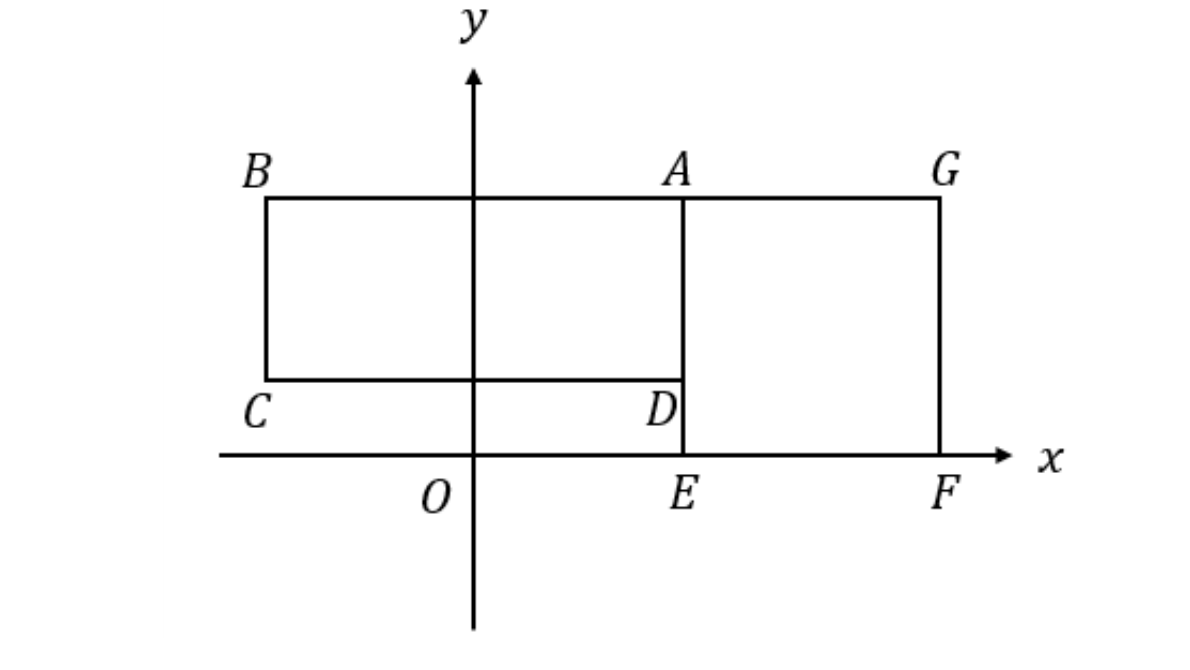
In the diagram, ABCD is a rectangle and AEFG is a square. ABCD is symmetrical about the y-axis. EF lies on the x-axis and BAG is a straight line. The coordinates of B are (−4, 7) and the coordinates of F are (p, q). Find the value of p + 2q.
Answer: 11
Since rectangle ABCD is symmetrical about the y-axis and B = (−4, 7), its mirror vertex A = (4, 7).
Square AEFG has its top edge AG on the line y = 7 and its bottom edge EF on the x-axis (y = 0), so the square's side length equals the vertical distance 7 − 0 = 7.
E lies directly below A: E = (4, 0). G lies 7 units to the right of A: G = (4 + 7, 7) = (11, 7). F lies directly below G: F = (11, 0).
So p = 11, q = 0, and p + 2q = 11.
29
statistics
hard
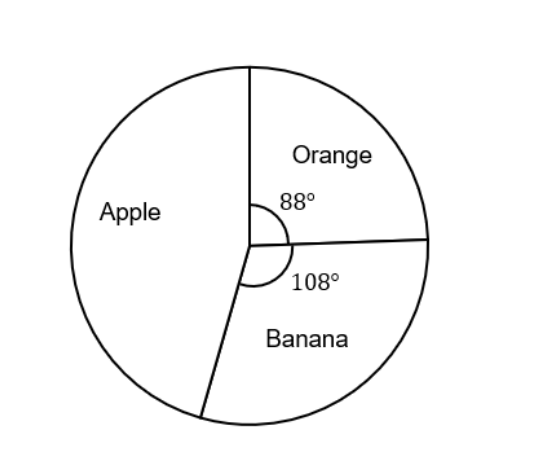
In a survey, some students were asked to choose their favourite fruit from apple, banana, and orange. Each student chose exactly one fruit. The results are represented on the pie chart as shown. What is the minimum number of students who chose banana?
Answer: 27
From the pie chart, Orange = 88°, Banana = 108°, so Apple = 360 − 88 − 108 = 164°.
For the number of students in each category to be a whole number, the total N must make N × 88/360, N × 108/360 and N × 164/360 all integers. In lowest terms these fractions are 11/45, 3/10 and 41/90, so N must be a multiple of lcm(45, 10, 90) = 90.
The smallest valid N is 90, giving Banana = 90 × 108/360 = 27 students (Orange = 22, Apple = 41). Since the banana count scales up with N, this is the minimum.
30
number theory
hard
Written as a product of its prime factors, 81000 = 2³ × 5³ × 3⁴. The number k is a factor of 81000 and its last digit is 5. If it is a perfect square, find the greatest possible value of k.
Answer: 2025
For k's last digit to be 5, k must be divisible by 5 but not by 2, so k = 3ᵃ × 5ᵇ with 0 ≤ a ≤ 4 and 1 ≤ b ≤ 3.
For k to be a perfect square, both exponents must be even: the only even choice for b in {1,2,3} is b = 2, and the largest even choice for a in {0,...,4} is a = 4.
Greatest k = 3⁴ × 5² = 81 × 25 = 2025 (and indeed 2025 = 45², ends in 5, and divides 81000 since 81000 / 2025 = 40).
31
number theory
hard
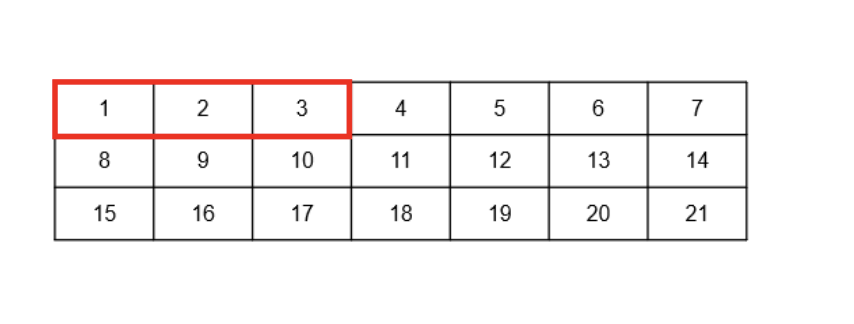
The diagram shows the first three rows of an array of numbers, each row having 7 numbers. Rectangles consisting of three numbers are selected as shown. Tₙ is defined to be the sum of numbers in the rectangle, where n is the smallest number in the rectangle. For example, T₁ = 1 + 2 + 3 and T₁₂ = 12 + 13 + 14. If Tₖ is at least 8000, find the smallest possible value of k.
Answer: 2668
A rectangle starting at n covers n, n+1, n+2, so Tₙ = 3n + 3, but this is only valid when n, n+1 and n+2 lie in the same row — i.e. n must fall in one of the first 5 columns of its row of 7 (rows are [1–7], [8–14], [15–21], ...).
We need 3k + 3 ≥ 8000 ⟹ k ≥ 2665.67, so k ≥ 2666. Checking columns: row 381 spans [2661, 2667], so 2666 is column 6 and 2667 is column 7 — both invalid (the rectangle would wrap into the next row). Row 382 starts at 2668 (column 1), which is valid.
T₂₆₆₈ = 3(2668) + 3 = 8007 ≥ 8000, so the smallest valid k is 2668.