Section A
Multiple Choice — 15 Questions
(+2 / -1)
1
algebra
easy
Find the value of the following.
2020 × 2020 − 2019 × 2021
Answer: C
Let x = 2020. Then 2020 × 2020 − 2019 × 2021 = x² − (x − 1)(x + 1) = x² − (x² − 1) = 1.
2
algebra
medium
Three apples and four oranges cost $10.90, while five apples and seven oranges cost $18.90. How much do nine apples and 13 oranges cost?
Answer: D
Let the cost of each apple be x dollars and each orange be y dollars.
3x + 4y = 10.90 (1)
5x + 7y = 18.90 (2)
Subtracting (1) from (2): 2x + 3y = 8.00 (3)
Adding (2) to 2×(3): 9x + 13y = 5x + 7y + 2(2x + 3y) = 18.90 + 2 × 8.00 = $34.90.
3
geometry
medium
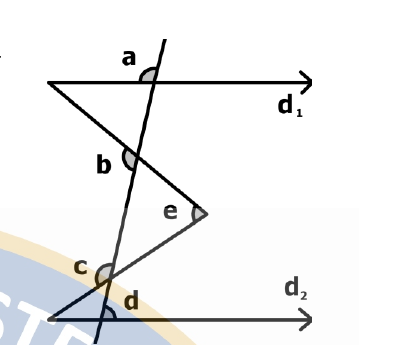
In the following diagram, d₁ is parallel to d₂ and a + b + c + d = 460°. What is angle e in degrees?
Answer: A
Since d₁ ∥ d₂, a and d are angles on the same transversal lines cut by the two parallel lines, so a + d = 180°. This means b + c = 460° − 180° = 280°.
Angles e, (180° − b) and (180° − c) form a triangle (the triangle formed by the two transversals and d₂), so e + (180° − b) + (180° − c) = 180°, giving e = b + c − 180° = 280° − 180° = 100°.
4
sequences
medium
Find the next term of the following sequence.
1935, 1940, 1948, 1962, 1985, 2020, …
Answer: A
The differences between consecutive terms are 5, 8, 14, 23, 35. The differences between these differences are 3, 6, 9, 12 — increasing multiples of 3, so the next one is 15.
The next first-difference is 35 + 15 = 50, so the next term is 2020 + 50 = 2070.
5
number-theory
easy
Find the last digit of the following product.
2²⁰²⁰ × 3²⁰²²
Answer: D
2²⁰²⁰ × 3²⁰²² = 2²⁰²⁰ × 3²⁰²⁰ × 3² = (2 × 3)²⁰²⁰ × 3² = 6²⁰²⁰ × 9.
The last digit of 6ⁿ is always 6 for any positive integer n, so the last digit of 6²⁰²⁰ × 9 is the last digit of 6 × 9 = 54, which is 4.
6
geometry
hard
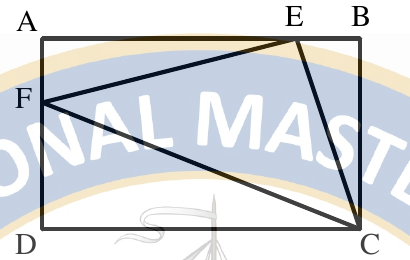
In the rectangle ABCD, point E is on the side AB while point F is on the side AD such that BE = (1/4)AE and DF = (2/3)AD. What is the ratio of areas of the rectangle ABCD to triangle FEC?
Answer: A
Let AB = DC = 5x, so AE = 4x and BE = x (since BE = ¼AE). Let AD = BC = 3y, so DF = 2y and AF = y.
Area(ABCD) = 15xy.
Area(AEF) = ½ × 4x × y = 2xy.
Area(FCD) = ½ × 2y × 5x = 5xy.
Area(EBC) = ½ × x × 3y = 3xy/2.
Area(FEC) = 15xy − 2xy − 5xy − 3xy/2 = 13xy/2.
Area(ABCD) : Area(FEC) = 15 : 13/2 = 30 : 13.
7
number-theory
medium
The six-digit number 2X475Y is divisible by 36. How many possible values of X are there?
Answer: B
For 2X475Y to be divisible by 36 = 4 × 9, it must be divisible by both 4 and 9.
Divisible by 4: the last two digits 5Y must be divisible by 4, so Y = 2 or Y = 6.
Divisible by 9: the digit sum 2 + X + 4 + 7 + 5 + Y = 18 + X + Y must be divisible by 9, so X + Y must be divisible by 9.
If Y = 2: X = 7 (since X + 2 = 9). If Y = 6: X = 3 (since X + 6 = 9).
So there are 2 possible values of X (7 or 3).
8
number-theory
hard
There are roses and lilies at a flower shop. Four roses cost $7 while three lilies cost $8. Billy bought some roses and lilies and paid $86. Which of the following can be the number of roses he bought?
Answer: E
For the total cost to be a whole number of dollars, the number of roses must be a multiple of 4 and the number of lilies a multiple of 3. Let roses = 4a and lilies = 3b, so 7a + 8b = 86.
When a = 1, b is not a whole number. When a = 2, b = 9 (roses = 8, lilies = 27). Checking a = 3 to 12, the only other solution is a = 10, b = 2 (roses = 40, lilies = 6).
So the number of roses bought must be 8 or 40 — none of options A to D (16, 24, 44, 36) are possible, so the answer is option E.
9
combinatorics
medium
How many triples (x, y, z) of positive integers are there such that x + y + z = 14?
Take note that (x, y, z), (x, z, y), (y, z, x), (y, x, z), (z, x, y) and (z, y, x) are the same triple.
Answer: D
List the triples by their largest number:
largest 12: (12,1,1) — 1 triple
largest 11: (11,2,1) — 1 triple
largest 10: (10,3,1),(10,2,2) — 2 triples
largest 9: (9,4,1),(9,3,2) — 2 triples
largest 8: (8,5,1),(8,4,2),(8,3,3) — 3 triples
largest 7: (7,6,1),(7,5,2),(7,4,3) — 3 triples
largest 6: (6,6,2),(6,5,3),(6,4,4) — 3 triples
largest 5: (5,5,4) — 1 triple
Total = 1+1+2+2+3+3+3+1 = 16. (This matches the standard partitions-of-14-into-3-positive-parts count, round(14²/12) = 16.)
10
logic
hard
What is the least number of weights required to weigh any objects of integer number of grams from 1 to 35 grams? The weights must be put on one plate while the object is put on the other plate. Also, the weights must be in an integer number of grams.
Answer: D
Using thirty-five 1-gram weights would work but is not optimal. Instead, substitute 18 of the 1-gram weights with one 18-gram weight (still able to weigh 1–35 g), then substitute 9 of the remaining 17 one-gram weights with a 9-gram weight, and so on, ending with weights 18 g, 9 g, 4 g, 2 g, 1 g and 1 g — 6 weights in total that can weigh any integer amount from 1 to 35 grams.
In general, the least number of weights needed to weigh every integer from 1 to N grams is ⌊log₂N⌋ + 1, which for N = 35 is 5 + 1 = 6 (5 weights following powers of 2 can only reach a maximum of 31).
11
geometry
medium
Each face of a soccer ball is either a pentagon or a hexagon. Each pentagonal face is adjacent to five hexagonal faces and each hexagonal face is adjacent to three pentagonal and three hexagonal faces. If the ball has 12 pentagonal faces, how many hexagonal faces are there?
Answer: B
Each pentagon is adjacent to 5 hexagons, so the total number of pentagon–hexagon adjacent edges = 5 × 12 = 60.
Since each hexagonal face is adjacent to exactly 3 pentagonal faces, the number of hexagons = 60 ÷ 3 = 20.
12
logic
medium
Alice, Jane, Philip and Victor were born in 1982, 1983, 1984, 1985 in the cities of Athens, Moscow, Paris and Singapore, though not in that order. It is given that
- The person born in Paris is one year older than the one born in Singapore.
- Victor was born one year later than the person born in Paris.
- Philip was born in Moscow.
- Alice was born two years later than Victor was.
Which year was Jane born in?
Answer: A
Let the Paris person's birth year be p, so the Singapore person's year is p + 1. Victor's year is one year after Paris's, i.e. p + 1 — the same as the Singapore person's year, so Victor was born in Singapore.
Alice's year is Victor's year + 2 = p + 3. Since all four years lie in 1982–1985 (a span of 3), p = 1982 and p + 3 = 1985, so Paris's year is 1982, Victor/Singapore's year is 1983, and Alice's year is 1985.
Philip is born in Moscow (not Paris), and Alice's year (1985) isn't Paris's year (1982), so Jane must be the Paris-born person, with birth year 1982. (Philip, in Moscow, takes the remaining year, 1984.)
13
combinatorics
hard
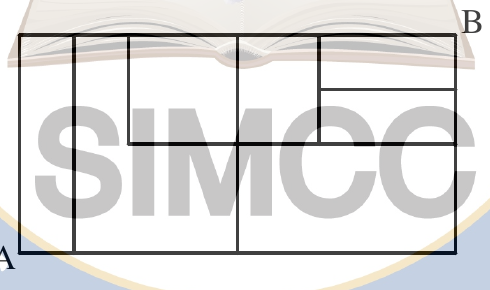
In the diagram below, an ant can move only upwards or rightwards. How many ways are there for the ant to get from point A to point B along the existing lines?
Answer: A
Label each lattice point along the drawn lines with the number of ways to reach it from A, by adding the labels of the points that lead into it (moving only up or right, and only along lines that are actually drawn in the figure). Working from A = 1 outward, the two points feeding directly into B end up labelled 4 and 3, so the number of ways from A to B is 4 + 3 = 7.
14
combinatorics
medium
Henry has a bag with 13 yellow, seven brown, 25 red and ten green balls. All the balls are of the same size and shape. What is the least number of balls Henry needs to take out without looking to make sure that he gets three different coloured balls?
Answer: C
Consider the worst case: Henry could take out all 25 red balls first, then all 13 yellow balls, having drawn 38 balls of only 2 colours. The 39th ball must then be brown or green, guaranteeing a 3rd colour.
(Red and yellow are the two most numerous colours, 25 and 13, so this is indeed the worst case.)
15
combinatorics
hard
How many four-digit numbers are there between 3700 and 9600 that can be formed using only the digits 3, 7, 5, 6, 0 or 9 without repetition of any digits?
Answer: D
Case 1 — thousands digit is 3: for the number to exceed 3700, the hundreds digit must be 7 or 9 (2 choices), then 4 choices for the tens digit and 3 for the units digit: 2 × 4 × 3 = 24.
Case 2 — thousands digit is 5, 6 or 7 (all such numbers are automatically between 3700 and 9600): 3 choices for the thousands digit, 5 choices for the hundreds digit, 4 for the tens digit, 3 for the units digit: 3 × 5 × 4 × 3 = 180.
Case 3 — thousands digit is 9: for the number to stay under 9600, the hundreds digit must be 0, 3 or 5 (3 choices; 6 or 7 would make it ≥ 9600 given no repeated digits), then 4 choices for the tens digit and 3 for the units digit: 3 × 4 × 3 = 36.
Total = 24 + 180 + 36 = 240.
Section B
Open-ended numeric answers — 10 Questions
(+4)
16
statistics
hard
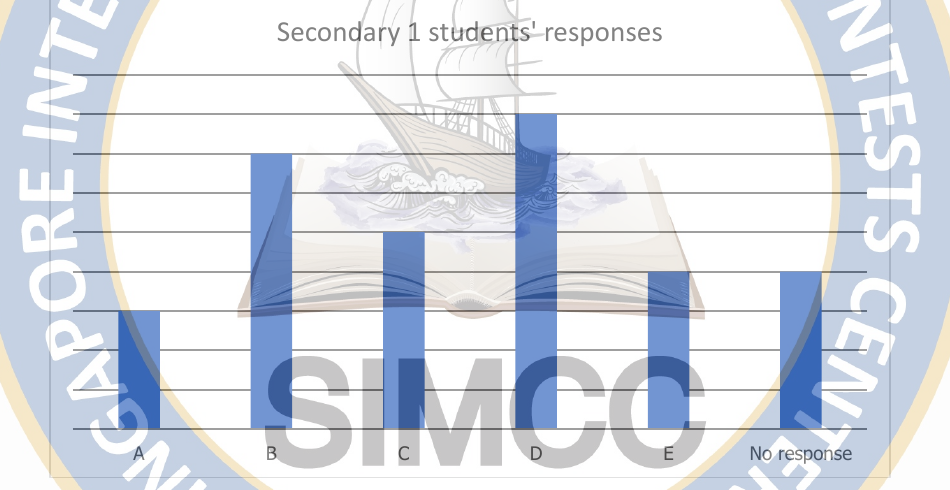
The following bar chart shows the responses made by all Secondary 1 students from Integrity Secondary School in a multiple-choice question. All the horizontal lines are equally spaced. The correct answer scores 2 points, 0 points for no response and −1 point for the wrong answer. The total points scored by all the students is −120. If the correct answer is B, how many students solved the question correctly?
Answer: 140
Let each equally-spaced gridline unit represent x students. Reading the bar heights in gridline units from the chart: A = 3x, B = 7x, C = 5x, D = 8x, E = 4x (No response = 4x, which scores 0 and isn't needed further).
Since B is correct, the number who answered correctly is 7x, scoring 7x × 2 = 14x points.
The number who answered wrongly is A + C + D + E = 3x + 5x + 8x + 4x = 20x, scoring 20x × (−1) = −20x points.
Total points = 14x − 20x = −6x = −120, so x = 20.
Number of students who answered correctly = 7x = 7 × 20 = 140.
17
rate
medium
Andrea and Claire left from Woodlands and HarbourFront respectively and travelled towards each other at the same time. When Andrea arrived at HarbourFront, Claire needed to travel for another 5 km more to reach Woodlands. If Andrea travelled 20% faster than Claire, find the distance, in km, between Woodlands and HarbourFront.
Answer: 30
Let Andrea's speed be 6x km/h and Claire's speed be 5x km/h (since 6x is 20% faster than 5x). Let D be the distance between Woodlands and HarbourFront.
Andrea takes D/(6x) hours to reach HarbourFront. In that same time, Claire travels 5x × D/(6x) = 5D/6 km, and is left with D − 5D/6 = D/6 km still to go.
This remaining distance is given as 5 km, so D/6 = 5, giving D = 30 km.
18
number-theory
medium
Find the smallest positive integer n for which 3993n is a multiple of 2475.
Answer: 75
Factorise: 3993 = 3 × 11³ and 2475 = 5² × 3² × 11.
3993n/2475 = (3 × 11³ × n)/(5² × 3² × 11) = (11² × n)/(5² × 3) = 121n/75.
Since gcd(121, 75) = 1, this is an integer only when 75 divides n. The smallest such positive n is 75.
19
geometry
hard
In the diagram, four identical circles touch the large circle and pass through the centre of the large circle. If the diameter of the large circle is 28 cm, find the area (in cm²) of the shaded region. (Use π = 22/7)
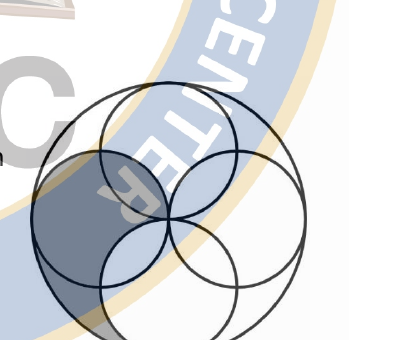
Answer: 154
Denote the three distinct region-types formed by the overlapping circles as A, B and C (as marked in the figure). By the 4-fold symmetry of the figure, the whole large circle is made up of 4 copies each of regions A, B and C, so 4A + 4B + 4C = area of the large circle = π × (28/2)² = (22/7) × 196 = 616.
The shaded region in the picture consists of exactly one A, one B and one C, so its area = (4A + 4B + 4C)/4 = 616/4 = 154 cm².
20
algebra
medium
Denote {n} = 1 + 3 + 5 + ⋯ + (2n − 1). For example, {5} = 1 + 3 + 5 + 7 + (2 × 5 − 1). Given that {m}/m + m = 2020, what is the value of m?
Answer: 1010
{n} is the sum of the first n odd numbers, which is always n² (e.g. {1}=1=1², {2}=1+3=4=2², {3}=1+3+5=9=3²). So {m} = m².
Then {m}/m + m = m²/m + m = m + m = 2m. Setting 2m = 2020 gives m = 1010.
21
number-theory
hard
What is the smallest positive integer that has exactly 3 odd divisors and 3 even divisors?
Answer: 18
A number with exactly 6 divisors is either p⁵ or p²q for distinct primes p, q. Since it needs both even and odd divisors, it must be even.
p⁵ = 2⁵ = 32 has divisors 1,2,4,8,16,32 — only 1 odd divisor, so this form fails.
p²q with p = 2: n = 4q has divisors 1,2,4,q,2q,4q — only 2 odd divisors (1 and q), so this form also fails.
p²q with q = 2 (i.e. n = 2p² for an odd prime p): divisors are 1,p,p²,2,2p,2p² — exactly 3 odd (1,p,p²) and 3 even (2,2p,2p²). The smallest odd prime is p = 3, giving n = 2 × 9 = 18.
Checking: divisors of 18 are 1,2,3,6,9,18 — odd divisors {1,3,9}, even divisors {2,6,18}. So the smallest such integer is 18.
22
logic
hard
The operator ∧ acts on two integers to give the following outcomes:
4∧8 = 2412
5∧9 = 2812
1∧7 = 1618
2∧3 = 103
What is the value of 6∧7?
Answer: 263
The pattern is a∧b = [2(a+b)][3(b−a)], where the two bracketed numbers are written next to each other (concatenated), not multiplied.
Check: 4∧8 = [2(12)][3(4)] = concatenate 24 and 12 → 2412. ✓ 2∧3 = [2(5)][3(1)] = concatenate 10 and 3 → 103. ✓
So 6∧7 = [2(13)][3(1)] = concatenate 26 and 3 → 263.
23
combinatorics
medium
Peter has five different books of different subjects to be placed on a single-decked shelf. He does not want to place the Physics book next to the Biology one. In how many ways can he place all his books?
Answer: 72
Total arrangements of 5 distinct books without restriction = 5! = 120.
Arrangements where Physics and Biology ARE adjacent: treat them as one block (which can be ordered 2 ways internally), then arrange this block with the other 3 books: 2 × 4! = 48.
Arrangements where they are NOT adjacent = 120 − 48 = 72.
24
rate
hard
Peter and Frank together can build a house in 12 days. Frank and George together can build the same house in six days. It is given that each of them works exactly nine hours per day. If Peter and George together can build the house in 6.5 days, how long (in hours) will Peter, Frank and George work together to build the house?
Round your answer to the nearest hour.
Answer: 45
Let Peter, Frank and George build 1/P, 1/F and 1/G of the house per day respectively.
1/P + 1/F = 1/12, 1/F + 1/G = 1/6, 1/P + 1/G = 1/6.5 = 2/13.
Adding all three: 2(1/P + 1/F + 1/G) = 1/12 + 1/6 + 2/13 = 1/4 + 2/13 = 21/52, so 1/P + 1/F + 1/G = 21/104.
Working together they take 104/21 days to build the house. At 9 hours per day, that is (104/21) × 9 = 936/21 = 312/7 ≈ 44.57 hours, which rounds to 45 hours.
25
logic
hard
In the following cryptarithm, all the different letters stand for different digits.
W I N
+ S A S M O
-----------
M E D A L
If N = 7 and M = 6, find the value of the sum S + A + S + M + O.
Answer: 29
Aligning by place value (WIN is 3 digits, SASMO and MEDAL are 5 digits), the ten-thousands column gives S (+ a possible carry) = M = 6. Since S ≠ M, and the carry into that column can be at most 1, S = 5 (with a carry of 1 out of the thousands column).
The thousands column then forces A + (carry) = 10 + E; since A is a single digit, A = 9 and the carry from the hundreds column is 1, giving E = 0.
Substituting N = 7, M = 6, S = 5, A = 9, E = 0 leaves the digits {1, 2, 3, 4, 8} for W, I, O, D, L.
From the units column, N + O = L (+ 10 × carry): testing the remaining digits, either (O = 1, L = 8, no carry) or (O = 4, L = 1, with a carry of 1).
The first case forces W = D + 5 using only {2,3,4}, which has no valid solution — impossible.
The second case (O = 4, L = 1) leaves {2,3,8} for W, I, D: the tens column gives I = 2, and the hundreds column gives W = D + 5, solved by D = 3, W = 8.
Full check: WIN = 827, SASMO = 59564, MEDAL = 60391, and indeed 827 + 59564 = 60391. ✓
So S + A + S + M + O = 5 + 9 + 5 + 6 + 4 = 29.