Section A
Multiple Choice Questions — 15 Questions
(+3)
1
number-theory
medium
Find the possible value(s) of √(√0.0081 + √0.0001 + √0.81).
Answer: A
Evaluate the innermost square roots first: √0.0081 = 0.09 (since 0.09² = 0.0081), √0.0001 = 0.01 (since 0.01² = 0.0001), and √0.81 = 0.9 (since 0.9² = 0.81). Adding these: 0.09 + 0.01 + 0.9 = 1.00. Finally, √1.00 = 1. The radical sign √ always denotes the principal (non-negative) square root by definition, so the value is exactly 1, not ±1 — option C is a trap that confuses 'the equation x² = 1 has two solutions' with 'the value of the √ symbol applied to 1'. The answer is A.
2
fractions
easy
If 5 is added to the numerator and denominator of the fraction 6/11, how will the value of the fraction change?
Answer: B
6/11 ≈ 0.545. Adding 5 to both numerator and denominator gives 11/16 = 0.6875. Since 0.6875 > 0.545, the fraction increases. (In general, adding the same positive amount to the numerator and denominator of a proper fraction — one less than 1 — always moves it closer to 1, i.e., increases it.) Option D is a trap: the new fraction's value is 11/16, but that is not the same as the amount of the increase (the actual increase is 11/16 − 6/11 = 25/176 ≈ 0.142). The answer is B.
3
algebra
medium
If a mother makes x cakes in 2 hours and y pizzas in 3 hours, how many cakes and pizzas altogether does she make in 6 hours? Assume she is making both together and that she works just as fast as if she made them separately.
Answer: A
Her cake rate is x cakes per 2 hours = x/2 cakes/hour, and her pizza rate is y pizzas per 3 hours = y/3 pizzas/hour. In 6 hours she makes 6 × (x/2) cakes and 6 × (y/3) pizzas, so the total number of items is 6(x/2) + 6(y/3) = 6(x/2 + y/3). The answer is A.
4
ratio-proportion
easy
Sasha wants to fit an image into a box on her computer screen. Her original image was 1 1/2 inches wide and 2 1/4 inches tall. Her computer screen box is 4 inches wide. She needs to adjust the box on her computer screen. How tall does the computer screen box need to be for her to fit the image exactly and snugly into the box, without squishing or stretching the image? The choices shown are in inches.
Answer: C
To avoid distortion, the new width and new height must be scaled by the same factor. Original width = 1 1/2 = 3/2 inches, original height = 2 1/4 = 9/4 inches. Scale factor = new width ÷ original width = 4 ÷ (3/2) = 8/3. New height = original height × scale factor = (9/4) × (8/3) = 72/12 = 6 inches. The answer is C.
5
algebra
medium
I have a set of four numbers P, Q, R, S in ascending order. The average of P, Q, and R is 22, and the average of Q, R, and S is 24. The largest number is 27. Then, the smallest number in this set:
Answer: D
Since P ≤ Q ≤ R ≤ S and S is the largest, S = 27. From the averages: P+Q+R = 3×22 = 66, and Q+R+S = 3×24 = 72. Subtracting the first from the second: S − P = 72 − 66 = 6, so P = S − 6 = 27 − 6 = 21. The smallest number is 21 = 3×7, a multiple of 7. The answer is D.
6
place-value
easy
The difference in the place values of the numeral 7 in the largest and the smallest numbers formed using 3, 4, 5, 6, 7 (each digit is used once and exactly once) is
Answer: A
The largest number formed from digits 3,4,5,6,7 (each used once) is 76543 (digits in descending order); here 7 is in the ten-thousands place, with place value 70000. The smallest number is 34567 (digits in ascending order); here 7 is in the units place, with place value 7. The difference is 70000 − 7 = 69993. The answer is A.
7
fractions
hard
Assume that all sections within each of the given shapes are the same size. Consider only the area represented by the flower, the circle, etc. without including any surrounding area around it. Which fraction below represents the fraction of the shaded part of any shape in the simplest form?

The image shows five shapes labelled i-v, each divided into equal sections with some sections shaded. The five answer choices are plain fractions (not shape labels); exactly one of the five shapes has a shaded fraction, in simplest form, equal to one of the five printed choices.
Answer: D
Check the shaded fraction of each shape. Shape i is a 12-petal flower with 8 of its 12 petals shaded, giving 8/12 = 2/3 — this matches option D exactly. (For completeness: shape ii, a circle cut into 5 equal sectors, has 3 shaded = 3/5; shape iii, a parallelogram cut into 3 equal strips, has 1 shaded = 1/3; shape iv, a 12-sector polygon, has most (but not a 'nice' fraction of) its sectors shaded; shape v, an 8-petal flower, is fully shaded = 1. None of these other four values equal any of the five printed options, so shape i's 2/3 is the unique match.) The answer is D.
8
geometry
medium
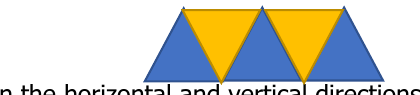
A tessellation is a set of figures that can cover a plane without overlapping or leaving any gaps. Tessellations with triangles would look like the following: [see figure]. You can continue in the horizontal and vertical directions infinitely to place more such triangles to form larger such tightly fitted spaces with no gaps or overlaps. Consider three identical regular pentagons. In how many ways can 3 such pentagons be arranged so that they form a tessellation?
Answer: A
Each interior angle of a regular pentagon is (5−2)×180°/5 = 108°. For shapes to tessellate the plane edge-to-edge, the angles meeting at every interior vertex must add up to exactly 360° with no gaps or overlaps. For regular pentagons meeting n at a point, we would need 108n = 360, i.e., n = 10/3, which is not a whole number. Since no whole number of 108° angles can ever add up to exactly 360°, regular pentagons can never be arranged — using 3 of them or any other number — to tile around a point without a gap or overlap, so they cannot form a true tessellation at all. The answer is A (Zero).
9
graphs
medium
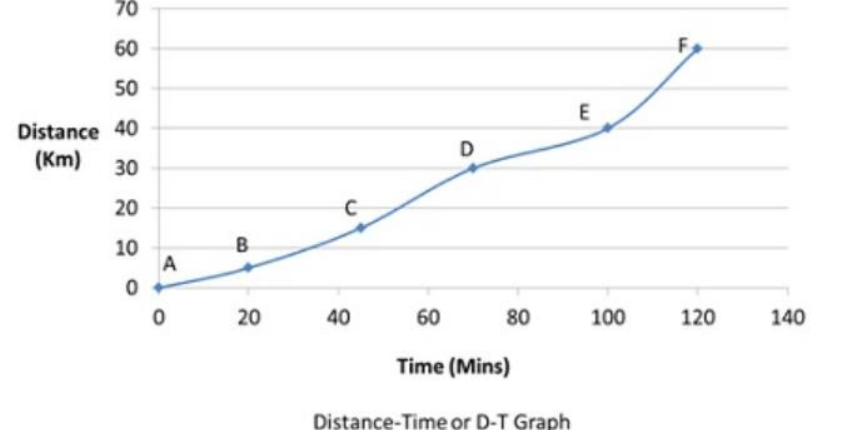
Look at the following graph. Which of the following sections of the graph have the highest rate of change?
Answer: E
The rate of change on a distance-time graph is the slope (distance ÷ time) of each segment. Reading the points: A(0,0), B(20,5), C(45,15), D(70,30), E(100,40), F(120,60). Slope A→B = (5−0)/(20−0) = 0.25 km/min. Slope B→C = (15−5)/(45−20) = 10/25 = 0.4. Slope A→C (average) = (15−0)/(45−0) ≈ 0.33. Slope D→E = (40−30)/(100−70) = 10/30 ≈ 0.33. Slope E→F = (60−40)/(120−100) = 20/20 = 1.0 km/min, which is the steepest (highest rate of change) of all the listed sections. The answer is E.
10
spatial-reasoning
medium
A paper is folded as shown below and punched in its folded state. When the paper is opened out again, what will be the pattern of holes formed?
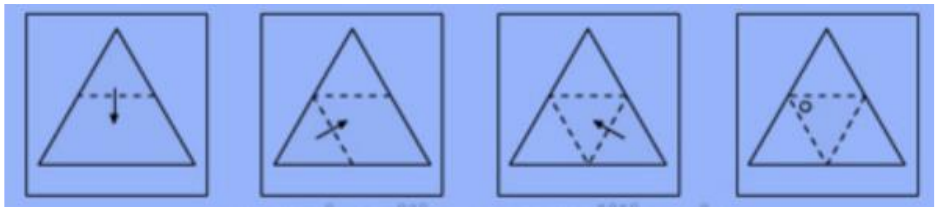
Each option below is itself an image of a triangle with small punched-hole marks.
Answer: B
The first fold shown (step 1) is a fold along the vertical line from the apex straight down to the midpoint of the base — a mirror fold that maps the left half of the triangle exactly onto the right half. Because this is the very first fold applied, every hole punched afterward, once the paper is fully unfolded again, must appear as a left-right mirror-symmetric pattern about that same vertical line (any point punched on one side of the fold necessarily has a mirror partner on the other side, since the two halves were coincident when the later folds/punch were made). Checking the options for left-right symmetry about the triangle's vertical axis: option A's three holes are not symmetric; option B has one hole on the axis near the apex and two holes that mirror each other at the two base corners — symmetric; option C's five holes are all clustered to one side — not symmetric; option D's holes are clustered on one side plus one at a single corner — not symmetric. Only option B is consistent with the required mirror symmetry, matching the paper's own answer key. The answer is B.
11
sets
medium
Which of the following Venn diagrams represents soccer players, high school Math enthusiasts, and students?
Each option below is itself an image of a Venn diagram.
Answer: A
None of the three groups (soccer players, high-school Math enthusiasts, students) is a subset of, or automatically contains, either of the others: a soccer player need not be a student or a Math enthusiast, a Math enthusiast need not be a student or a soccer player, and a student need not play soccer or love Math — yet a person could belong to any two, or all three, of the groups at once. This calls for the standard three mutually-overlapping-circles Venn diagram, where each pair of circles overlaps (and there is a common region where all three overlap) but no circle is nested inside, or excludes, another. Option A shows exactly this — three same-sized circles in a symmetric, pairwise-overlapping arrangement. Option B shows circles of very different sizes overlapping in a chain (not a symmetric mutual overlap); option C shows fully nested (concentric) circles, implying one group is a subset of another, which is not required here; option D shows one large circle (e.g., 'students') fully containing two overlapping smaller circles, which would wrongly force every soccer player and every Math enthusiast to be a student. The answer is A.
12
sets
medium
40 people are in a movie theatre which offers two snack options – popcorns and chips. 26 people like popcorns but they do not like chips. 32 students like popcorns. Everyone in the theatre likes at least one of the two snack options. Find the number of people who like both.
Answer: A
Let 'popcorn-only' = people who like popcorn but not chips = 26 (given). '32 students like popcorns' means the total number of popcorn-likers (popcorn-only plus those who like both) is 32. So the number who like both = 32 − 26 = 6. (As a check: chips-only = 40 − 26 − 6 = 8, and 26 + 6 + 8 = 40, consistent with everyone liking at least one snack.) The answer is A.
13
geometry
medium
The surface areas of the two spheres are in the ratio 4:9. Find the ratio of their volumes.
Answer: E
Surface area of a sphere is proportional to r², so if the surface areas are in ratio 4:9, the radii are in ratio √4:√9 = 2:3. Volume is proportional to r³, so the volumes are in ratio 2³:3³ = 8:27. The answer is E.
14
number-theory
easy
How many three-digit natural numbers are divisible by 7?
Answer: D
The smallest three-digit multiple of 7 is 105 = 15×7 (since 100/7 ≈ 14.3, round up to 15). The largest three-digit multiple of 7 is 994 = 142×7 (since 999/7 ≈ 142.7, round down to 142). The count of multiples from the 15th to the 142nd is 142 − 15 + 1 = 128. The answer is D.
15
coordinate-geometry
medium
A lattice point is a point in a Cartesian coordinate system such that both its x- and y-coordinates are integers. How many lattice points are there in a line with (2,4), (3,6)?
Answer: E
The slope through (2,4) and (3,6) is (6−4)/(3−2) = 2, so the line's equation is y − 4 = 2(x − 2), i.e., y = 2x. For every integer value of x, y = 2x is also an integer, so every one of the infinitely many points (x, 2x) for integer x is a lattice point on this line. The answer is E.
Section B
Open-Ended (Integer) Questions — 5 Questions
(+5)
16
number-theory
hard
Suppose you have a number with 2021 digits. Let P be its sum of digits. Let Q be the sum of the digits of P. Let R be the sum of the digits of Q. (Assume simple addition but not digital sum or recursive sum.) Find the largest value of Q.
Answer: 0035
A 2021-digit number's digit sum P can be any integer from 1 up to 9×2021 = 18189 (the maximum, achieved when every digit is 9). We want to choose the underlying number — equivalently, choose P anywhere in [1, 18189] — so that Q = digit-sum(P) is as large as possible. Checking candidates: for P = 17999 (a 5-digit number ≤ 18189), Q = 1+7+9+9+9 = 35. For P = 9999 (a 4-digit number, also certainly ≤ 18189 and achievable, e.g. by making 1111 of the 2021 digits equal to 9 and the rest 0), Q = 9+9+9+9 = 36, which is larger. An exhaustive check of every integer from 1 to 18189 confirms 9999 gives the largest possible digit sum (36) of any value P can take, and no other value of P (including any 5-digit P ≤ 18189, whose digit sum can be at most 35, since the ten-thousands digit is forced to 1) beats it.
17
number-theory
hard
Given
X Y Z
+ Z Y X
---------
A B A A
where A, B, X, Y, Z are unique positive single-digit numbers, what is the number of possible combinations for X and Z to satisfy this equation?
Answer: 0006
Write the sum algebraically: (100X+10Y+Z) + (100Z+10Y+X) = 101(X+Z) + 20Y, and this must equal ABAA = 1000A + 100B + 10A + A = 1011A + 100B. Since the sum of two 3-digit numbers is at most 999+999 = 1998, the leading digit of the 4-digit result must be A = 1. Column-by-column (with carries), the tens column forces 2Y + (carry from units) = 1 + 10×(carry into hundreds); since Y ≥ 1 makes 2Y ≥ 2, the only consistent solution is carry-into-hundreds = 1 and 2Y + 1 = 11, giving Y = 5 (with a carry of 1 out of the units column). The units column then gives X + Z = 11, and the hundreds column gives B = X+Z+1−10 = 2. An exhaustive check of all digit assignments confirms Y=5, A=1, B=2 always, with X+Z=11 and X,Z drawn from the remaining digits {3,4,6,7,8,9} (excluding 1, 2, 5 which are taken). The pairs (X,Z) with X+Z=11 from that set are (3,8), (8,3), (4,7), and (7,4) — 4 ordered combinations in total.
18
3d-geometry
medium
A steel cuboid is reshaped into a cube. Initially, its length, breadth, and depth were 270 cm, 100 cm, and 64 cm respectively. Find the sum of digits of the surface area of the cube.
Answer: 0018
The volume is conserved when reshaping: Volume = 270 × 100 × 64 = 1,728,000 cm³. Since 1,728,000 = 1728 × 1000 and 1728 = 12³ and 1000 = 10³, the cube root of 1,728,000 is 12 × 10 = 120. So each side of the cube is 120 cm. Surface area of the cube = 6 × 120² = 6 × 14400 = 86,400 cm². Sum of digits of 86400 = 8+6+4+0+0 = 18.
19
algebra
medium
If (3x − 4):(y + 15) is a fixed ratio and if x = 7/3, then y = 12. Find the value of x + y when x = 2.
Answer: 0005
First find the fixed ratio k = (3x−4)/(y+15) using the given pair x=7/3, y=12: 3(7/3)−4 = 7−4 = 3, and y+15 = 12+15 = 27, so k = 3/27 = 1/9. Now use this ratio with x = 2: 3(2)−4 = 2, so 2/(y+15) = 1/9, giving y+15 = 18, so y = 3. Therefore x + y = 2 + 3 = 5.
20
number-theory
easy
What is the sum of prime numbers between 2000 and 2021?
Answer: 6031
Checking each odd number strictly between 2000 and 2021 for primality: 2001 = 3×667 (composite), 2003 is prime, 2005 = 5×401 (composite), 2007 = 3×669 (composite), 2009 = 7×287 (composite), 2011 is prime, 2013 = 3×671 (composite), 2015 = 5×403 (composite), 2017 is prime, 2019 = 3×673 (composite). So the primes in this range are 2003, 2011, and 2017. Their sum is 2003 + 2011 + 2017 = 6031.
Section C
Open-Ended (Integer) Questions — 5 Questions
(+6)
21
coordinate-geometry
medium
A lattice point is a point in a Cartesian coordinate system such that both its x- and y-coordinates are integers. A point lattice is constructed by plotting all of the points (a, b) such that a and b are positive integers. How many points in the point lattice lie on the line y = −4x + 8?
Answer: 0001
We need positive integers a, b with b = −4a + 8. For b to be positive, −4a+8 > 0, i.e., a < 2, so the only positive integer choice is a = 1, giving b = −4(1)+8 = 4 (also positive, so valid). If a = 2, b = 0, which is not positive, so it is excluded (0 is not a positive integer). Any a ≥ 2 gives b ≤ 0, also excluded. So the only qualifying lattice point is (1,4) — exactly 1 point.
22
data-interpretation
medium
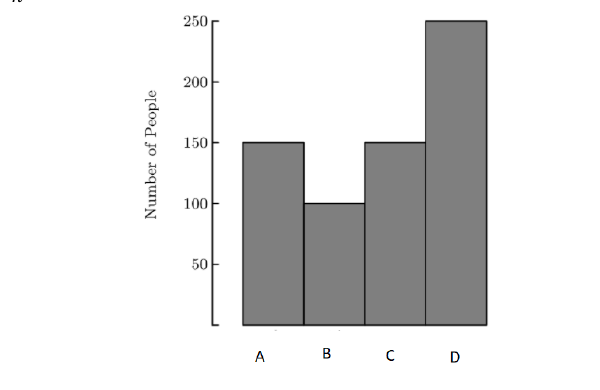
Several people were surveyed for their preference from 4 drinks A, B, C, D. All the people surveyed are represented in the graph below. If the fraction of people who preferred A is m/n, find m + n.
Answer: 0016
From the bar graph: A = 150, B = 100, C = 150, D = 250 people. Total surveyed = 150+100+150+250 = 650. The fraction who preferred A is 150/650, which simplifies (dividing both by 50) to 3/13. So m = 3, n = 13, and m + n = 16.
23
number-theory
hard
How many three-digit natural numbers 'n' can there be such that all the three conditions given below are satisfied: Condition 1: n − 14 is divisible by 7, Condition 2: n − 24 is divisible by 8, and Condition 3: n − 36 is divisible by 9.
Answer: 0001
Condition 1 means n ≡ 14 ≡ 0 (mod 7), i.e., n is divisible by 7. Condition 2 means n ≡ 24 ≡ 0 (mod 8), i.e., n is divisible by 8. Condition 3 means n ≡ 36 ≡ 0 (mod 9), i.e., n is divisible by 9. So n must be a common multiple of 7, 8, and 9. Since these are pairwise coprime in the relevant sense needed for LCM, LCM(7,8,9) = 504. The three-digit multiples of 504 are just 504 itself (504×2 = 1008 has four digits). So there is exactly 1 such three-digit number.
24
algebra
hard
Simplify and round off to the nearest whole number: 16/(√14+√10) − 58/(3√5−4) + √180 + √160
Answer: 0007
Rationalize each fraction. First term: 16/(√14+√10) × (√14−√10)/(√14−√10) = 16(√14−√10)/(14−10) = 16(√14−√10)/4 = 4√14 − 4√10. Second term: 58/(3√5−4) × (3√5+4)/(3√5+4) = 58(3√5+4)/(45−16) = 58(3√5+4)/29 = 2(3√5+4) = 6√5 + 8. Also, √180 = √(36×5) = 6√5, and √160 = √(16×10) = 4√10. Putting it together: (4√14 − 4√10) − (6√5 + 8) + 6√5 + 4√10 = 4√14 + (−4√10+4√10) + (−6√5+6√5) − 8 = 4√14 − 8. Numerically, √14 ≈ 3.7417, so 4√14 ≈ 14.9666, and 14.9666 − 8 ≈ 6.9666, which rounds to 7.
25
number-theory
hard
Use all 9 digits exactly once - 1, 2, 3, 4, 5, 6, 7, 8, 9, as numerator and denominator, create a fraction equalling 1/3 (one third). The digits in the numerator and denominator should together have all the 9 digits shown here. What is the numerator?
Answer: 5832
We need a numerator N and denominator D with N/D = 1/3 (so D = 3N), where the digits of N together with the digits of D use each of 1-9 exactly once. Trying the 4-digit numerator N = 5832: its digits are 5,8,3,2. Then D = 3×5832 = 17496, with digits 1,7,4,9,6. Combined, the digits used are {5,8,3,2,1,7,4,9,6} = {1,2,3,4,5,6,7,8,9}, each exactly once, with no repeats and no zero. Also 5832/17496 = 1/3 exactly (since 17496 ÷ 3 = 5832). So the numerator is 5832.