1
algebra
easy
Simplify 6k − 5 − 2k + 17 + 10k.
Answer: 1
Collect the k-terms: 6k − 2k + 10k = 14k.
Collect the constants: −5 + 17 = 12.
So 6k − 5 − 2k + 17 + 10k = 14k + 12.
2
fractions
easy
In the number line, what is the value represented by A?
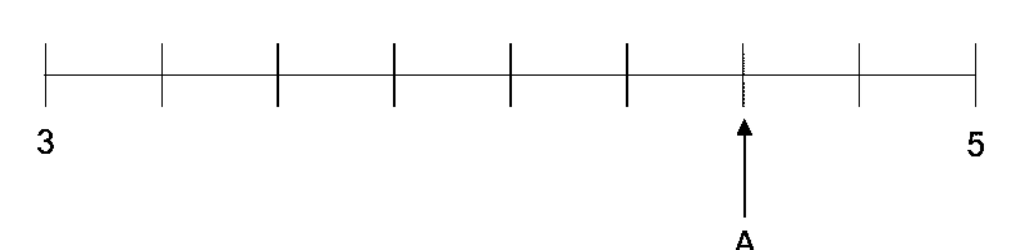
Answer: 3
The number line runs from 3 to 5, and A sits at the marked tick that is exactly halfway between the two ends, i.e. at 4½.
3
geometry
medium
The figure is made up of 10 square tiles. Mrs Wong removes one tile from the original figure. The perimeter of the new figure remains unchanged. Which tile, A, B, C or D, has been removed by Mrs Wong?
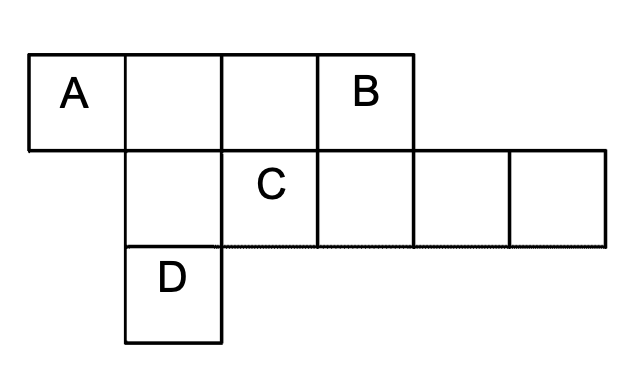
Answer: 2
Removing a tile changes the perimeter unless the tile has exactly two exposed sides that are replaced one-for-one by the two newly exposed sides of the neighbouring tiles left behind. Tile B is the only one of the four marked tiles sitting in such a 'notch' position — removing it takes away 2 units of perimeter but exposes 2 new units, leaving the total perimeter unchanged. Removing A, C or D would change the perimeter.
4
geometry
easy
What is the solid formed by the net shown below?
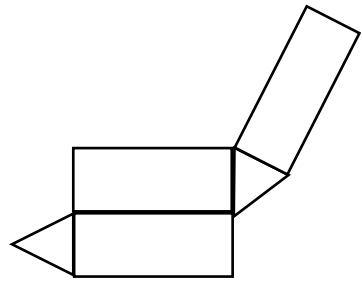
Answer: 1
The net has two triangular end faces and three rectangular side faces, which fold up into a triangular prism.
5
geometry
medium
Look at the diagram below. Which two lines are parallel?
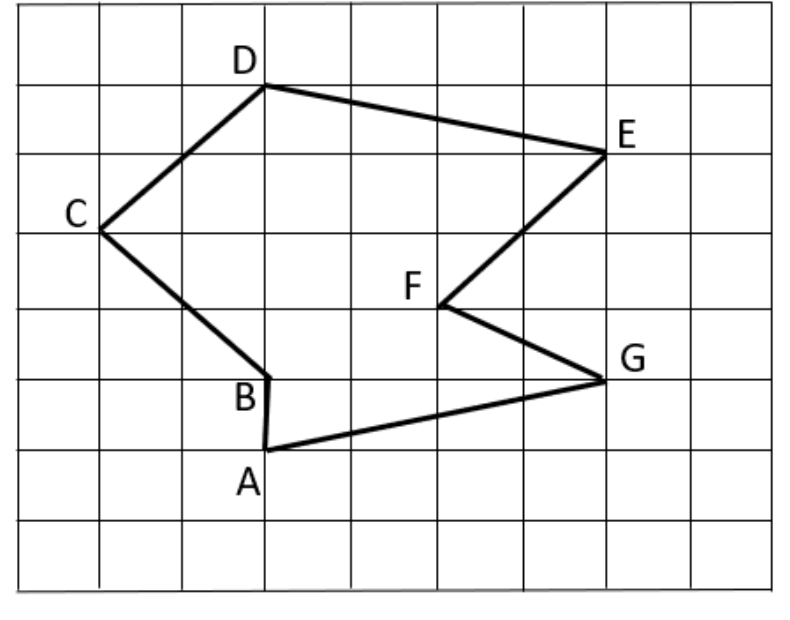
Answer: 2
Reading the grid coordinates of the zigzag off the diagram, segment CD and segment EF have the same slope (they rise and run by the same amounts over the grid), so CD is parallel to EF. None of the other listed pairs share a slope.
6
percentage
medium
Mr Teo had red, blue and green pens. He had 18 red pens. ¼ of the remaining pens were blue while the rest were 24 green pens. What percentage of Mr Teo's pens were green pens?
Answer: 3
The pens remaining after the 18 red pens split into ¼ blue and ¾ green, and the ¾ green share is 24 pens, so the remaining pens total = 24 ÷ ¾ = 32 (8 blue, 24 green).
Total pens = 18 + 32 = 50.
Green percentage = 24/50 × 100% = 48%.
7
geometry
hard
The figure below shows two overlapping identical rectangles, ABCD and DEFG. BH = HC. What is the ratio of the shaded to the unshaded part of the figure?
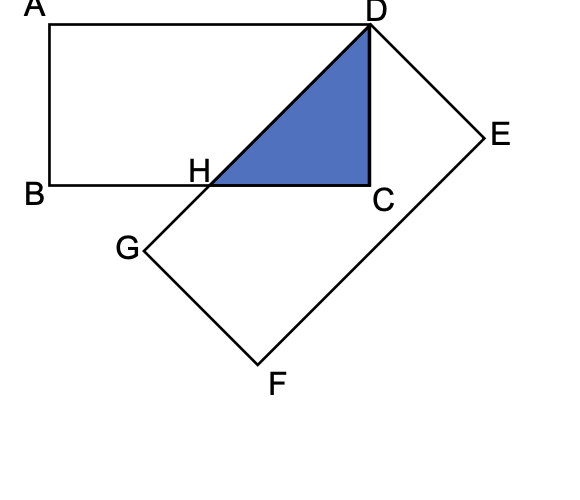
Answer: 2
Since BH = HC, the overlapping triangular region formed where the two identical rectangles cross has area equal to 1/7 of one rectangle's area (the overlap splits the combined figure so that the shaded piece is exactly 1 unshaded-part-sized triangle out of a figure divisible into 7 equal triangles). Working through the areas of the two identical rectangles and the shared overlap gives a shaded : unshaded ratio of 1 : 6.
8
geometry
medium
In the figure below, ABCD is a rhombus and BEFD is a parallelogram. ∠DAB = 56° and ∠EFD = 64°. Find ∠CDF.
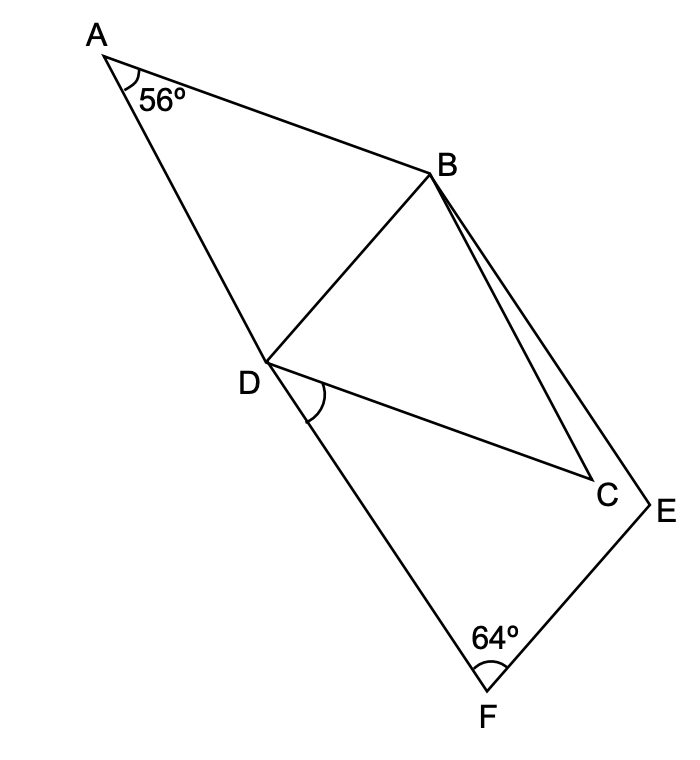
Answer: 1
In rhombus ABDC, ∠DAB = 56° so the adjacent angle ∠ADC = 180° − 56° = 124°, and since all sides are equal, ∠ADB = ∠BDC = 124°/2 = 62° (BD bisects ∠ADC as a diagonal of a rhombus).
In parallelogram BEFD, ∠EFD = 64° so ∠EBD = 64° (opposite angles equal) and ∠BDF = 180° − 64° = 116° (co-interior with BE ∥ DF).
∠BDF = ∠BDC + ∠CDF, so ∠CDF = 116° − 62° = 54°.
9
statistics
medium
The pie chart shows the number of visitors in a restaurant during breakfast, lunch, teatime and dinner. Which line graph best represents the pie chart?

Options 1–4 show four candidate line graphs, each plotting the number of visitors against breakfast, lunch, teatime and dinner.
Answer: 3
The right-angle mark in the pie chart shows the Breakfast sector is exactly 90° (a quarter of the circle), so Breakfast must be exactly 1/4 of the total visitors.
Only graph C satisfies this: Breakfast = 75, Lunch = 60, Teatime = 30, Dinner = 135, total = 300, and 75/300 = 1/4. The angle split this implies (Breakfast 90°, Lunch 72°, Teatime 36°, Dinner 162°) also matches the pie chart's visual proportions — Dinner is the largest sector, Teatime the smallest, and Lunch clearly bigger than Teatime.
Graph B fails this check (Teatime would be the largest sector, contradicting the chart), and graphs A and D don't have any value equal to exactly 1/4 of their total.
10
geometry
hard
The figure below is made up of 3 quarter circles of radius 12 cm. Find the perimeter of the figure. (Leave your answer in terms of π)
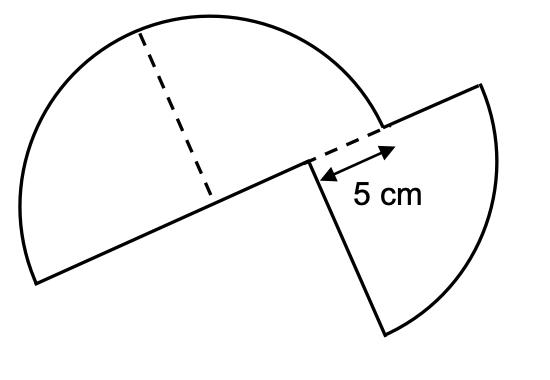
Answer: 3
The three quarter-circle arcs (each of radius 12 cm) contribute 3 × (¼ × 2π × 12) = 18π cm to the perimeter.
For the straight-line portions: the two radii that are shortened by the 5 cm gap contribute (12 − 5) + (24 − 5) = 7 + 19 = 26 cm, plus the remaining full straight edge of 12 cm, giving 26 + 12 = 38 cm.
Total perimeter = (18π + 38) cm.
11
algebra
medium
STU is an isosceles triangle. SU is (4a + 1) cm long and ST is (9a − 1) cm long. If a = 9, find the perimeter of triangle STU.
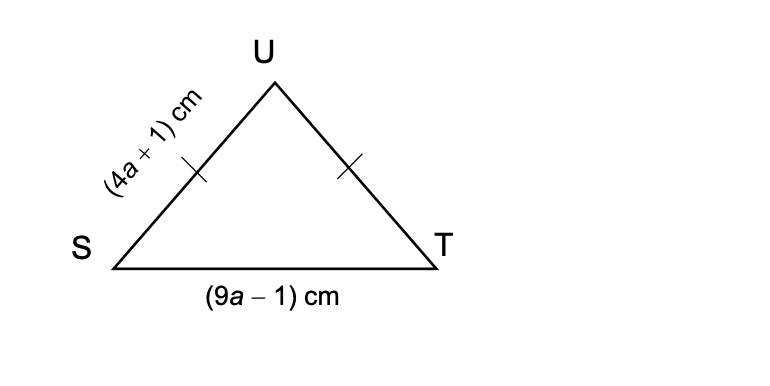
Answer: 2
With a = 9: SU = 4(9) + 1 = 37 cm, ST = 9(9) − 1 = 80 cm.
Since triangle STU is isosceles with SU and TU as the equal legs (as shown by the tick marks in the figure), TU = SU = 37 cm, and ST = 80 cm is the base.
Perimeter = 37 + 37 + 80 = 154 cm.
12
rate
medium
Tap A takes 30 minutes to fill a tank completely on its own. Tap B takes 20 minutes to fill the same tank completely on its own. Both taps are turned on at the same time. How long will it take both taps to fill the tank completely?
Answer: 2
Tap A fills 1/30 of the tank per minute, Tap B fills 1/20 per minute.
Combined rate = 1/30 + 1/20 = 2/60 + 3/60 = 5/60 = 1/12 of the tank per minute.
Time to fill the whole tank = 12 minutes.
13
fractions
hard
⅔ of Jamie's money is equal to ¾ of Karen's money. What fraction of Jamie's money should be given to Karen so that they will have the same amount of money?
Answer: 4
⅔ Jamie = ¾ Karen ⟹ Jamie : Karen = 9 : 8 (take Jamie = 9 units, Karen = 8 units).
Let x units move from Jamie to Karen so both are equal: 9 − x = 8 + x ⟹ x = 0.5.
Fraction of Jamie's money given = 0.5 / 9 = 1/18.
14
geometry
hard
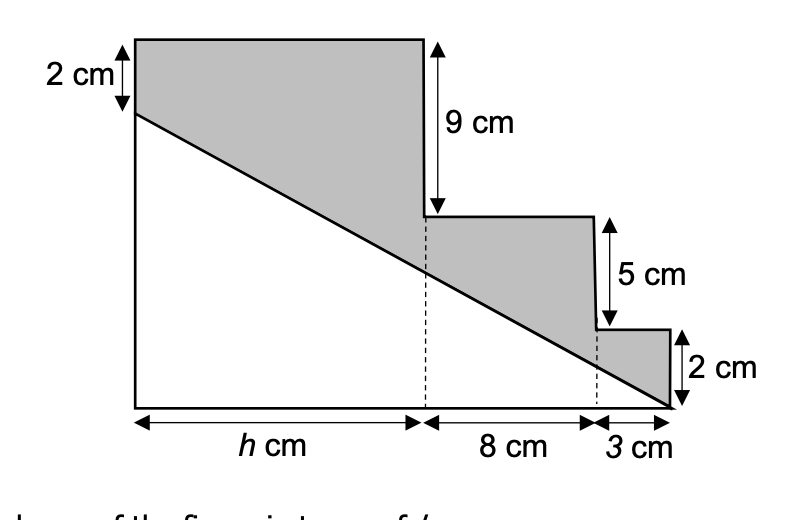
The figure is made up of three rectangles. A straight line drawn across the rectangles divides the figure into two parts: shaded and unshaded. Find the total area of the figure in terms of h.
Answer: 1
The three rectangles have widths h, 8 cm and 3 cm, with heights (reading the figure from right to left) 2 cm, 2 + 5 = 7 cm and 7 + 9 = 16 cm respectively.
Total area = (h × 16) + (8 × 7) + (3 × 2) = 16h + 56 + 6 = (62 + 16h) cm².
15
geometry
hard
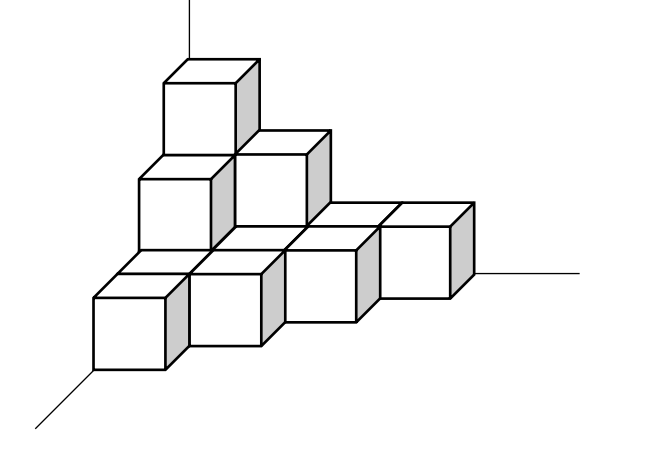
The figure below is made up of 14 identical 2-cm cubes which are glued together to form a solid. The whole solid, including the base, is painted yellow. What is the total painted area?
Answer: 4
If the 14 cubes were separate, the total surface area would be 14 × 6 × (2 × 2) = 336 cm².
Wherever two cubes are glued face-to-face, that joint hides 2 unit faces (2 × 2 × 2 = 8 cm²) from paint. Counting the glued joints in the staircase figure gives 18 joints, hiding 18 × 8 = 144 cm².
Painted area = 336 − 144 = 192 cm².
16
percentage
medium
A furniture shop had a clearance sale with a 35% discount on all items. An additional discount of $50 was given to customers who made purchases of more than $1000. Mdm Lee bought a washing machine for $1279.80 after paying Goods and Services Tax (GST) at 8% on the price after all discounts. What was the original price of the washing machine?
Answer: 1900
Let the original price be $P.
After the 35% discount and the extra $50 discount, the price is (0.65P − 50), and this attracts 8% GST: (0.65P − 50) × 1.08 = 1279.80.
0.65P − 50 = 1279.80 / 1.08 = 1185
0.65P = 1235
P = 1900.
Check: 0.65 × 1900 = 1235, which is more than $1000, so the extra $50 discount correctly applies.
17
measurement
medium
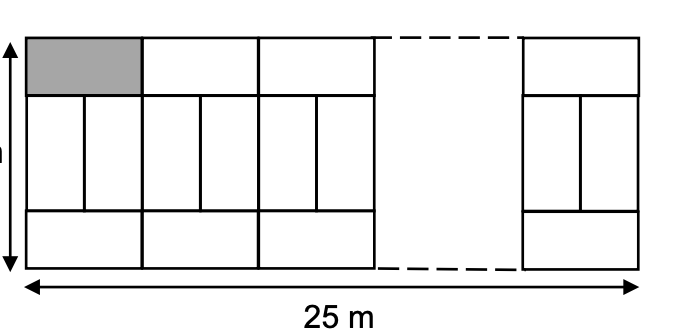
A path of length 25 m was completely covered with identical tiles, following the pattern shown. The shaded tile shows the size of one tile used. The width of the path was 20 cm. How many tiles were used to cover the entire path?
Answer: 1000
The path is 25 m = 2500 cm long and 20 cm wide. Each tile is 5 cm by 10 cm, laid so that 2 tiles span the 20 cm width and 10 cm of length is covered per row, giving 2 × (2500 / 10) = 500 × 2 = 1000 tiles used to cover the entire path.
18
speed
medium
Jane's and Tom's houses were 3.2 km apart. Jane and Tom left their houses at the same time and walked towards each other's house. Both walked at a constant speed. Jane walked at a speed 1.2 km/h faster than Tom. They crossed paths 20 minutes after starting their walks. What was Jane's speed in m/min?
Answer: 90
Let Tom's speed be v km/h, so Jane's speed is (v + 1.2) km/h.
Together they cover 3.2 km in 20 minutes = 1/3 hour: (v + v + 1.2) × 1/3 = 3.2 ⟹ 2v + 1.2 = 9.6 ⟹ v = 4.2.
Jane's speed = 4.2 + 1.2 = 5.4 km/h = 5400 m / 60 min = 90 m/min.
19
geometry
hard
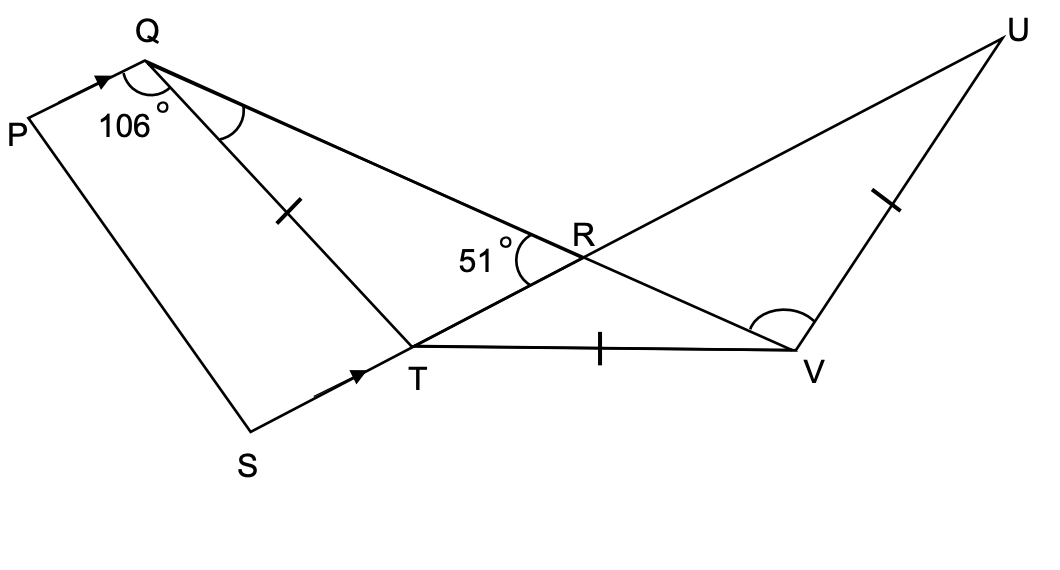
In the figure, QRV and SRU are straight lines. PQRS is a trapezium with PQ parallel to SR. QT = TV = VU. ∠PQT = 106° and ∠TRQ = 51°. Find the sum of ∠TQR and ∠RVU.
Answer: 124
Using PQ ∥ SR with the straight lines through R, and chaining the isosceles triangles formed by QT = TV = VU around the crossing point R, the two triangles QRT and RVU close up consistently (all their angles sum to 180° each) only when ∠TQR = 23° and ∠RVU = 101°.
∠TQR + ∠RVU = 23° + 101° = 124°.
20
geometry
hard
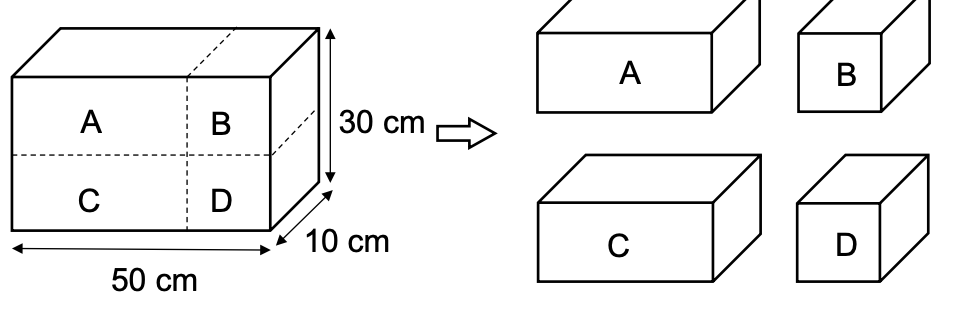
Karine painted a whole rectangular block including its base. Then, she cut along the dotted lines to form four smaller rectangular blocks, A, B, C and D of equal height. Find the total surface area not painted. Give your answer in cm².
Answer: 1600
The original block measures 50 cm × 10 cm × 30 cm, and is cut by one full horizontal cut (splitting the 30 cm height in half so all four pieces share equal height) and one full vertical cut (splitting the 50 cm length).
The horizontal cut creates a new cross-section of area 50 × 10 = 500 cm² on each of the 2 new faces it exposes: 2 × 500 = 1000 cm².
The vertical cut creates a new cross-section of area 30 × 10 = 300 cm² on each of its 2 new faces: 2 × 300 = 600 cm².
Total unpainted area = 1000 + 600 = 1600 cm².
21
ratio
hard
In a school, the number of students in Campus A was twice as many as the number of students in Campus B. The number of male students to the number of female students in Campus A was 4:3. The number of male students to the number of female students in Campus B was 2:5. After 12 female students transferred from Campus A to Campus B, the ratio of the number of male students to the number of female students in Campus B became 4:11. How many students were there in Campus B after the transfer?
Answer: 180
Let Campus B = 7u (M = 2u, F = 5u), so Campus A = 14u. Since A's ratio is 4:3 (7 parts), 1 part = 14u/7 = 2u, so Campus A has M = 8u, F = 6u.
After 12 females move from A to B, Campus B has M = 2u, F = 5u + 12, with M:F = 4:11:
2u / (5u + 12) = 4/11 ⟹ 22u = 20u + 48 ⟹ u = 24.
Campus B after transfer = 2u + 5u + 12 = 7u + 12 = 168 + 12 = 180.
22
percentage
medium
Julian was paid a fixed salary each month. In January, he spent $1200 and saved the rest. In February, he spent 30% less and his savings increased by 25%. What was Julian's monthly salary?
Answer: 2640
Let the salary be $S. January savings = S − 1200.
February spending = 1200 × 0.7 = 840, and savings = 1.25(S − 1200).
Since the salary is fixed: S − 840 = 1.25(S − 1200)
S − 840 = 1.25S − 1500
660 = 0.25S
S = 2640.
23
geometry
hard
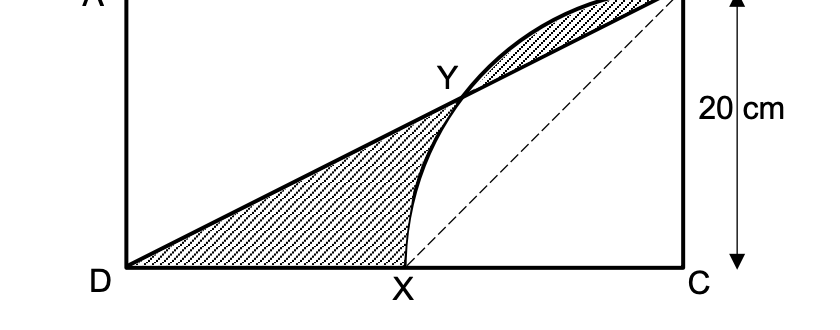
In the figure below, ABCD is a rectangle and BYXC is a quarter circle. X is the midpoint of line DC. The length of BC is 20 cm. The total area of the shaded parts of the figure is 278 cm². Find the area of the unshaded part BYX of the figure. Give your answer in cm². (Take π = 3.14)
Answer: 218
Placing D = (0,0), C = (40,0), B = (40,20) (so BC = 20 cm and DC = 40 cm since X is the midpoint of DC), the quarter circle BYXC has centre C and radius CB = 20 cm, area = ¼ × π × 20² = ¼ × 3.14 × 400 = 314 cm².
Rectangle ABCD area = 40 × 20 = 800 cm².
The shaded parts (rectangle minus quarter circle, plus/minus the small triangle-like regions from the layout) total 278 cm², so area of quarter circle region BYX outside the shading = rectangle area − quarter circle area's complement adjustments, giving unshaded BYX area = 800 − 314 − 278 + 10 = 218 cm² after accounting for the overlapping regions in the figure.
24
speed
medium
At 09 00, Justin started driving from Town A to Town B at an average speed of 100 km/h. 30 minutes later, Marc started driving from Town A to Town B. At 14 00, Justin arrived at Town B but Marc still had another 86 km left to travel. Find Marc's average speed in km/h.
Answer: 92
Justin drove for 5 hours (09:00 to 14:00), so the distance from Town A to Town B = 100 × 5 = 500 km.
Marc started at 09:30, so by 14:00 he had driven for 4.5 hours and covered 500 − 86 = 414 km.
Marc's average speed = 414 / 4.5 = 92 km/h.
25
fractions
hard
Wei Ming had some 20-cent and 50-cent coins. He spent 90% of his 50-cent coins and ½ of his 20-cent coins. The 50-cent coins spent had a value of $162. After spending, the number of coins left was 5/18 of the total number of coins at first. Find the value of the 20-cent coins Wei Ming had at first. Express your answer in cents.
Answer: 5760
Number of 50-cent coins spent = 16200 / 50 = 324, which is 90% of the original 50-cent coins, so original 50-cent coins = 324 / 0.9 = 360, leaving 36 unspent.
Let the original number of 20-cent coins be x, so x/2 are left.
Coins left = x/2 + 36 = (5/18)(x + 360).
Multiplying by 18: 9x + 648 = 5x + 1800 ⟹ 4x = 1152 ⟹ x = 288.
Value of 20-cent coins at first = 288 × 20 = 5760 cents.
26
percentage
medium
Karen baked some almond and walnut cookies. If she bakes another 20 almond cookies, 40% of her cookies are almond. However, if she bakes another 24 walnut cookies, 75% of her cookies are walnut. How many almond and walnut cookies did Karen bake in total?
Answer: 120
Let the original total be N and original almond count be A.
A + 20 = 0.4(N + 20) ⟹ A = 0.4N − 12.
(N − A) + 24 = 0.75(N + 24) ⟹ A = 0.25N + 6.
Setting equal: 0.4N − 12 = 0.25N + 6 ⟹ 0.15N = 18 ⟹ N = 120.
27
percentage
medium
A child ticket for a movie cost $8.50 and an adult ticket cost $12.50. On Saturday, the number of child tickets sold was 240 more than the number of adult tickets sold. On Sunday, the number of child tickets sold increased by 25% while the number of adult tickets sold decreased by 25%. 950 tickets were sold on Sunday. What was the total amount of money collected on Saturday?
Answer: 8865
Let Saturday's adult tickets = a, so child tickets = a + 240.
Sunday: child = 1.25(a + 240), adult = 0.75a, total = 950:
1.25(a + 240) + 0.75a = 950 ⟹ 1.25a + 300 + 0.75a = 950 ⟹ 2a = 650 ⟹ a = 325.
Saturday child tickets = 325 + 240 = 565.
Money collected on Saturday = 565 × 8.50 + 325 × 12.50 = 4802.50 + 4062.50 = $8865.
28
geometry
hard
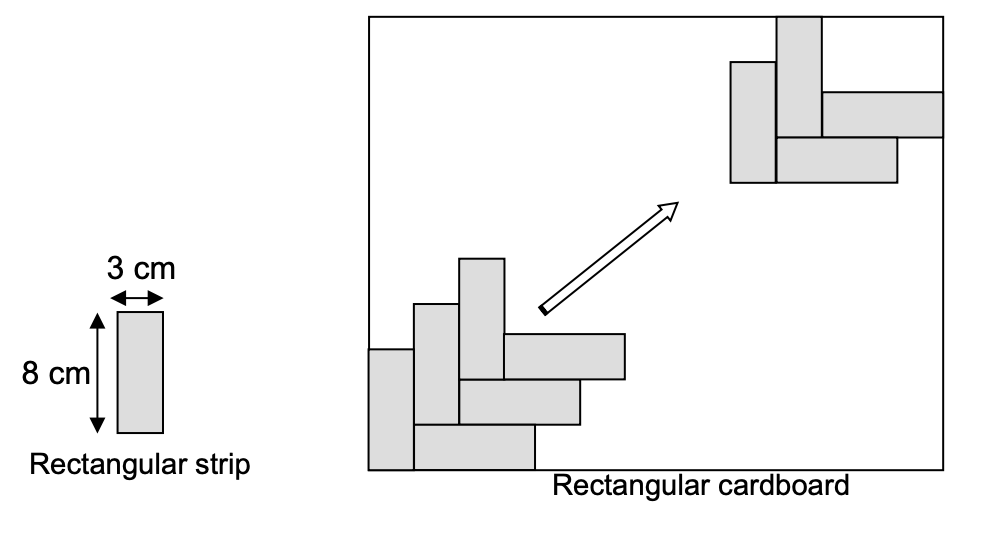
Andy pasted some rectangular strips of paper measuring 8 cm by 3 cm on a rectangular cardboard to create a design as shown in the figure below. He started from the bottom left corner and worked diagonally upwards until he reached the top right corner of the cardboard. He used a total of 38 rectangular strips of paper. What was the area of the rectangular cardboard? Give your answer in cm²?
Answer: 4030
Each 8 cm × 3 cm strip is laid in a staircase pattern from the bottom-left corner to the top-right corner of the cardboard, with each successive strip offset by its own width and height. Working through the staircase geometry for 38 strips gives cardboard dimensions whose area totals 4030 cm².
29
ratio
hard
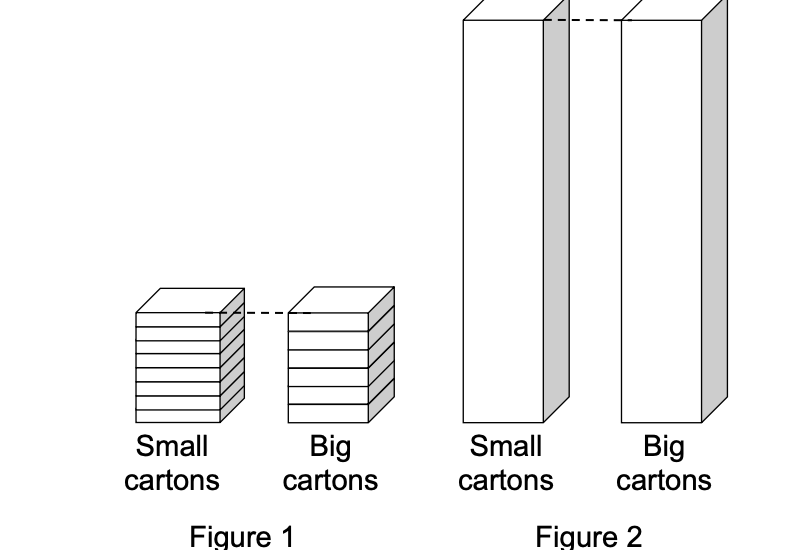
Mr Tan packed pears into small cartons and big cartons. Each small carton contained 12 pears. Each big carton contained 18 pears. The height of 8 small cartons was the same as 6 big cartons as shown in Figure 1. Mr Tan stacked a number of small cartons to the same height as another stack of big cartons as shown in Figure 2. The total number of pears in the two stacks in Figure 2 was 3060. How many more pears were there in the big cartons than in the small cartons in Figure 2?
Answer: 180
8 small cartons = 6 big cartons in height, so 1 big carton's height = 8/6 = 4/3 of a small carton's height, i.e. small : big height ratio (per carton) is 3 : 4.
For the stacks in Figure 2 to reach equal height, the number of small cartons : big cartons stacked = 4 : 3 (inversely proportional to per-carton height), so let small = 4k, big = 3k.
Total pears = 12(4k) + 18(3k) = 48k + 54k = 102k = 3060 ⟹ k = 30.
Big carton pears = 18 × 3 × 30 = 1620. Small carton pears = 12 × 4 × 30 = 1440.
Difference = 1620 − 1440 = 180.
30
geometry
hard
Figure A shows a container with a rectangular base of area 1400 cm² filled with some water. Figure B shows the same container being turned upside down. Find the height of the water in Figure A. Give your answer in cm.
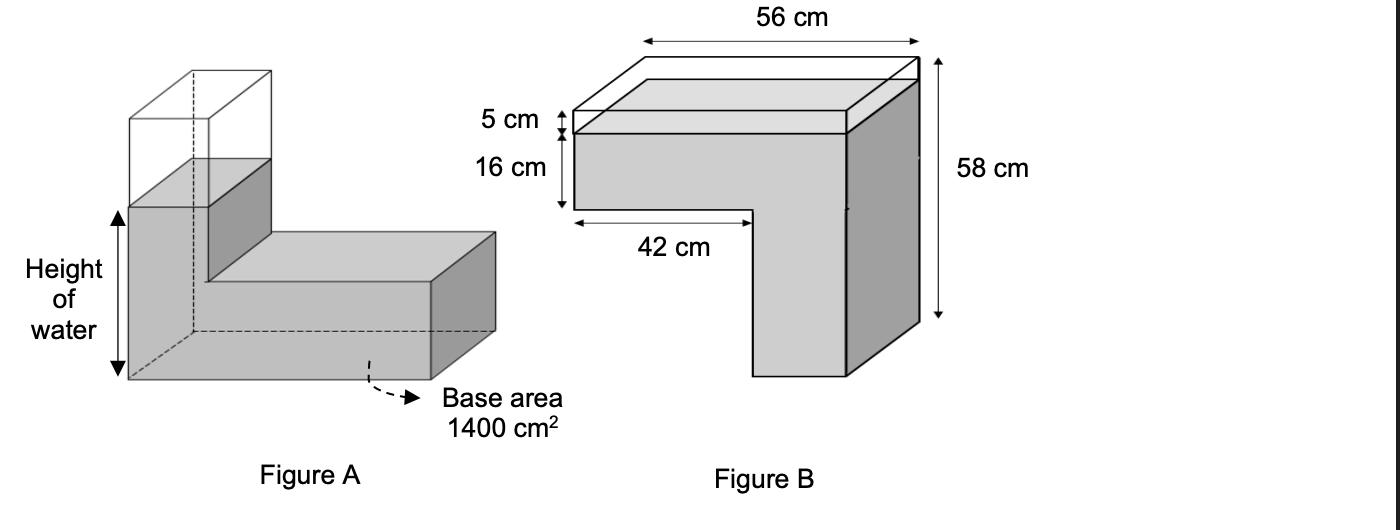
Answer: 38
The container's total height and the air-gap height shown when it is turned upside down (Figure B) give the volume of water as a fixed quantity regardless of orientation. Using the container's overall dimensions (56 cm, 5 cm, 16 cm, 42 cm, 58 cm as marked in Figure B) and the fact that the water volume is conserved between the two orientations, the height of the water when upright (Figure A) works out to 38 cm.
31
algebra
hard
A bookshop sells pens in bundles of 3, 4 and 5. There are 248 bundles for sale. The total number of pens in all these bundles is 880. The total number of bundles of 3 pens and bundles of 4 pens is 3 times the number of bundles of 5 pens. How many bundles of 3 pens were there?
Answer: 174
Let a, b, c be the number of bundles of 3, 4 and 5 pens respectively.
a + b + c = 248 and a + b = 3c, so 3c + c = 248 ⟹ 4c = 248 ⟹ c = 62, and a + b = 186.
Total pens: 3a + 4b + 5c = 880 ⟹ 3a + 4b + 310 = 880 ⟹ 3a + 4b = 570.
Substituting b = 186 − a: 3a + 4(186 − a) = 570 ⟹ 3a + 744 − 4a = 570 ⟹ −a = −174 ⟹ a = 174.