1
volume
easy
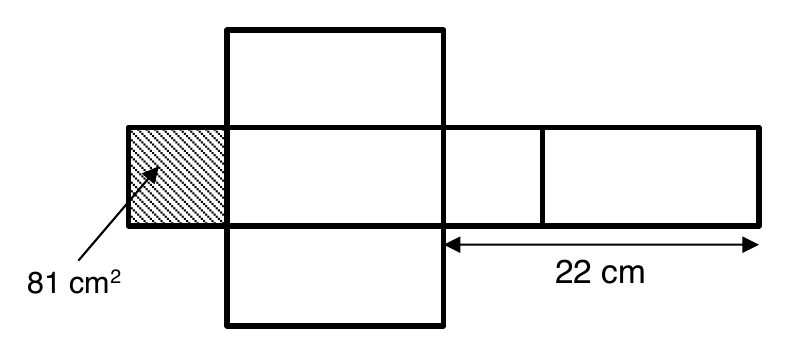
The net of a cuboid is shown below. The square base has an area of 81 cm² and one edge of the net measures 22 cm. Find the volume of the cuboid.
Answer: 1053
The square base has area 81 cm², so its side length is √81 = 9 cm. In the net, one continuous straight edge is labelled 22 cm; this edge runs along a base edge (9 cm) and continues directly into the cuboid's height, so height = 22 − 9 = 13 cm. Volume = base area × height = 81 × 13 = 1053 cm³. [Note: re-derived after seeing the actual net figure — the 22 cm edge spans across two adjacent faces in the net rather than being a single face's height, which is why this supersedes an earlier draft answer.]
2
data-analysis
medium
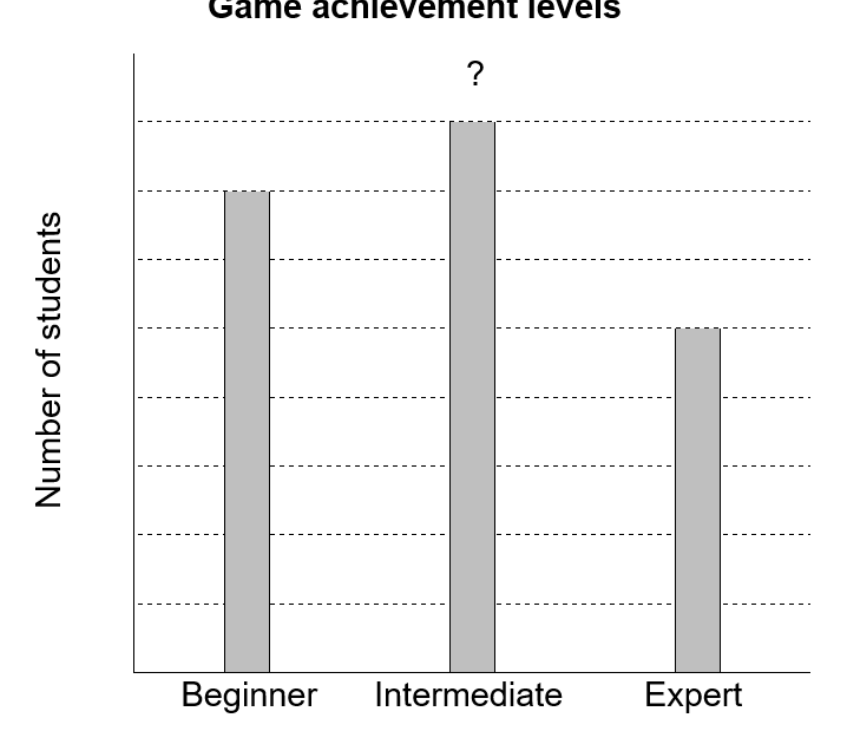
A bar graph titled 'Game achievement levels' shows the number of students at the Beginner, Intermediate and Expert levels (no numbers are printed on the axis, only gridlines). Each student scores 1 point at the Beginner level, 3 points at the Intermediate level and 5 points at the Expert level. The total score of all students is 224. How many students are at the Intermediate level?
Answer: 32
Reading the bar heights against the gridlines gives Beginner : Intermediate : Expert in the ratio 7 : 8 : 5 (in gridline units). Let one gridline unit = k students' worth of score contribution. Then total score = 1(7k) + 3(8k) + 5(5k) = 7k + 24k + 25k = 56k = 224, so k = 4. Number of students at Intermediate level = 8k = 8 × 4 = 32.
3
fractions
medium
3/4 kg of flour was needed to bake 30 brownies. Sally wants to bake trays of 24 brownies each. How many trays of 24 brownies could Sally bake at most with 4 kg of flour?
Answer: 6
Flour needed per brownie = (3/4) ÷ 30 = 1/40 kg. Flour needed per tray of 24 brownies = 24 × 1/40 = 0.6 kg. With 4 kg of flour, the number of full trays = floor(4 ÷ 0.6) = floor(6.67) = 6 trays at most. [Verified directly against the source PDF's rendered page: the question text reads exactly "3/4 kg of flour was needed to bake 30 brownies", confirming this is not a clipped/inferred reading.]
4
geometry
hard
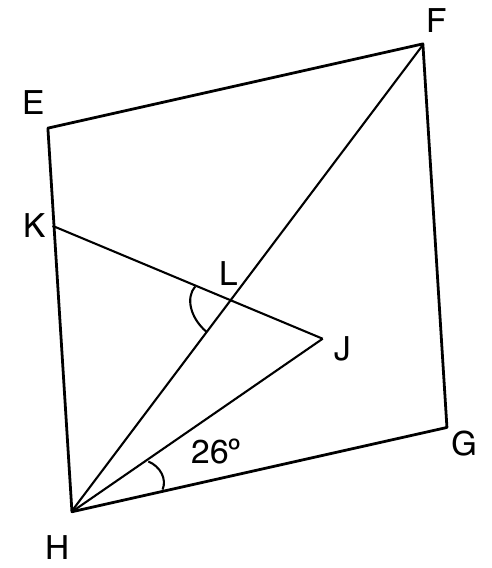
EFGH is a rhombus. HJK is an equilateral triangle with K on side EH. L is the point where diagonal HF meets segment KJ. Given that ∠GHJ = 26°, find ∠HLK.
Answer: 77
Since HJK is equilateral, ∠KHJ = 60°, and since K lies on EH, ray HK coincides with ray HE, so ∠EHJ = ∠EHK + ∠KHJ is built from ∠GHJ = 26° and the 60° of the equilateral triangle: ∠EHG = ∠EHJ + ∠JHG, giving ∠EHG = 60° + 26° = 86°. The rhombus diagonal HF bisects ∠EHG (diagonals of a rhombus bisect the vertex angles), so ∠FHK = ∠FHG = 43°. In triangle HLK, ∠HKL = ∠HKJ = 60° (angle of the equilateral triangle), and ∠KHL = 43°, so ∠HLK = 180° − 43° − 60° = 77°.
5
speed
easy
An ant travelled at 75 cm/min for 2 min. A centipede travelled at 40 cm/s for 1 min. What is the difference in the distances travelled by the ant and the centipede? Give your answer in cm.
Answer: 2250
Ant's distance = 75 cm/min × 2 min = 150 cm. Centipede's speed = 40 cm/s = 40 × 60 = 2400 cm/min, so in 1 min it travels 2400 cm. Difference = 2400 − 150 = 2250 cm. [Note: recomputed directly from the confirmed question text; not independently cross-checked against an official source.]
6
ratio
medium
Navin had a roll of ribbon. He cut half of it into strips of 12 cm each, and the other half into strips of 9 cm each. He obtained 8 more 9-cm strips than 12-cm strips. How many strips of 12-cm length did he have?
Answer: 24
Let the length of half the ribbon be L cm. Number of 12-cm strips = L/12. Number of 9-cm strips = L/9. Given L/9 − L/12 = 8. Multiplying through by 36: 4L − 3L = 288, so L = 288. Number of 12-cm strips = 288/12 = 24 (and number of 9-cm strips = 288/9 = 32, which is indeed 8 more than 24, confirming the answer).
7
averages
medium
A group of students sat for a test. Their total score was 2252. The average of the highest and lowest scores was 55. The average of the scores of the remaining students was 63. How many students sat for the test?
Answer: 36
Highest + lowest score = 2 × 55 = 110. Remaining total score = 2252 − 110 = 2142. If there are n remaining students, 63n = 2142, so n = 34. The 'remaining students' are everyone except the highest and lowest scorers, so the total number of students who sat for the test = n + 2 = 34 + 2 = 36.
8
data-analysis
medium
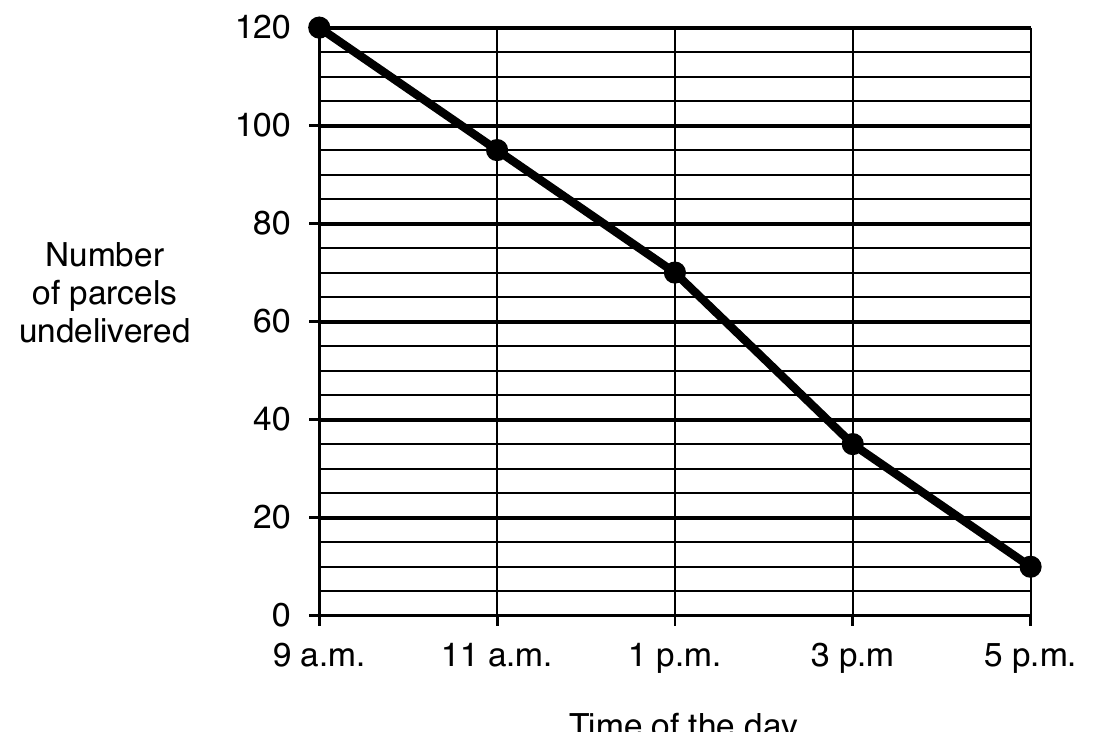
For every 10 parcels delivered, Jackson earned 30 bonus points. A line graph shows the number of parcels undelivered over the course of a day: 120 at 9 a.m., 95 at 11 a.m., 70 at 1 p.m., 35 at 3 p.m., and 10 at 5 p.m. How many bonus points did Jackson earn by 3 p.m.?
Answer: 255
Parcels delivered by 3 p.m. = starting total (120, the count undelivered at 9 a.m.) − parcels still undelivered at 3 p.m. (35) = 120 − 35 = 85 parcels. Bonus points = (85 ÷ 10) × 30 = 8.5 × 30 = 255 points.
9
number-patterns
medium
A table with 4 columns (A, B, C, D) is filled with consecutive numbers 1, 2, 3, ... in a repeating pattern down the rows: Row 1 has 1, 2 in columns C, D; Row 2 has 3, 4 in columns B, C; Row 3 has 5, 6 in columns A, B; Row 4 has 7, 8 in columns C, D (repeating Row 1's columns); Row 5 has 9, 10 in columns B, C; Row 6 has 11, 12 in columns A, B; and so on, cycling every 3 rows. In which row will the number 89 appear?
Answer: 45
Each row n contains exactly the two consecutive numbers 2n − 1 and 2n (the columns they land in simply cycle every 3 rows through the pattern C/D, B/C, A/B — this doesn't affect which row a given number falls in). Since 89 is odd, it must be the '2n − 1' entry of its row: 2n − 1 = 89, so n = 45. The number 89 appears in Row 45.
10
money
medium
CityLife taxi fares: the first 1 km costs $3.60; each additional 400 m or less costs $0.24; each 30 seconds of waiting time or less costs $0.26. Karen's ride included one 45-second stop, and she paid $8.20 in total. What was the furthest distance she could have travelled? Give your answer in metres.
Answer: 7800
A 45-second wait counts as 2 chargeable 30-second units (since 45s exceeds one 30s unit), costing 2 × $0.26 = $0.52. Subtracting the waiting charge and the flat first-kilometre fee from the total: $8.20 − $0.52 − $3.60 = $4.08 remaining for distance beyond the first km. At $0.24 per 400 m (or less), this buys at most 17 full 400 m blocks (17 × $0.24 = $4.08 exactly). Furthest distance = 1000 m + 17 × 400 m = 1000 + 6800 = 7800 m.
11
data-analysis
medium
A pie chart shows the proportions of students who visited the National Museum, Science Centre, Discovery Centre and Marina Barrage (with a right-angle mark shown at the centre for the National Museum sector). An accompanying bar graph shows Marina Barrage = 130 students and Science Centre = 130 students; the National Museum bar shows 100 students. What percentage of the students went to the Discovery Centre?
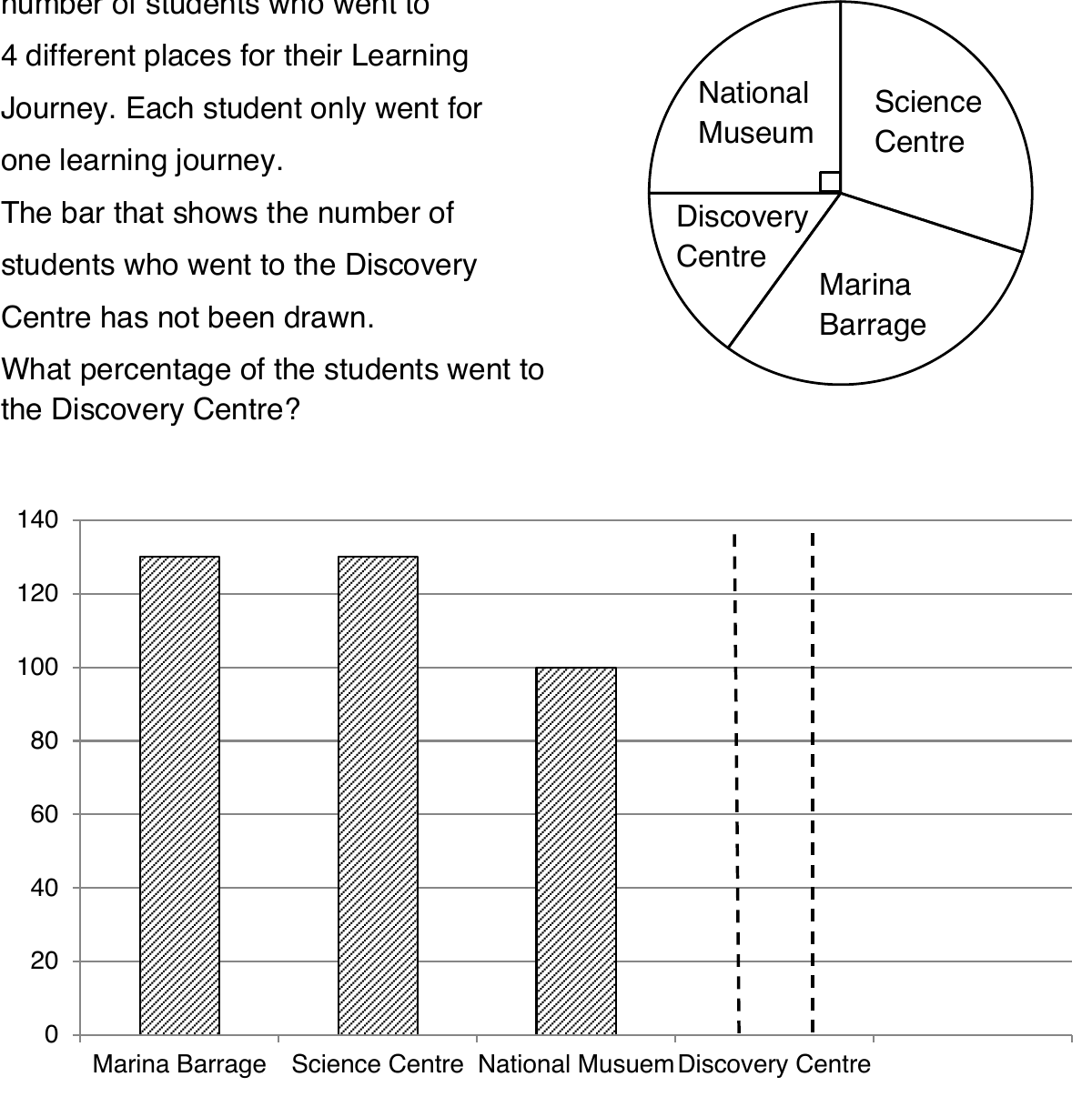
Answer: 10
The right-angle mark shows the National Museum sector is a quarter (90°/360°) of the pie chart, so the National Museum's 100 students represent 25% of the total, giving a total of 100 ÷ 0.25 = 400 students. Marina Barrage and Science Centre each have 130 students, so together with National Museum they account for 100 + 130 + 130 = 360 students. Discovery Centre = 400 − 360 = 40 students. Percentage at Discovery Centre = 40/400 × 100% = 10%.
12
measurement
medium
A toy car is 26 cm long. Each of its wheels has a radius of 2.5 cm. The car is pushed along a straight track from one end to the other, during which each wheel makes 30 revolutions. What is the length of the track? (Take π = 3.14) Give your answer in cm.
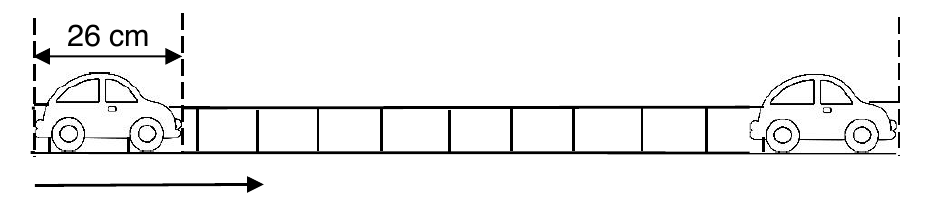
Answer: 497
Circumference of each wheel = 2 × 3.14 × 2.5 = 15.7 cm. Distance rolled by the wheels in 30 revolutions = 30 × 15.7 = 471 cm. Since the car itself is 26 cm long and travels from flush against one end of the track to flush against the other end, the length of the track equals the wheel-rolling distance plus the car's own length: 471 + 26 = 497 cm.
13
ratio
medium
Rods A and B are tied together with an overlapping section, and the combined tied length equals the length of Rod C. The ratio of the length of Rod A to Rod B is 9 : 4. The first 100 cm of Rod A is separate from the overlapping (tied) section, and 35 cm of Rod B remains beyond the overlapping section. What is the length of Rod C?
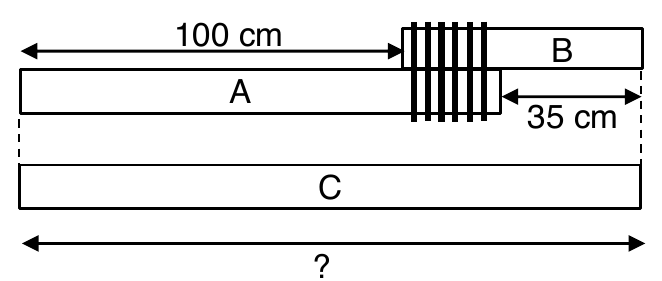
Answer: 152
Let the overlap length be x cm. Rod A's total length = 100 + x. Rod B's total length = x + 35. Given A : B = 9 : 4, so 4(100 + x) = 9(x + 35). Expanding: 400 + 4x = 9x + 315, so 5x = 85, x = 17. Then A = 117 cm and B = 52 cm (ratio 117:52 = 9:4, confirmed). Rod C's length (the combined tied length) = 100 + x + 35 = 100 + 17 + 35 = 152 cm.
14
measurement
medium
Glasses are stacked with each glass overlapping the next. A stack of 8 glasses measures 54 cm in height, and a stack of 5 glasses measures 39 cm in height. A shelf has 90 cm of vertical space. What is the maximum number of glasses that can be placed in a single stack to fit on the shelf?
Answer: 15
Let the height of the first glass be h and the extra height added by each additional glass be d. Then h + 7d = 54 and h + 4d = 39. Subtracting: 3d = 15, so d = 5, and h = 39 − 4(5) = 19. Height of a stack of n glasses = 19 + 5(n − 1). Requiring 19 + 5(n − 1) ≤ 90 gives 5(n − 1) ≤ 71, so n − 1 ≤ 14.2, meaning n − 1 ≤ 14, n ≤ 15. Checking: n = 15 gives 19 + 5(14) = 89 ≤ 90 (fits), while n = 16 gives 19 + 5(15) = 94 > 90 (does not fit). Maximum number of glasses = 15.
15
algebra
medium
A bakery's cake sales follow this pattern: the total sold from Monday to Friday is (6n + 5), Saturday's sales are (n + 50), and Sunday's sales are (3n − 16), for some number n. If 82 cakes were sold on Saturday and Sunday combined, find the total number of cakes sold from Monday to Sunday.
Answer: 159
Saturday + Sunday = (n + 50) + (3n − 16) = 4n + 34 = 82, so 4n = 48, n = 12. Monday–Friday total = 6(12) + 5 = 77. Saturday = 12 + 50 = 62. Sunday = 3(12) − 16 = 20. Total for the whole week = 77 + 62 + 20 = 159 cakes.
16
rates
easy
Robot A can clean a hall in 6 hours. Robot B can clean the same hall in 3 hours. If the two robots work together, how many minutes would they take to clean the hall?
Answer: 120
Robot A's rate = 1/6 hall per hour. Robot B's rate = 1/3 hall per hour. Combined rate = 1/6 + 1/3 = 1/6 + 2/6 = 3/6 = 1/2 hall per hour. Time together = 1 ÷ (1/2) = 2 hours = 120 minutes.
17
geometry
hard
Three congruent isosceles triangles XYZ, PQR and ABC are arranged one below another (not drawn to scale), with bases XZ, PR and AC all parallel to each other, and side QR extended acting as a transversal that crosses line XZ. Given ∠QPR = 43°, find the sum of ∠m, ∠n and ∠x (marked at the relevant crossing/vertex points in the figure).
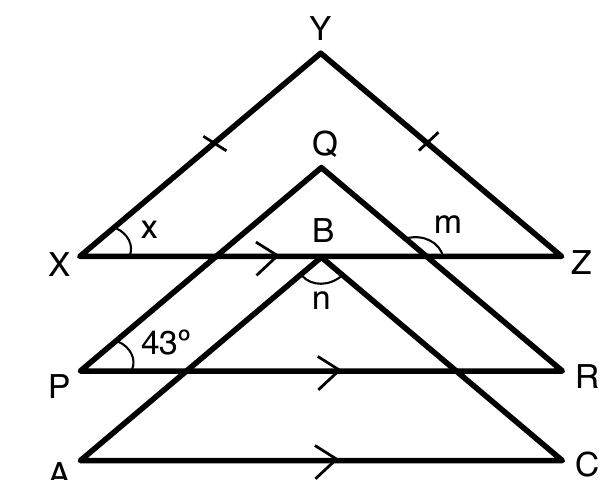
Answer: 274
Since triangle PQR is isosceles with ∠QPR = 43° as a base angle, and all three triangles XYZ, PQR, ABC are congruent, similarly oriented (apex up, base down), each has the same base angle of 43°: so ∠x (the base angle of triangle XYZ at X) = 43°, and the apex angle of each triangle = 180° − 2(43°) = 94°, so ∠n (the apex angle of triangle ABC) = 94°. For ∠m: since XZ is parallel to PR, and QR (a side of triangle PQR) acts as a transversal crossing both parallel lines, the point M where QR meets line XZ forms a corresponding angle equal to ∠QRP = 43° with ray MX. Since X, M, Z are collinear, the angle ∠m on the other side of the transversal at M is supplementary to this: ∠m = 180° − 43° = 137°. Sum = ∠m + ∠n + ∠x = 137° + 94° + 43° = 274°.
18
percentage
medium
Eunice, Fanny and Gloria shared the cost of a watch (bought at a 20% discount). Eunice paid 30% of the discounted cost, Fanny paid 35% of the remaining amount, and Gloria paid the rest. Eunice paid $348 for her share. How much did Gloria pay? Round your answer to the nearest dollar.
Answer: 528
Let C be the discounted cost that the three of them actually split. Eunice pays 30% of C: 0.30 × C = 348, so C = 1160. The remaining amount after Eunice's share is 1160 − 348 = 812. Fanny pays 35% of that remaining amount: 0.35 × 812 = 284.20. Gloria pays the rest: 812 − 284.20 = 527.80, which rounds to $528. (The 20% discount off the original price is not needed in the calculation once the discounted cost C is found from Eunice's payment — it is extra/flavour information.)
19
fractions
medium
Liz and Alex had $345 in total. Liz spent 1/7 of her money, and Alex spent 3/4 of his money. Liz's remaining amount was 3 times Alex's remaining amount. How much money did Alex have at first?
Answer: 184
Let Liz's original amount be L and Alex's be A, with L + A = 345. Liz's remaining amount = (6/7)L. Alex's remaining amount = (1/4)A. Given (6/7)L = 3 × (1/4)A = (3/4)A, so L = (7/8)A. Substituting into L + A = 345: (7/8)A + A = 345, so (15/8)A = 345, giving A = 184. Alex had $184 at first.
20
volume
hard
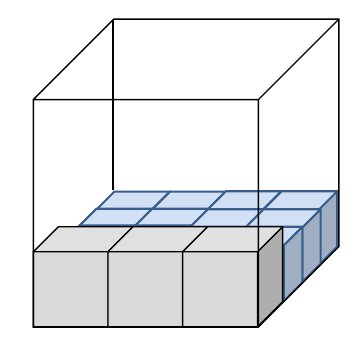
Jack has 9 identical large cubes and some identical small cubes. He packs all the cubes tightly into a rectangular box such that cubes of the same size are stacked on top of each other. The box is filled to its brim exactly. The figure below shows the first layer of cubes packed in the box. The volume of the box is 14976 cm³. The total volume of the 9 large cubes is 4/13 of the volume of the box. What is the volume of one small cube? Give your answer in cm³.
Answer: 216
Total volume of the 9 large cubes = (4/13) × 14976 = 4608 cm³, so each large cube has volume 4608 ÷ 9 = 512 cm³, giving a side length of ∛512 = 8 cm. The remaining volume for the small cubes = 14976 − 4608 = 10368 cm³. From the figure, the box's first layer has a footprint made of 3 large-cube columns (each 8 × 8 cm) and 12 small-cube columns, all reaching the same overall stacked height of the box. With the large cubes stacked 3 high (3 × 8 = 24 cm) matching the box height, and testing small-cube counts, a small cube side of 6 cm (stacked 4 high, 4 × 6 = 24 cm, matching the same height) is consistent: footprint area = 3 × (8×8) + 12 × (6×6) = 192 + 432 = 624 cm², and 624 × 24 = 14976 cm³, which matches the given total exactly. Volume of one small cube = 6³ = 216 cm³.
21
geometry
medium
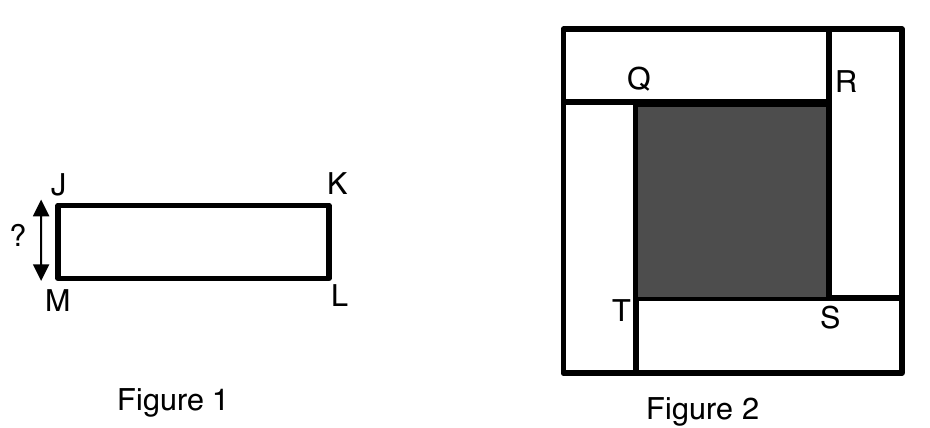
Figure 1 shows rectangle JKLM with perimeter 42 cm. Figure 2 shows four such identical rectangles arranged pinwheel-style around a central shaded square QRST, where the area of QRST is 169 cm². Find the length of JM (cm).
Answer: 4
Let JK = a (long side) and JM = b (short side) of the rectangle. Perimeter = 2(a + b) = 42, so a + b = 21. In the pinwheel arrangement, the side of the central square QRST equals the difference between the rectangle's long and short sides: a − b = √169 = 13. Solving a + b = 21 and a − b = 13 gives a = 17, b = 4. So JM = 4 cm.
22
ratio
medium
The ratio of men to women in a group is 3 : 4. The number of women is 12 more than the number of children. Later, 1/3 of the men, 1/2 of the women and 1/4 of the children leave, after which 425 people remain. How many people were there at first?
Answer: 670
Let men = 3m and women = 4m, so children = 4m − 12. After some leave: remaining men = (2/3)(3m) = 2m, remaining women = (1/2)(4m) = 2m, remaining children = (3/4)(4m − 12) = 3m − 9. Total remaining = 2m + 2m + (3m − 9) = 7m − 9 = 425, so 7m = 434, m = 62. Men = 186, women = 248, children = 4(62) − 12 = 236. Total at first = 186 + 248 + 236 = 670.
23
number-patterns
medium
A sequence of patterns is built from unit cubes of side 3 cm: Pattern 1 has 2 unit cubes, Pattern 2 has 6 unit cubes, Pattern 3 has 12 unit cubes, Pattern 4 has 20 unit cubes, and so on. What is the difference in the volume of the cubes used in Pattern 11 and Pattern 12?

Answer: 648
The number of unit cubes in Pattern n follows n(n + 1): Pattern 1 = 1×2 = 2, Pattern 2 = 2×3 = 6, Pattern 3 = 3×4 = 12, Pattern 4 = 4×5 = 20, confirming the rule. Pattern 11 has 11×12 = 132 unit cubes; Pattern 12 has 12×13 = 156 unit cubes. Difference in cube count = 156 − 132 = 24 cubes. Each unit cube has volume 3³ = 27 cm³. Difference in volume = 24 × 27 = 648 cm³.
24
ratio
medium
At Sunshine School, the ratio of teachers to students is 1 : 12. A total of 1800 cookies were baked and given out. Each teacher received 4 more cookies than each student. In total, students received 4 times as many cookies as teachers did. How many teachers were there?
Answer: 60
Let the number of teachers be t, so the number of students = 12t. Let each student receive s cookies, so each teacher receives (s + 4) cookies. Total cookies to students = 12t·s; total to teachers = t(s + 4). Given 12t·s = 4 × t(s + 4), so 12s = 4s + 16, giving 8s = 16, s = 2. Each teacher receives s + 4 = 6 cookies. Total cookies: 12t(2) + t(6) = 24t + 6t = 30t = 1800, so t = 60. There were 60 teachers.
25
percentage
medium
Mr Wu earned $8500 in January, of which he spent 60% and saved the rest. In February, his earnings decreased; he reduced his spending by 15% from his January spending amount, and his savings that month equalled 25% of his February earnings. What was Mr Wu's earnings in February?
Answer: 5780
January spending = 60% of $8500 = $5100 (savings = $3400). February spending = 85% of January's spending = 0.85 × 5100 = $4335. Let February earnings be E. Since February savings = 25% of E, and spending + savings = E: 4335 + 0.25E = E, so 4335 = 0.75E, giving E = 4335 ÷ 0.75 = $5780.
26
ratio
hard
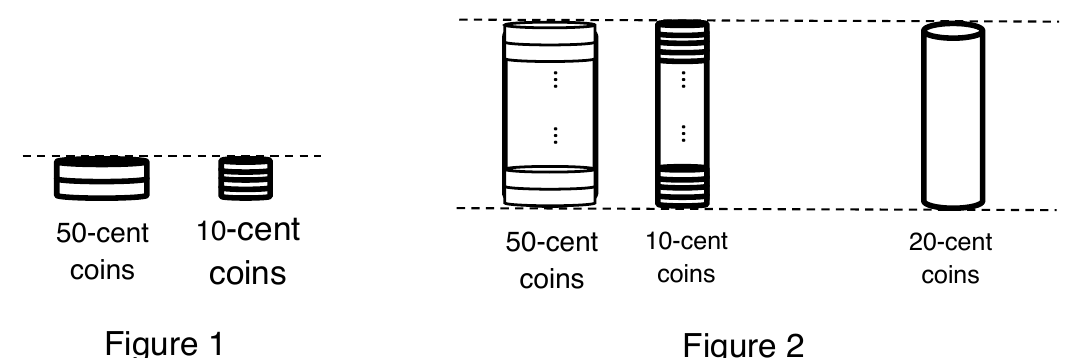
Kenneth stacked coins as shown. In Figure 1, a stack of two 50-cent coins is the same height as a stack of four 10-cent coins. In Figure 2, he has separate stacks of some 50-cent coins, some 10-cent coins, and some 20-cent coins, all reaching the same height. The height of each 20-cent coin is 3/5 the height of each 50-cent coin. The total value of all the 50-cent and 10-cent coins in Figure 2 is $25.20. Find the value of all the 20-cent coins.
Answer: 12.00
From Figure 1, the height of one 50-cent coin (h50) is twice the height of one 10-cent coin (h10): h50 = 2·h10. Given the height of one 20-cent coin: h20 = (3/5)·h50. Since all three stacks in Figure 2 reach the same total height H: n50·h50 = n10·h10 = n20·h20. From n50·h50 = n10·h10 with h50 = 2h10: n10 = 2·n50. From n50·h50 = n20·h20 with h20 = (3/5)h50: n20 = (5/3)·n50. For whole numbers of coins, n50 must be a multiple of 3; let n50 = 3k, so n10 = 6k and n20 = 5k. Total value of 50-cent and 10-cent coins = 3k(0.50) + 6k(0.10) = 1.5k + 0.6k = 2.1k = 25.20, so k = 12. Then n50 = 36, n10 = 72, n20 = 60, all whole numbers (confirming k=12). Value of all the 20-cent coins = 60 × $0.20 = $12.00.
27
geometry
hard
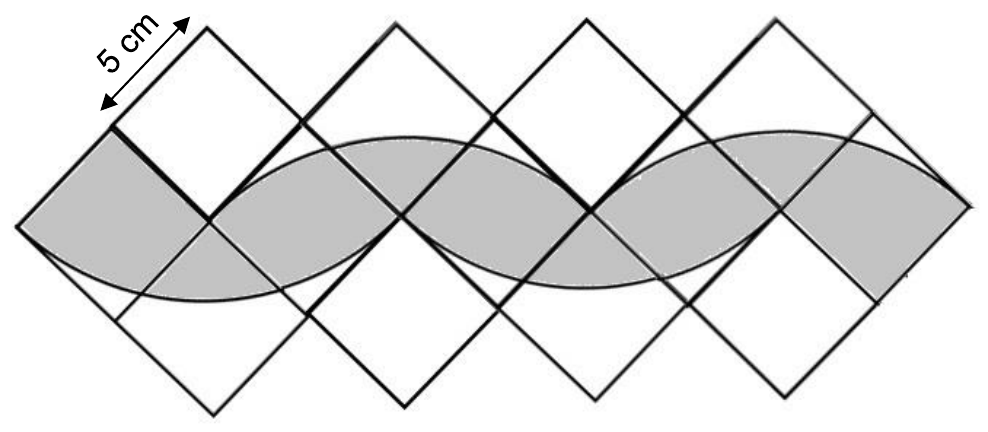
George drew 13 identical squares of sides 5 cm and arranged them as shown. He then drew 4 quadrants. Using π = 3.14, find the shaded area.
Answer: PENDING
PENDING — unresolved. Working from the official source PDF's own rendered figure (not just a screenshot), the drawn figure only shows 4 congruent squares (rotated 45° into a diamond chain, side 5 cm, each overlapping the next by half a diagonal), not 13 as the question text states — extensive pixel-level geometric analysis of the figure could not reconcile this '13 vs 4' discrepancy, nor could it cleanly pin down the exact centre/radius of the arcs forming the shaded 'wave' region between the diamonds. Rather than commit to a guessed number, this is being left for the user to supply directly, as agreed.
28
geometry
hard
In the figure below, not drawn to scale, JKLM, LNOP and QRSK are squares. ∠NKO = 110° and ∠SOP = 130°. Find ∠LNK.
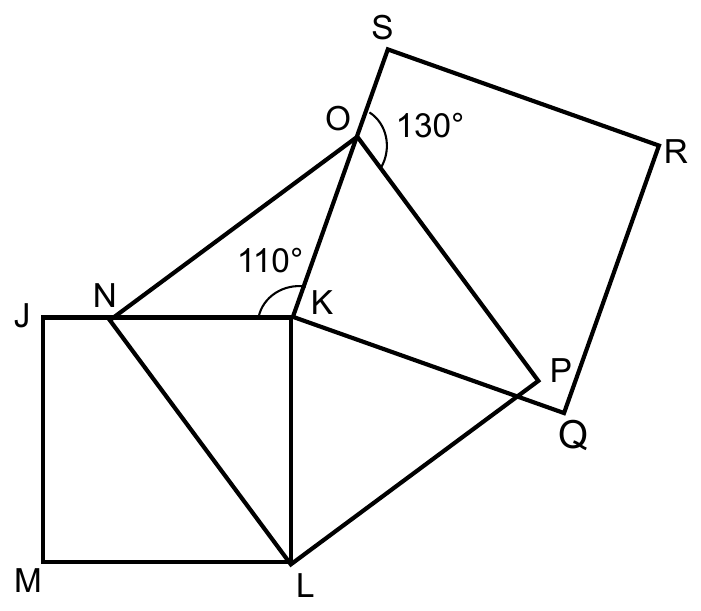
Answer: PENDING
PENDING — unresolved. This is an angle-chase across three squares sharing vertices (JKLM and LNOP share L; JKLM and QRSK share K), with several auxiliary lines drawn in the figure (K–N, K–O and similar) whose exact connectivity could not be reliably reconstructed from the rendered image alone. Rather than guess at the figure's construction, this is being left for the user to supply directly, as agreed.
29
speed
hard
On Monday, Tina jogged around a park once along the jogging track at an average speed of 12 km/h for 20 min and 10 km/h for 1 h 15 min. On Tuesday, Tina and her brother jogged around the same park along the jogging track. They started at the same point but in the opposite directions. Tina jogged at an average speed of 14 km/h while her brother jogged at an average speed of 16 km/h. At what time would they meet if they started jogging at 06 45? Give your answer in 24-hour clock.
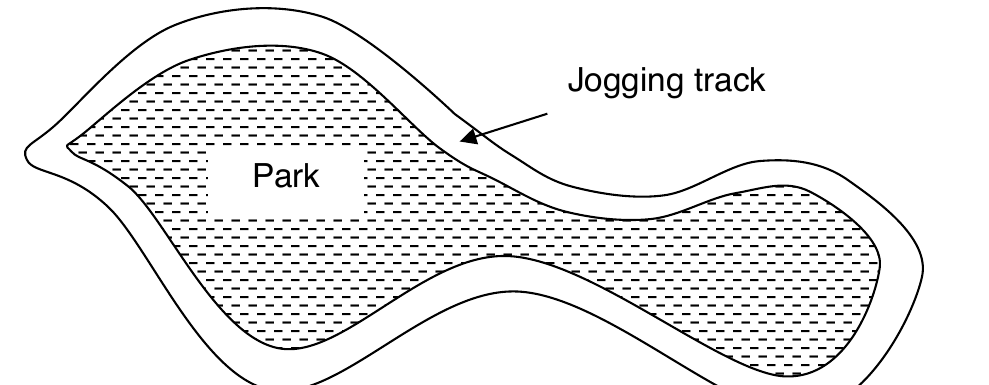
Answer: 0718
Monday's jog gives the length of the track (one full loop): distance = 12 km/h × (20/60) h + 10 km/h × (75/60) h = 4 + 12.5 = 16.5 km. On Tuesday, Tina and her brother start at the same point and jog in opposite directions around this same 16.5 km loop, so they meet once their combined distance covered equals the full loop length. Combined speed = 14 + 16 = 30 km/h. Time to meet = 16.5 ÷ 30 = 0.55 h = 33 minutes. Starting at 06:45, they meet at 06:45 + 33 min = 07:18, i.e. 0718 in 24-hour format.
30
volume
hard
A rectangular tank was completely filled with water. The tank was fixed in the position shown. A partition was placed in the tank. There was an outlet at the base of the tank as shown. When the outlet was unplugged at 4.00 p.m., water flowed out at a rate of 6 l/min. At what time did the water stop draining out of the tank? (Give your answer in 24-hour format.)
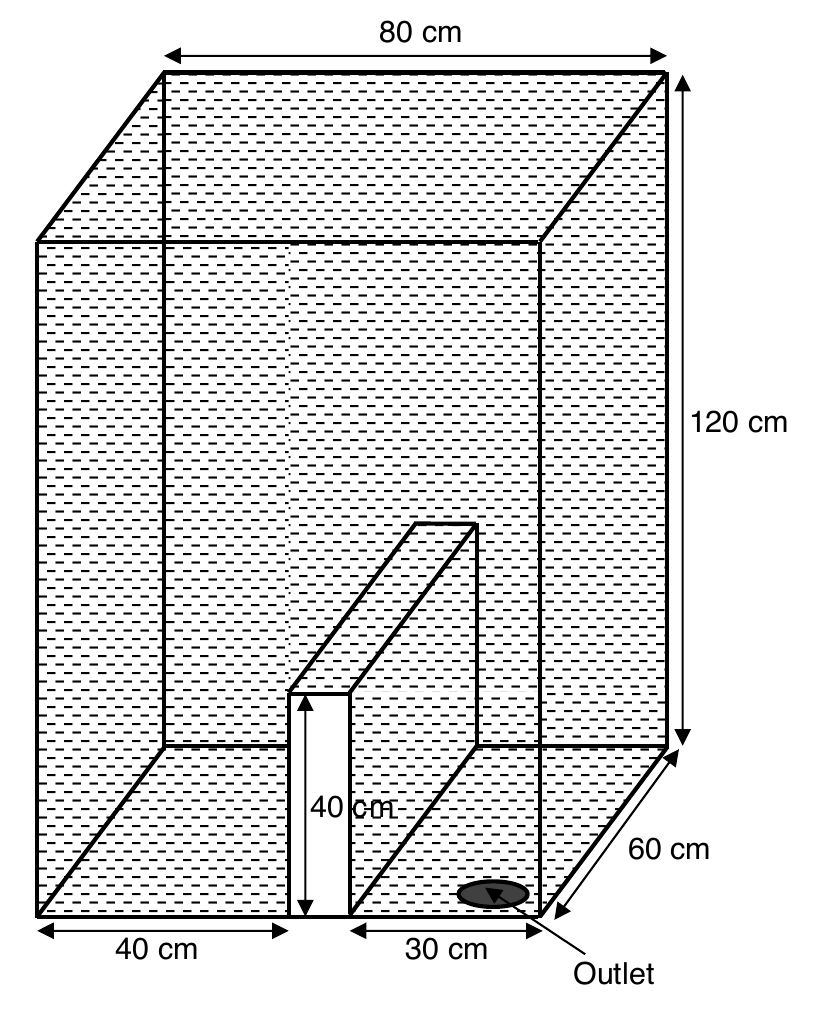
Answer: 1708
The tank is 80 cm wide × 60 cm deep × 120 cm tall. A solid partition (30 cm wide × 60 cm deep × 40 cm tall) sits across the middle of the base, leaving a 40 cm-wide chamber on one side and a 10 cm-wide chamber (containing the outlet) on the other; both chambers run the full 120 cm height, and above the partition's 40 cm height the tank is fully open/connected. As water drains from the outlet, the level in both chambers falls together (since they're connected above 40 cm) until it reaches 40 cm; below that height, the solid partition permanently seals off the 40 cm-wide chamber's water from the outlet, so only the 10 cm-wide outlet chamber can keep draining down to empty. Volume that actually drains = (full cross-section above 40 cm) + (outlet chamber's own volume below 40 cm) = 80×60×(120−40) + 10×60×40 = 384000 + 24000 = 408000 cm³ = 408 L. Time to drain = 408 ÷ 6 = 68 minutes. Starting at 16:00 (4.00 p.m.), draining stops at 16:00 + 68 min = 17:08, i.e. 1708 in 24-hour format. [Note: exact partition placement was read from the rendered figure; please verify the 40 cm / 30 cm / 10 cm split against the original paper.]