Logical Reasoning
MCQs — 15 Questions
(+1)
1
figure-counting
hard
Count the number of triangles in the given figure.
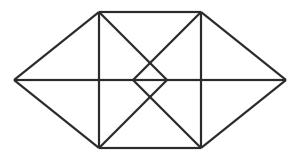
Answer: B
Count in groups:
• Each pointed end has 3 triangles (its top half, its bottom half and the whole end): 3 × 2 = 6.
• Each slanting "<" line pair joins a vertical line; on each side this makes 5 triangles (with the top half, the bottom half, the vertical line and the outer edges): 5 × 2 = 10.
• In the middle, the crossing lines make a small diamond: its top and bottom halves give 2 triangles, and the triangles above and below the diamond (touching the top and bottom edges) give 2 more: 4.
Total = 6 + 10 + 4 = 20.
2
coding-decoding
easy
In a certain code language, if BRIDGE is written as CTJFHG, then how will CAMERA be written in the same code language?
Answer: D
The letters move forward by +1, +2, +1, +2, … in turn: B→C, R→T, I→J, D→F, G→H, E→G.
So CAMERA → C+1 = D, A+2 = C, M+1 = N, E+2 = G, R+1 = S, A+2 = C → DCNGSC.
3
water-images
easy
Select the CORRECT water image of the given figure.

Answer: A
In a water image the figure flips top to bottom; left and right stay the same. The black dot moves from the top-left corner to the bottom-left corner, as in A.
4
blood-relations
medium
G is P's maternal granddaughter and niece of C. E is mother of G and C is the only son of P. If E is married to M, then how is M related to P?
Answer: B
G is P's maternal granddaughter, so G's mother E is P's daughter (C is P's son, so C is G's maternal uncle).
M is married to E, so M is the husband of P's daughter, i.e. P's son-in-law.
5
dot-situation
hard
Select a figure from the options which does not satisfy the same conditions of placement of dots as in the given figure.
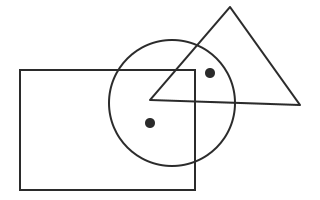
Answer: A
In the given figure one dot is in the region common to the circle and triangle only, and the other dot is in the region common to the rectangle and circle only.
In B, C and D both such regions exist.
In A, the part common to the circle and the triangle lies wholly inside the rectangle, so there is no region common to the circle and triangle only. So A does not satisfy the conditions.
6
clocks
medium
Find the angle traced by the hour hand when the minute hand makes 3 1/3 complete rotations.
Answer: A
One rotation of the minute hand = 1 hour. 3 1/3 rotations = 3 h 20 min = 10/3 hours.
The hour hand turns 30° each hour, so it turns 10/3 × 30° = 100°.
7
word-formation
medium
If a meaningful English word is formed from the first, fourth, sixth and seventh letters of the word FORECAST, then what will be the third letter of the word thus formed? If more than one such word can be formed, then give 'Y' as the answer and if no such word can be formed, then give 'Z' as the answer.
Answer: B
F O R E C A S T: 1st = F, 4th = E, 6th = A, 7th = S.
The letters F, E, A, S make only one word: SAFE. Its third letter is F.
8
pattern-completion
medium
Which of the following figures will complete the pattern in the given figure?
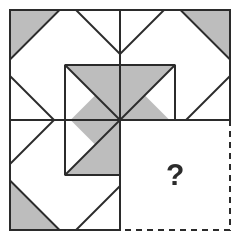
Answer: C
The figure is symmetric about its vertical middle line: the top-right quarter is the mirror image of the top-left quarter.
So the missing bottom-right quarter must be the mirror image of the bottom-left quarter, which is C.
9
directions
medium
Shashi walks 30 m towards West, took a left turn and walks 20 m, then again turns left and walks 10 m. Finally, he walks 40 m towards North. In which direction is the starting position from his current position?
Answer: D
Take the start as (0, 0). 30 m West → (−30, 0). Left turn faces South, 20 m → (−30, −20). Left again faces East, 10 m → (−20, −20). 40 m North → (−20, 20).
The start (0, 0) is 20 m East and 20 m South of him, so it is to the South-East.
10
paper-folding
medium
A square transparent sheet with a pattern and a dotted line on it is given. Select a figure from the options as to how the pattern would appear when the transparent sheet is folded along the dotted line.
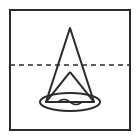
Answer: A
The lower part folds up over the upper part, so the lower part of the pattern is flipped top to bottom on top of the upper part. Since the sheet is transparent, both parts are seen together, as in A.
11
mathematical-operations
medium
If '÷' stands for '+', '−' stands for '÷', '+' stands for '×' and '×' stands for '−', then what is the value of 36 + 4 − 8 × 15 ÷ 25?
Answer: B
After changing the signs: 36 × 4 ÷ 8 − 15 + 25 = 144 ÷ 8 − 15 + 25 = 18 − 15 + 25 = 28.
12
missing-number
medium
Find the missing number, if same rule is followed in all the three figures.
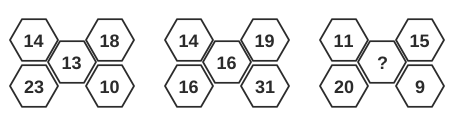
Answer: B
The middle number is the sum of the four outer numbers divided by 5.
(14 + 18 + 23 + 10) ÷ 5 = 65 ÷ 5 = 13 and (14 + 19 + 16 + 31) ÷ 5 = 80 ÷ 5 = 16.
So ? = (11 + 15 + 20 + 9) ÷ 5 = 55 ÷ 5 = 11.
13
figure-matrix
hard
Select a figure from the options which will complete the given figure matrix.
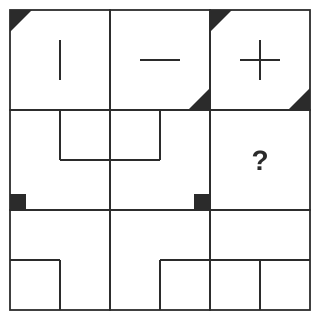
Answer: B
In each row the third figure is made by putting the first two figures together.
In row 2, the first figure has the right L-line and the bottom-left black square; the second has the left L-line and the bottom-right black square. Together they give a line across the middle, a line from the top to the centre and both bottom corners black, which is B.
14
odd-one-out
medium
Select the odd one out.
Answer: B
The number is twice the sum of the positions of the two letters.
VE: 2 × (22 + 5) = 54. SA: 2 × (19 + 1) = 40. DU: 2 × (4 + 21) = 50.
GO: 2 × (7 + 15) = 44, not 46. So GO46 is the odd one out.
15
cubes-dice
hard
Select a box from the options which is similar to the box formed when the given sheet of paper is folded to form a box.
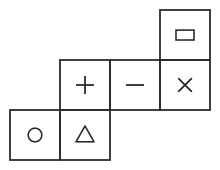
Answer: A
From the net, the opposite pairs are + and ×, − and ○, △ and □.
In B, − and ○ are seen together; in C, + and × are seen together; in D, △ and □ are seen together. Opposite faces can never be seen together, so these are wrong.
A (□ on top, ○ in front, + on the right) matches the folded box.
Mathematical Reasoning
MCQs — 20 Questions
(+1)
16
number-patterns
easy
Which of the following numbers is the 8th triangular number?
Answer: D
8th triangular number = 1 + 2 + … + 8 = 36.
4³ = 64, 2⁶ = 64, 8² = 64 and 6² = 36. So the answer is the 2nd power of 6.
17
rounding
easy
A number when rounded off to the nearest thousands becomes 94,000. Find the largest possible value of the number.
Answer: B
Numbers from 93,500 to 94,499 round to 94,000. 94,500 would round up to 95,000. So the largest is 94,499.
18
fractions
easy
Find the denominator of the equivalent fraction of 36/48 with numerator 9.
Answer: D
36 ÷ 4 = 9, so divide the denominator by 4 too: 48 ÷ 4 = 12. So 36/48 = 9/12.
19
perimeter
easy
If side of a square is tripled, then the new perimeter is ___ times the original perimeter.
Answer: A
Perimeter = 4 × side. New perimeter = 4 × 3s = 3 × (4s), so it is 3 times the original.
20
large-numbers
medium
Find the number that is 3660 less than the greatest 6-digit number formed by using the digits 2, 5, 6 and 0 (use digits 2 and 6 twice and other digits only once).
Answer: D
The digits are 6, 6, 5, 2, 2, 0. The greatest number is 665220.
665220 − 3660 = 661560.
21
data-handling
medium
The given pictograph shows the number of milk cartons sold by 4 different shops in a week.
If total money earned by shop Q is ₹ 8060, then find the money earned by selling each carton.
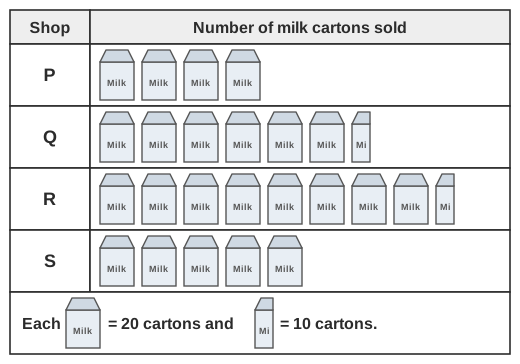
Answer: A
Shop Q has 6 full symbols and a half symbol: 6 × 20 + 10 = 130 cartons.
Money per carton = 8060 ÷ 130 = ₹ 62.
22
data-handling
medium
The given pictograph shows the number of milk cartons sold by 4 different shops in a week.
If another shop T sold 190 milk cartons, then how many less cartons did it sell than shops P, R and S together?
Answer: B
P = 4 × 20 = 80, R = 8 × 20 + 10 = 170, S = 5 × 20 = 100. Together = 350.
350 − 190 = 160.
23
fractions
medium
Compare and fill the box.
4 2/5 − 2/3 + 1/7 ☐ 2 1/3 + 1 1/2 − 2 2/5
Answer: B
Left side: 22/5 − 2/3 + 1/7 = (462 − 70 + 15)/105 = 407/105 ≈ 3.88.
Right side: 7/3 + 3/2 − 12/5 = (70 + 45 − 72)/30 = 43/30 ≈ 1.43.
So the left side is greater: >.
24
area
hard
Find the area of the given figure (not drawn to scale).
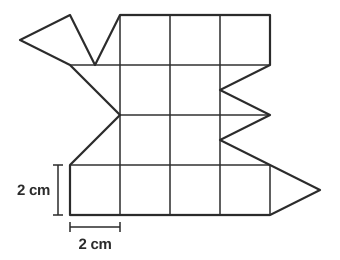
Answer: B
Each small square is 2 cm × 2 cm = 4 sq. cm.
The figure has 12 full squares, and the triangular and notched parts make 5 half squares = 2½ squares more. Total = 14½ squares.
Area = 14.5 × 4 = 58 sq. cm.
25
length
medium
On a straight road, there are four cities A, B, C and D. Distance between B and D is 39 km, between A and C is 27 km and between C and D is 15 km. How far is A from B?

Answer: B
B to C = BD − CD = 39 − 15 = 24 km.
A to B = AC − BC = 27 − 24 = 3 km.
26
number-patterns
medium
Starting from 22, which is the largest odd number that appears in the Collatz sequence?
Answer: A
Halve even numbers; for odd n use 3n + 1.
22 → 11 → 34 → 17 → 52 → 26 → 13 → 40 → 20 → 10 → 5 → 16 → 8 → 4 → 2 → 1.
The odd numbers are 11, 17, 13, 5, 1. The largest is 17.
27
prime-factorisation
medium
Sum of distinct prime factors of largest 4-digit number is ___.
Answer: A
9999 = 9 × 1111 = 3 × 3 × 11 × 101.
Distinct primes: 3, 11 and 101. Sum = 115.
28
lines
medium
How many pairs of parallel lines are there in the given figure?
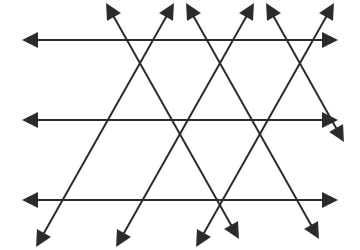
Answer: B
There are three sets of 3 parallel lines (horizontal, slanting right and slanting left).
Each set of 3 lines gives 3 pairs, so 3 × 3 = 9 pairs.
29
data-handling
medium
The given line graph shows the number of visitors to a museum over six months. Between which of the following two months, the increase in number of visitors was minimum?
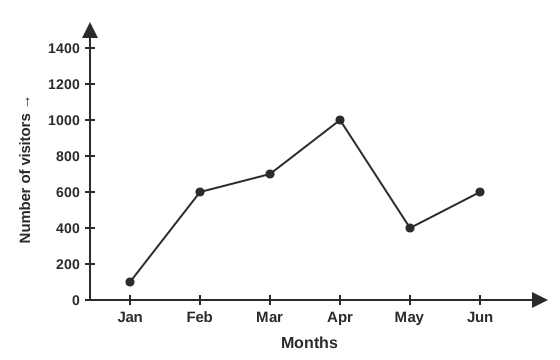
Answer: D
Increases: Mar–Apr 700 → 1000 = 300; Jan–Feb 100 → 600 = 500; May–Jun 400 → 600 = 200; Feb–Mar 600 → 700 = 100.
The smallest increase is from Feb to Mar.
30
symmetry
medium
How many of the following alphabets have rotational symmetry of order 2?

Answer: C
A letter has rotational symmetry of order 2 if it looks the same after a half turn (180°).
H, N, O and I do; B, T, C, E and D do not. That is 4 letters.
31
angles
easy
Which of the following figures does not contain any reflex angle inside it?
Answer: B
A reflex angle is more than 180°; it appears where a figure has an inward corner.
The hourglass (A) and the notched shape (C) each have an inward corner. The house shape (B) has no inward corner, so it has no reflex angle.
32
integers
hard
Consider the number line given below. Find the additive inverse of −(−X + (−Y)).

Answer: B
The marks go up by 45, so X = −135 and Y = 135.
−X + (−Y) = 135 − 135 = 0, so −(0) = 0. The additive inverse of 0 is 0.
33
number-series
easy
Find the missing term in the given sequence.
3, 7, 15, 31, ___, 127
Answer: C
Each term is double the previous term plus 1: 3 → 7 → 15 → 31 → 63 → 127.
34
quadrilaterals
hard
Which of the following statements is INCORRECT?
P: It is possible to construct a 4-sided figure in which all the angles are equal to 90° but opposite sides are not equal.
Q: It is not possible to construct a 4-sided figure in which all sides are equal in length but it is not a square.
Answer: C
P: a 4-sided figure with all angles 90° is a rectangle, and the opposite sides of a rectangle are always equal. So P is incorrect.
Q: a rhombus has all sides equal but is not a square (its angles need not be 90°). So Q is incorrect too.
Both P and Q are incorrect.
35
mirror-images
medium
Which of the following figures is the CORRECT reflection of the given figure?
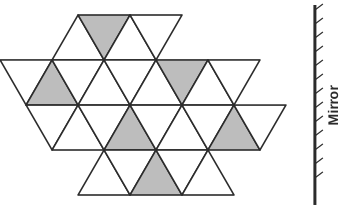
Answer: C
The mirror is on the right, so the figure flips left to right and stays the same way up. Every shaded triangle moves to the same position on the other side, as in C.
Everyday Mathematics
MCQs — 10 Questions
(+1)
36
angles
medium
A bicycle wheel has 20 spokes. What is the largest obtuse angle formed between the two spokes?
Answer: C
The angle between two neighbouring spokes is 360° ÷ 20 = 18°. Angles between spokes are multiples of 18°.
The largest multiple of 18° below 180° is 9 × 18° = 162°.
37
multiples
easy
The total number of seats in a classroom is more than 60 but less than 80. How many rows will be there in the classroom, if each row has 9 seats?
Answer: A
Multiples of 9 between 60 and 80 are 63 and 72. 63 ÷ 9 = 7 and 72 ÷ 9 = 8. So 7 or 8 rows.
38
large-numbers
medium
Mihir divided his property between his two sons equally and gave ₹ 65,34,870 to each. His daughter insisted that she should also get a share. So the sons divided the property into 3 equal shares and gave her one part of it. How much did each one get?
Answer: C
Total property = 2 × 65,34,870 = ₹ 1,30,69,740.
Each of 3 shares = 1,30,69,740 ÷ 3 = ₹ 43,56,580.
39
fractions
easy
Mr. Sharma earns ₹ 80000 per month. He spends 2/10 of his income on education, 1/5 on household, 3/10 on entertainment and saves the remaining amount. What fraction of income is his saving?
Answer: A
Spent = 2/10 + 2/10 + 3/10 = 7/10. Saving = 1 − 7/10 = 3/10.
40
exponents
easy
A library is setting up book racks with books in powers of 3 configuration. If the largest rack is set up with 5th power of 3 books, then how many books are in that rack?
Answer: A
3⁵ = 3 × 3 × 3 × 3 × 3 = 243.
41
integers
medium
In a game, there are two dices each of whose faces have the numbers: 1, −2, 3, −4, 5, −6. Which of the following numbers is not possible to get by adding numbers (one from each dice) on these two dice?
Answer: A
−12 = −6 + (−6), 4 = 1 + 3 and −8 = −4 + (−4) are all possible.
To get −11 we would need −6 + (−5) or −11 + 0, but −5 is not on the dice. So −11 is not possible.
42
perimeter
medium
A page of a notebook measures 32 cm × 24 cm. A rectangular border is drawn (inside it) 1 cm from top and bottom each and 1.5 cm from left and right sides each. Find the perimeter of the border.
Answer: D
Take the page as 24 cm wide and 32 cm tall. Border width = 24 − 2 × 1.5 = 21 cm; border height = 32 − 2 × 1 = 30 cm.
Perimeter = 2 × (21 + 30) = 102 cm.
43
time
medium
Meera practiced piano for 3/5 hours each day from Monday to Wednesday. On Thursday and Friday, she practiced for 40 minutes each day. Find the total time Meera took for practice piano in 5 days.
Answer: B
3/5 hour = 36 minutes. Monday to Wednesday = 3 × 36 = 108 min. Thursday and Friday = 2 × 40 = 80 min.
Total = 188 min = 3 h 8 min.
44
fractions
hard
Jatin divides a sheet of paper into 8 equal parts. Then he cuts each of those into 8 equal smaller pieces. After that, he again cuts each of the resulting pieces into 6 equal pieces. He then colours 55 yellow, 99 pieces red, 78 pieces green and rest are uncoloured. What fraction of the total pieces are not coloured?
Answer: C
Total pieces = 8 × 8 × 6 = 384. Coloured = 55 + 99 + 78 = 232. Uncoloured = 384 − 232 = 152.
152/384 = 19/48.
45
number-puzzles
easy
Sahil thinks of a 2-digit number. The sum of its digits is 12. If the digit in the units place is one-third of the digit in the tens place, then which number is Sahil thinking?
Answer: C
If the units digit is u, the tens digit is 3u. u + 3u = 12, so u = 3 and the tens digit is 9. The number is 93.
Achievers Section
MCQs — 5 Questions
(+3)
46
perimeter
hard
Read the given statements carefully and select the CORRECT option.
Statement-I: A square has perimeter 24 cm. It is reshaped into a rectangle of same perimeter by reducing one pair of opposite sides by 2 cm, then the area of rectangle is 36 sq. cm.
Statement-II: The cost of fencing a rectangular garden is ₹ 960 at the rate of ₹ 12 per m. If both length and breadth of the garden are increased by 2 m, then the cost of fencing at the same rate increases by ₹ 96.
Answer: D
I: the square's side is 6 cm. Reducing one pair by 2 cm gives 4 cm; to keep the perimeter 24 cm the other pair becomes 8 cm. Area = 4 × 8 = 32 sq. cm, not 36. False.
II: perimeter = 960 ÷ 12 = 80 m. Adding 2 m to length and breadth adds 2 × (2 + 2) = 8 m. Extra cost = 8 × 12 = ₹ 96. True.
47
fractions
hard
Solve the following and select the CORRECT option.
(i) Satyam had ₹ 600. He spent 1/4 of it on shoes and 1/3 of the remaining on a bag. After buying both, what fraction of total money is left with him?
(ii) The population of a town is 725382. In a survey, it is reported that one out of every 3 persons is female. How many more males than females are there in that town?
Answer: D
(i) Shoes = 600 ÷ 4 = ₹ 150, leaving ₹ 450. Bag = 450 ÷ 3 = ₹ 150, leaving ₹ 300. 300/600 = 1/2.
(ii) Females = 725382 ÷ 3 = 241794; males = 483588. Difference = 241794.
48
data-handling
hard
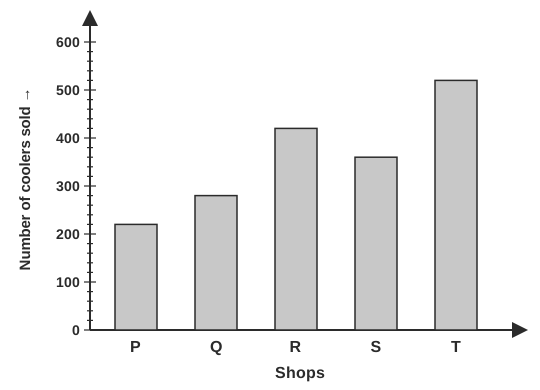
The given bar graph shows the sales of coolers in summers in five different shops.
(i) Which shop accounts for 7/30 of the total sales of all the five shops?
(ii) Difference between the sales of P and S is same as difference between the sales of which other two shops?
Answer: A
Sales: P 220, Q 280, R 420, S 360, T 520. Total = 1800.
(i) 7/30 × 1800 = 420, which is shop R.
(ii) S − P = 360 − 220 = 140, and R − Q = 420 − 280 = 140. So Q and R.
49
number-patterns
hard
Read the given statements carefully and state 'T' for true and 'F' for false.
(i) The Kaprekar process involves addition of numbers formed by rearranging digits.
(ii) 12, 6, 3, 10, 5, 15, 8, 4, 2, 1 is a Collatz sequence.
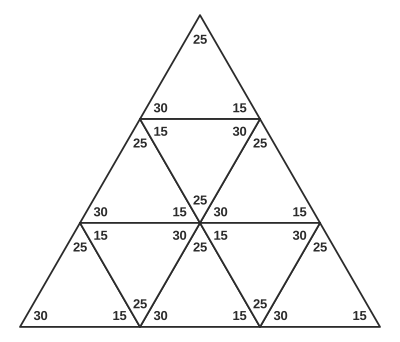
(iii) The sum of all the numbers in the given below pattern is 630.
Answer: B
(i) The Kaprekar process subtracts the smaller arrangement of the digits from the larger one. False.
(ii) After 5 the Collatz rule gives 3 × 5 + 1 = 16, not 15. False.
(iii) There are 9 small triangles, each with the numbers 25, 15 and 30 (sum 70). 9 × 70 = 630. True.
50
integers
hard
Match the following and select the CORRECT option.
Column-I
(P) The sum of two integers between 2 and −5, which are additive inverses of each other is ___.
(Q) The additive inverse of ((−27) + (−54) + (−32)) + 65 + 46 is ___.
(R) If we are at −18 on the number line, then to reach 28 we should move ___ integers.
(S) The successor of (−22 + (−98) − (−84) − 9) is ___.
Column-II
(i) 2
(ii) −44
(iii) 0
(iv) 46
Answer: C
(P) A number and its additive inverse always add to 0 → (iii).
(Q) −27 − 54 − 32 + 65 + 46 = −113 + 111 = −2; its additive inverse is 2 → (i).
(R) From −18 to 28 is 28 − (−18) = 46 → (iv).
(S) −22 − 98 + 84 − 9 = −45; its successor is −44 → (ii).