Logical Reasoning
MCQs — 15 Questions
(+1)
1
dictionary-order
easy
Arrange the given words as they occur in a dictionary and select the CORRECT option.
1. Corner
2. Central
3. Command
4. Control
5. Comedy
Answer: A
Central comes first (Ce before Co).
The rest begin with Co: Comedy, Command (Come before Comm), then Control, then Corner (n before r).
Order: Central, Comedy, Command, Control, Corner = 2, 5, 3, 4, 1.
2
paper-folding
medium
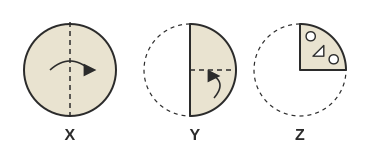
The given question consists of a set of three figures X, Y and Z which shows the sequence of folding of a piece of paper. Fig. Z shows the manner in which the folded paper has been cut. Select a figure from the options which shows the unfolded form of Fig. Z.
Answer: C
The circle was folded along the vertical line and then along the horizontal line, so each cut is repeated in all four quarters as a mirror image across both fold lines.
That gives 8 small circles and 4 triangles, and the right angle of each triangle always points away from the centre of the circle — figure C.
In A the triangles are turned the wrong way, in B two circles are missing, and in D the triangles have not been flipped.
3
cube-and-dice
medium
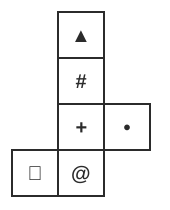
Select a box from the options that is similar to the box formed when the given sheet of paper is folded to form a box.
Answer: D
When the sheet is folded, the opposite faces are: ▲ and +, # and @, • and △.
A shows △ next to •, and C shows @ next to #, so both are impossible.
With + on top and # in front, the face on the right is △ (in B, # cannot be on the right when △ is in front). So the box is D.
4
venn-diagrams
easy
Which of the following Venn diagrams best represents the relationship amongst "Road transport, Water transport and Boats"?
Answer: D
Boats are a kind of water transport, so the Boats circle lies inside the Water transport circle.
Road transport is completely different, so it is a separate circle. That is diagram D.
5
direction-sense
medium
Megha walks 120 m towards East, then takes a left turn and walks 60 m. She then turns left again and walks 80 m. She then takes a right turn and walks 40 m. Finally, she walks 40 m after turning to her left. How far is she now from her starting point?
Answer: B
Take the start as (0, 0).
East 120 m → (120, 0); left (North) 60 m → (120, 60); left (West) 80 m → (40, 60); right (North) 40 m → (40, 100); left (West) 40 m → (0, 100).
She is 100 m due North of the starting point.
6
series-completion
medium
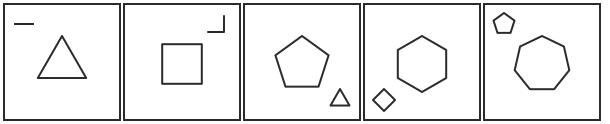
Select a figure from the options which will continue the same series as established by the Problem Figures.
Answer: B
The big shape gains one side each time: triangle, square, pentagon, hexagon, heptagon → next an octagon.
The small shape also gains one side each time (1 line, 2 lines, triangle, square, pentagon → next a hexagon) and moves clockwise round the corners: top-left, top-right, bottom-right, bottom-left, top-left → next top-right.
So the next figure is an octagon with a small hexagon at the top-right — figure B.
7
embedded-figures
medium
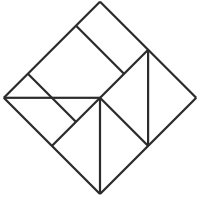
Select a figure from the options which is exactly embedded in the given figure as one of its parts.
Answer: B
Figure B (a triangle with a line from one corner) is formed by the left part of the figure: two sides of the outer square, the long diagonal line and the short line below it.
The shapes in A, C and D cannot be traced along the lines of the figure in that position.
8
counting-figures
medium
Find the number of squares formed in the given figure.
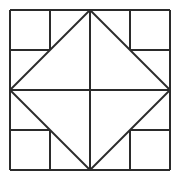
Answer: B
Small corner squares: 4.
Medium squares (each quarter of the big square): 4.
The big outer square: 1. The tilted square (diamond) through the mid-points of the sides: 1.
Total = 4 + 4 + 1 + 1 = 10.
9
calendar
easy
If 7th day of the month May is Sunday, then what will be the second last day of that month?
Answer: B
May has 31 days, so the second last day is 30th May.
7th is Sunday, so 28th (7 + 21) is also Sunday. Then 29th is Monday and 30th is Tuesday.
10
odd-one-out
medium
Select the odd one out.
Answer: C
SQN: S −2 Q −3 N. MKH: M −2 K −3 H. YWT: Y −2 W −3 T.
VTR: V −2 T −2 R. So VTR is the odd one out.
11
blood-relations
easy
Pointing towards a woman, Aman said, "She is the daughter of the wife of my grandfather's only child." How is that woman related to Aman?
Answer: C
Aman's grandfather's only child is Aman's father, and his wife is Aman's mother.
The daughter of Aman's mother is Aman's sister.
12
coding-decoding
easy
If in a certain code language, 'PARROT' is written as '@#22*3' and 'SNAKE' is written as '4©#1ϕ', then how will 'PEAKS' be written in the same code language?
Answer: D
From the two words: P = @, A = #, R = 2, O = *, T = 3, S = 4, N = ©, K = 1, E = ϕ.
PEAKS → @ ϕ # 1 4 = @ϕ#14.
13
mirror-and-water-images
medium
Select the CORRECT water image of the given figure.

Answer: C
A water image turns the figure upside down but keeps left and right the same.
So the big black triangle goes to the bottom pointing down, the two small triangles go to the top pointing down, F stays on the left but is upside down and V on the right becomes Λ — figure C.
A is a mirror image, B is the figure turned through 180° (and the dot is not black), and in D the letters have not been flipped.
14
ranking
easy
In a class, Anandita ranks 18th from the top and 13th from the bottom. How many students are there in the class?
Answer: B
Total = 18 + 13 − 1 = 30 (Anandita is counted in both ranks).
15
missing-figure
medium
Select the letter which will complete the given figure matrix.
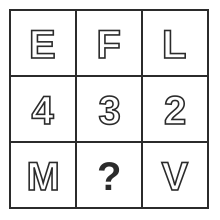
Answer: A
The number in the middle row is the number of straight lines needed to write the letter above it: E has 4, F has 3, L has 2.
The letter in the bottom row is written with the same number of lines: M has 4 and V has 2.
So the missing letter must have 3 straight lines: N. (T has 2, W has 4 and O has none.)
Mathematical Reasoning
MCQs — 20 Questions
(+1)
16
factors-and-multiples
medium
Study the given factor tree and find the difference between the 7th multiple of (p + q) and 9th multiple of (p − q).
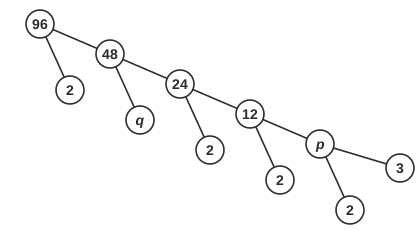
Answer: A
48 = q × 24, so q = 2. 12 = 2 × p, so p = 6 (and 6 = 2 × 3).
p + q = 8, so its 7th multiple is 56. p − q = 4, so its 9th multiple is 36.
Difference = 56 − 36 = 20.
17
lines-and-angles
easy
How many of the given letters have pairs of perpendicular lines?

Answer: B
F, M, H, I and E all have a vertical edge meeting a horizontal edge, so they have perpendicular lines.
A is made of slanting lines and horizontal lines only, so it has no perpendicular lines.
So 5 letters.
18
roman-numerals
medium
Which of the following roman numeral represents the successor of the number shown on the abacus?
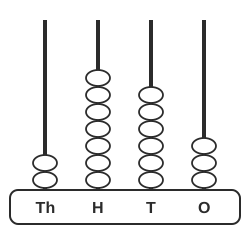
Answer: B
The abacus shows 2 thousands, 7 hundreds, 6 tens and 3 ones = 2763.
Its successor is 2764 = MM + DCC + LX + IV = MMDCCLXIV.
19
fractions
medium
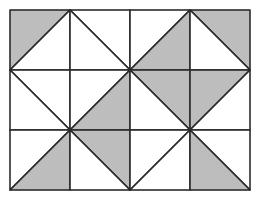
Which of the following is NOT an equivalent fraction of the unshaded fraction of the given figure?
Answer: A
The figure has 12 squares, each cut into 2 triangles, so 24 equal triangles. 9 are shaded, so 15 are unshaded.
Unshaded fraction = 15/24 = 5/8.
90/144 = 5/8, 60/96 = 5/8 and 35/56 = 5/8, but 105/180 = 7/12. So the answer is 105/180.
20
integers
medium
Which of the following is the GREATEST?
Answer: C
A: −(8395 + 1359) = −9754. B: −9574 + 1 = −9573. C: −9475 + 200 = −9275. D: 298 − 9999 = −9701.
The greatest (closest to zero) is −9275, option C.
21
lines-and-angles
medium
In the given figure (not drawn to scale), AB = 18 cm and AC = CD = DB. Find the length of line segment EF, if AE = EC and DF = FB.

Answer: B
AC = CD = DB = 18 ÷ 3 = 6 cm.
EC = 3 cm and DF = 3 cm.
EF = EC + CD + DF = 3 + 6 + 3 = 12 cm.
22
data-handling
medium
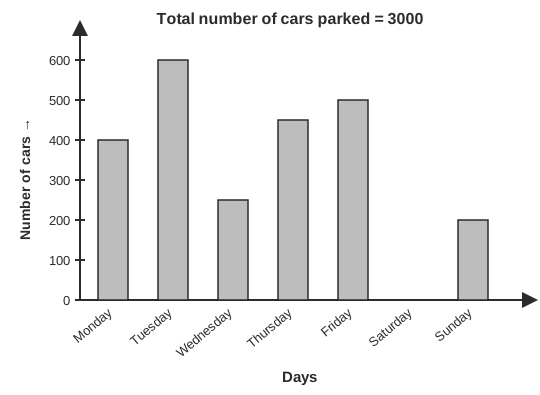
The given bar graph shows the number of cars parked in a parking on the seven days of a particular week. What fraction of the cars parked on Saturday to the total number of cars parked in the whole week?
Answer: A
Cars on the other days = 400 + 600 + 250 + 450 + 500 + 200 = 2400.
Saturday = 3000 − 2400 = 600.
Fraction = 600/3000 = 1/5.
23
data-handling
medium
Using the bar graph of Q22, how many less cars were parked on Saturday and Sunday together than the total cars parked from Monday to Friday?
Answer: C
Saturday + Sunday = 600 + 200 = 800.
Monday to Friday = 400 + 600 + 250 + 450 + 500 = 2200.
Difference = 2200 − 800 = 1400.
24
lines-and-angles
medium
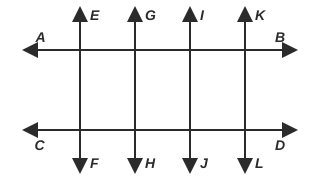
How many pairs of parallel lines are there in the given figure?
Answer: C
The horizontal lines AB and CD make 1 pair.
The 4 vertical lines EF, GH, IJ and KL make 4 × 3 ÷ 2 = 6 pairs.
Total = 1 + 6 = 7 pairs.
25
area-and-perimeter
hard
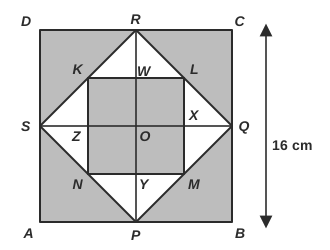
The given figure is formed by 3 squares. P, Q, R and S are the mid-points of the sides of square ABCD. RP and SQ intersect at point O. If W, X, Y and Z are the mid-points of RO, OQ, OP and OS respectively, then find the area of unshaded region.
Answer: A
Area of ABCD = 16 × 16 = 256 sq. cm. Square PQRS joins the mid-points, so its area is half of that = 128 sq. cm.
The square KLMN has its sides through W, X, Y and Z, so its side is OW + OY = 4 + 4 = 8 cm and its area is 64 sq. cm.
Unshaded region = 128 − 64 = 64 sq. cm.
26
symmetry
medium
Which of the following figures has exactly one line of symmetry?
Answer: A
In A, the grid matches itself when folded along the diagonal from the top-right corner to the bottom-left corner (● with ●, ■ with ■, ○ with ○), and along no other line.
B, C and D have no line of symmetry.
27
fractions
hard
If x 5/6 − 3 1/3 = (4/3 − 3/2) + (1/2 − 1/3) + 1/2, where x 5/6 is a mixed number, then find the value of x.
Answer: C
Right side: (8/6 − 9/6) + (3/6 − 2/6) + 1/2 = −1/6 + 1/6 + 1/2 = 1/2.
So x 5/6 = 1/2 + 3 1/3 = 3/6 + 20/6 = 23/6 = 3 5/6.
Therefore x = 3.
28
data-handling
easy
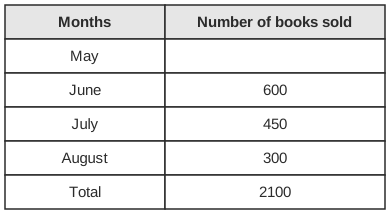
Which of the following is the correct representation of the number of story books sold in the month of May, if 1 book picture = 150 books?
Answer: D
May = 2100 − (600 + 450 + 300) = 2100 − 1350 = 750 books.
750 ÷ 150 = 5 pictures, which is option D.
29
division
medium
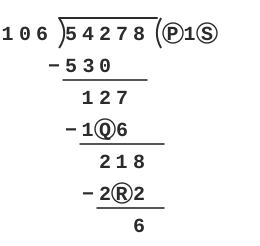
Find the value of (P + Q − S) × R.
Answer: C
54278 ÷ 106: 542 − 530 = 12, 127 − 106 = 21, 218 − 212 = 6.
The quotient is 512, so P = 5 and S = 2. 106 gives Q = 0 and 212 gives R = 1.
(P + Q − S) × R = (5 + 0 − 2) × 1 = 3.
30
divisibility
medium
Which of the following is divisible by all 2, 4, 5 and 8?
Answer: C
To be divisible by 5 and 8, the number must end in 0 and its last three digits must be divisible by 8.
460, 420 and 530 are not divisible by 8, but 200 = 8 × 25 is.
So 819200 is divisible by 2, 4, 5 and 8.
31
large-numbers
easy
Which of the following options is CORRECT?
Answer: C
1 crore = 10 million, so 10 crore = 100 million.
(10 million = 1 crore, 100 thousand = 1 lakh, and 1000 thousand = 1 million.)
32
integers
medium
On subtracting the largest 4-digit even positive integer from the largest 5-digit odd negative integer, we get
Answer: D
The largest 5-digit odd negative integer is −10001, and the largest 4-digit even positive integer is 9998.
−10001 − 9998 = −19999.
33
measurement
easy
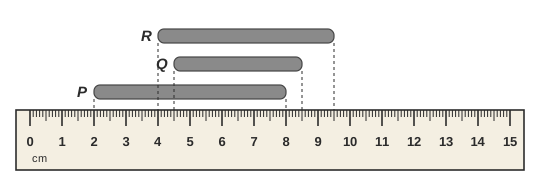
The given figure shows the lengths of 3 sticks. Find the total length of all the sticks.
Answer: D
P: from 2 cm to 8 cm = 6 cm. Q: from 4.5 cm to 8.5 cm = 4 cm. R: from 4 cm to 9.5 cm = 5.5 cm.
Total = 6 + 4 + 5.5 = 15.5 cm, which is none of the given values.
34
fractions
medium
Compare and fill the box.
Fraction of 120 minutes to 5 hours ☐ Fraction of 144 seconds to 60 minutes
Answer: A
120 minutes / 5 hours = 120/300 = 2/5.
144 seconds / 60 minutes = 144/3600 = 1/25.
2/5 is greater than 1/25, so the sign is >.
35
area-and-perimeter
medium
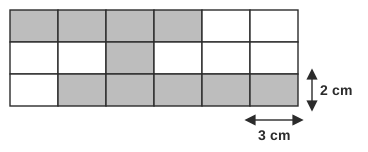
The given figure is made of identical rectangles, each 3 cm long and 2 cm wide. Find the perimeter of the shaded region.
Answer: C
Go round the outline of the shaded region and count the rectangle edges on it.
There are 16 long edges of 3 cm (48 cm) and 6 short edges of 2 cm (12 cm).
Perimeter = 48 + 12 = 60 cm.
Everyday Mathematics
MCQs — 10 Questions
(+1)
36
area-and-perimeter
medium
Riddhi joined three rectangular pieces of cloth to make a big rectangular table cloth (as shown in the given figure). Area of each rectangle is given inside. Find the cost of lacing the table cloth formed at the rate of ₹ 32 per m. (Ignore the stitching margins).
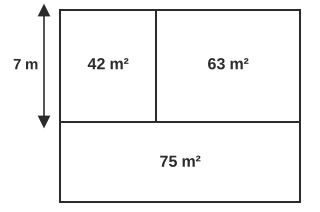
Answer: B
The top pieces are 7 m tall, so their widths are 42 ÷ 7 = 6 m and 63 ÷ 7 = 9 m. The table cloth is 6 + 9 = 15 m wide.
The bottom piece is 75 ÷ 15 = 5 m tall, so the cloth is 7 + 5 = 12 m long.
Perimeter = 2 × (15 + 12) = 54 m. Cost = 54 × 32 = ₹ 1728.
37
integers
easy
The given table shows the increase and decrease in temperature of a hill station in different hours on a certain day. What is the final temperature at 12 midnight, if the temperature at 8 a.m. was 8°C?
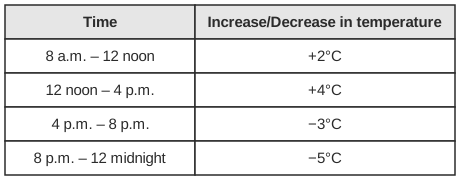
Answer: A
8 + 2 + 4 − 3 − 5 = 6°C.
38
roman-numerals
medium
In a particular week, a factory produces MMMDCCCXXVII white t-shirts, MDCCCLXXIX black t-shirts and MMCCCXLV blue t-shirts. How many total t-shirts produced by the factory in that week?
Answer: B
MMMDCCCXXVII = 3827, MDCCCLXXIX = 1879, MMCCCXLV = 2345.
Total = 3827 + 1879 + 2345 = 8051.
39
money
medium
The given table shows the cost of some items in three stores P, Q and R. If Raman goes to market and buy 2 pairs of trousers from store R, 1 jacket from store P and 4 caps from store Q, then find the total amount of money did he spend.
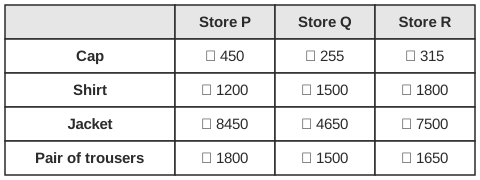
Answer: A
2 pairs of trousers from R = 2 × 1650 = ₹ 3300.
1 jacket from P = ₹ 8450. 4 caps from Q = 4 × 255 = ₹ 1020.
Total = 3300 + 8450 + 1020 = ₹ 12770.
40
decimals
medium
Mr Ahuja purchased two Maths books for ₹ 167.50 each, three Science books for ₹ 1375.75 and four Computer Science books for ₹ 168.55 each. He gave 5 notes of ₹ 500 each to the shopkeeper. How much amount will he get back?
Answer: D
Maths books: 2 × 167.50 = ₹ 335. Science books: ₹ 1375.75. Computer Science books: 4 × 168.55 = ₹ 674.20.
Total = 335 + 1375.75 + 674.20 = ₹ 2384.95.
He paid 5 × 500 = ₹ 2500, so he gets back 2500 − 2384.95 = ₹ 115.05.
41
area-and-perimeter
easy
The total cost of flooring a room is ₹ 2160. The rate of flooring is ₹ 45 per square metre. If the room is 8 metres long, then find its breadth.
Answer: D
Area = 2160 ÷ 45 = 48 sq. m.
Breadth = 48 ÷ 8 = 6 m.
42
fractions
hard
There are 1500 rose saplings in a garden. 2/5 of them are red rose saplings, 1/5 of them are white rose saplings and rest are yellow rose saplings. If 2/15 of red roses saplings, 3/25 of white rose saplings and 7/20 of yellow rose saplings were sold, then find the total number of white and yellow rose saplings left in the garden.
Answer: C
Red = 2/5 × 1500 = 600, white = 1/5 × 1500 = 300, yellow = 1500 − 900 = 600.
White sold = 3/25 × 300 = 36, so 264 are left. Yellow sold = 7/20 × 600 = 210, so 390 are left.
White and yellow left = 264 + 390 = 654.
(1174 would be the saplings left of all three colours, since 520 red are also left.)
43
integers
easy
If the price of diesel was ₹ 8 in 2017, increased to ₹ 10 in 2018, decreased by ₹ 6 in 2019, increased by ₹ 16 in 2020, then what is the price of diesel in 2020?
Answer: A
2018: ₹ 10. 2019: 10 − 6 = ₹ 4. 2020: 4 + 16 = ₹ 20.
44
large-numbers
easy
If the population of a city recorded in a particular year is one hundred two million three thousand nine hundred forty five, then the population written in Indian system of numeration is ______.
Answer: C
One hundred two million three thousand nine hundred forty five = 102003945.
In the Indian system the commas go after the hundreds and then every two digits: 10,20,03,945.
45
large-numbers
medium
Vishu writes the smallest 6-digit number and Rishi writes the greatest 7-digit number on the blackboard. Their Maths teacher finds the difference between the smallest 4-digit number and the sum of the two numbers written on the board. What would be the answer?
Answer: B
Sum = 100000 + 9999999 = 10099999.
Difference from the smallest 4-digit number = 10099999 − 1000 = 10098999.
Achievers Section
MCQs — 5 Questions
(+3)
46
fractions
hard
Read the given statements carefully and select the CORRECT option.
Statement-I : 4/9 of the animals at the farm were cows. 1/2 of the remaining animals were goats and rest were chicks. The fraction of the animals at the farm that were chicks is 5/18.
Statement-II : Jyoti had a collection of 640 round, rectangular and triangular stickers. 3/8 of the stickers were round, 1/4 of remaining were triangular and rest were rectangular. She had 200 more rectangular stickers than triangular stickers.
Answer: A
Statement-I: the remaining animals are 5/9. Half of them are goats, so chicks = 1/2 × 5/9 = 5/18. True.
Statement-II: round = 3/8 × 640 = 240, remaining = 400. Triangular = 1/4 × 400 = 100, rectangular = 300. 300 − 100 = 200. True.
So both statements are true.
47
integers
hard
Match the following and select the CORRECT option.
Column-I
P. The sum of additive inverse of (−222 + 158 − 500) and the greatest negative integer is
Q. Predecessor of successor of (198 + (−300) + 200 + (−50)) is
R. The sum of additive inverse of ((−3) + 5 + (−8)) and greatest one-digit positive integer is
S. The value of ((−15) + (−12) − (−3)) − ((−5) − (−25) + (−10)) is
Column-II
(i) 48
(ii) 15
(iii) 563
(iv) −34
Answer: A
P: −222 + 158 − 500 = −564; its additive inverse is 564; 564 + (−1) = 563 → (iii).
Q: 198 − 300 + 200 − 50 = 48, and the predecessor of its successor is 48 → (i).
R: −3 + 5 − 8 = −6; its additive inverse is 6; 6 + 9 = 15 → (ii).
S: (−15 − 12 + 3) − (−5 + 25 − 10) = −24 − 10 = −34 → (iv).
48
area-and-perimeter
hard
Fill in the blanks and select the CORRECT option.
(i) The area of the shaded part in the first figure is ______.
(ii) The second figure (not drawn to scale) is formed with identical squares. The cost of painting the unshaded region at the rate of ₹ 25 per cm² is ______.
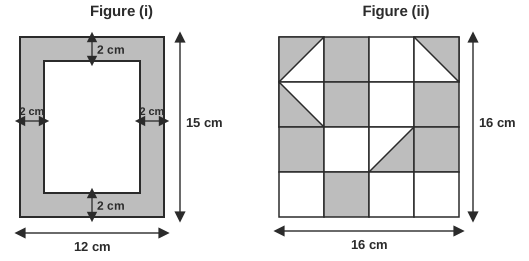
Answer: B
(i) Outer rectangle = 12 × 15 = 180 cm². The white rectangle is (12 − 4) × (15 − 4) = 8 × 11 = 88 cm². Shaded = 180 − 88 = 92 cm².
(ii) The 16 cm square is made of 16 squares of side 4 cm (16 cm² each). Shaded: 6 whole squares and 4 half squares = 8 squares = 128 cm².
Unshaded = 256 − 128 = 128 cm². Cost = 128 × 25 = ₹ 3200.
49
factors-and-multiples
hard
Which of the following options is INCORRECT?
Answer: C
A: the last three digits 712 = 8 × 89, so 755712 is divisible by 8 (and so by 2 and 4). Correct.
B: 1183 = 7 × 13 × 13 and 1792 = 7 × 256 have the common factor 7, so they are not co-prime. Correct.
C: 255 = 3 × 5 × 17, but 1 is not a prime number. Incorrect.
D: the greatest factor of 144 is 144, and 7 × 144 = 1008. Correct.
50
data-handling
hard
The given table shows the number of books printed by a publication house in the given five months.
(i) How many more books were printed in March and May together than in January and February together?
(ii) Find the fraction of number of books printed in April to the number of books printed in February.
(iii) If the cost of printing each book is ₹ 125, then find the total cost of all the books printed in January and March together.
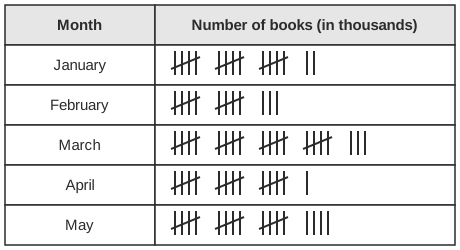
Answer: B
From the tally marks (in thousands): January 17, February 13, March 23, April 16, May 19.
(i) (23 + 19) − (17 + 13) = 42 − 30 = 12 thousand = 12000.
(ii) April : February = 16/13.
(iii) January + March = 40000 books; 40000 × 125 = ₹ 5000000.