Section A
Multiple Choice Questions — 15 Questions
(+3)
1
fraction-simplification
easy
Evaluate: (5 × 7 × 2 × 17) ÷ (14 × 34 × 35)
Answer: C
The numerator is 5×7×2×17 = 1190, and the denominator is 14×34×35 = 16660. Simplifying, 1190/16660 = 1/14, which as a decimal rounds to 0.071.
2
exponents
easy
What is the value of 0^1?
Answer: A
Any number raised to the power 1 equals itself, so 0^1 = 0.
3
pythagorean-theorem
medium
A triangle has sides 35 cm, 37 cm, and 12 cm. Identify the type of triangle it is.
Answer: C
Check the Pythagorean theorem using the two shorter sides: 12² + 35² = 144 + 1225 = 1369 = 37². Since the square of the longest side equals the sum of the squares of the other two, the triangle is right-angled.
4
arithmetic-sequences
medium
A child gets $10 pocket money every day. He saves $1 on the first day, $2 on the second day, $3 on the third day, $4 on the fourth day, and so on. On which day will he have saved enough to buy his sister a $50 school bag?
Answer: D
The total saved after n days is 1+2+...+n = n(n+1)/2. After day 9 the total is 9×10/2 = 45, which is less than $50. After day 10 the total is 10×11/2 = 55, which is at least $50, so day 10 is the first day he has enough.
5
ratio-scaling
medium
A photographer expands a photo diagonally in a software, to make it fit into a digital album. The bigger photo is neither squished nor stretched and looks proper. The original dimensions of the photo were 6 inches by 4 inches. Now the stretched photo is of the dimensions 12 inches by p inches. Find the value of p.
Answer: A
Because the photo is scaled proportionally (not squished or stretched), the ratio of new to original dimensions must be the same in both directions: 12/6 = 2. So p = 4 × 2 = 8 inches.
6
symmetry
easy
How many lines of symmetry does a parallelogram have?
Answer: E
A general parallelogram (one that is not also a rectangle, rhombus, or square) has no line of symmetry, since reflecting it across any line does not map the shape onto itself.
7
decimal-arithmetic
easy
Evaluate: 32.345 + 32.435 − 23.435
Answer: C
32.345 + 32.435 = 64.78. Then 64.78 − 23.435 = 41.345.
8
fractions-shaded-regions
medium
Assume that all sections within each of the given shapes are the same size. Consider only the area represented by the flower, the circle, etc. without including any surrounding area around it. Which figure has the smallest fraction of itself shaded?

Answer: C
Comparing shaded fractions: shape a has 9 of 12 petals shaded (3/4); shape b has 4 of 5 sectors shaded (4/5); shape c has only 1 of 4 equal strips shaded (1/4); shape d has 6 of 12 sectors shaded (1/2); shape e has 7 of 8 petals shaded (7/8). The smallest fraction shaded is shape c, at 1/4.
9
combinatorics-grid-paths
medium
The number of shortest paths along a 3 × 3 grid from one corner to the diagonally opposite corner is:
Answer: D
A 3×3 grid of points forms a 2×2 array of unit squares. The shortest path from one corner to the diagonally opposite corner requires exactly 2 moves in one direction and 2 moves in the perpendicular direction, in any order. The number of such arrangements is C(4,2) = 6.
10
speed-distance-time
easy
Look at the following table. Which two cars are going at the same speed?
Car A — Distance traveled: 40 km, Time taken: 1 hour
Car B — Distance traveled: 30 km, Time taken: 2 hours
Car C — Distance traveled: 40 km, Time taken: 2 hours
Car D — Distance traveled: 20 km, Time taken: 30 minutes
Answer: D
Speed = distance ÷ time. Car A: 40÷1 = 40 km/h. Car B: 30÷2 = 15 km/h. Car C: 40÷2 = 20 km/h. Car D: 20 km in 0.5 hour = 40 km/h. Cars A and D both travel at 40 km/h.
11
paper-folding
hard
A paper is folded as shown below and punched in its folded state. When the paper is opened out again, what will be the pattern of holes formed?
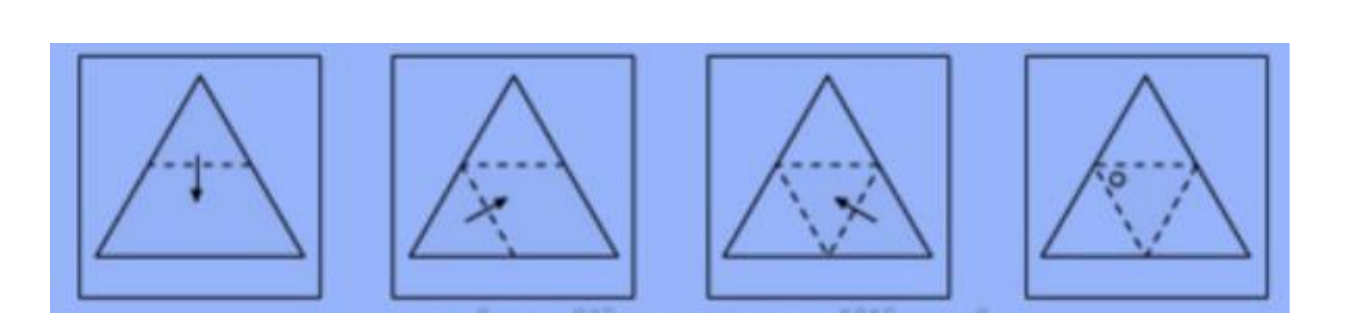
Answer: D
Unfolding a punched, folded paper reverses each fold, reflecting the punch hole across every crease line used to make that fold. Working backward through the triangular paper's three creases shown in the diagrams (the central fold, then the two diagonal folds bringing the side corners toward the middle), the single punch mark shown in the last folded diagram reflects into the multi-hole pattern shown in option D.
12
venn-diagrams
medium
A sports club offers three sports – soccer, basketball and baseball. All their members play at least one sport. Which of the following Venn diagrams represents the members of the sports club? Assume that there are no limits to the number of sports one can play and that some people may be physically strong enough and able enough to play any or all sports.
Answer: A
Since every member plays at least one sport and nothing prevents a member from playing two or all three sports, the diagram must show three equally general sets that overlap pairwise and share one common region for members who play all three — this is the classic three-circle Venn diagram in option A. Option B nests one circle inside a larger circle, option C shows strict concentric subsets, and option D encloses two overlapping circles entirely inside a third; each of these wrongly forces membership in one sport to imply membership in another.
13
area-perimeter-cost
hard
A rectangular park is to be fenced with a stone wall. There is a gate along the perimeter that is 2 m long, which is made of steel. Find the cost of fencing the park, if its dimensions are 100 m by 50 m. The entire perimeter may be taken to be the same height of 3 m. Take the cost of stone fencing as $23 per m² and steel fencing as $17 per m².
Answer: E
The park's perimeter is 2×(100+50) = 300 m. Removing the 2 m steel gate leaves 298 m of stone fencing. Each fenced meter has height 3 m, so the stone area is 298×3 = 894 m² and the steel area is 2×3 = 6 m². Cost = 894×$23 + 6×$17 = $20,562 + $102 = $20,664.
14
divisibility
easy
How many three-digit natural numbers are divisible by 5? Natural numbers are positive integers starting from 1.
Answer: C
Three-digit multiples of 5 range from 100 to 995. The count of such multiples is (995−100)/5 + 1 = 179 + 1 = 180.
15
simple-interest
medium
The interest on $1200 is more than the interest on $1000 by $30 in 3 years. Find the rate of interest for each year.
Answer: A
Using simple interest I = Prt/100, the difference in interest between $1200 and $1000 over 3 years is (1200−1000)×r×3/100 = 6r. Setting 6r = 30 gives r = 5%.
Section B
Open-Ended Questions — 5 Questions
(+5)
16
arithmetic-simplification
easy
Evaluate: (45 × 37 × 27) ÷ 185
Answer: 243
45×37×27 = 44,955. Dividing by 185: 44,955 ÷ 185 = 243, since 185×243 = 44,955.
17
data-interpretation
medium
Several people were surveyed for their preference from 4 drinks A, B, C, D. All the people surveyed are represented in the graph below. If the fraction of people who preferred A to those who preferred D is m/n, what is m + n?
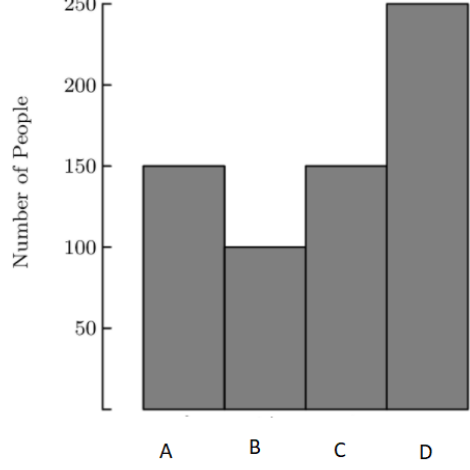
Answer: 8
From the graph, 150 people preferred A and 250 preferred D. The fraction preferring A to D is 150/250 = 3/5 in lowest terms, so m = 3 and n = 5, giving m + n = 8.
18
number-theory-remainders
medium
Find the smallest integer, which when divided by 7 gives a remainder of 0, but when divided by 10 gives a remainder of 1
Answer: 21
Positive numbers leaving remainder 1 when divided by 10 end in the digit 1: 1, 11, 21, 31, .... Checking each for divisibility by 7, 21 = 7×3 is the smallest such number.
19
volume-surface-area
medium
A steel cuboid is reshaped into a cube. Initially, its length, breadth, and depth were 270 cm, 100 cm, and 64 cm respectively. Find the sum of digits of the surface area of the cube.
Answer: 18
The cuboid's volume is 270×100×64 = 1,728,000 cm³. Since 120³ = 1,728,000, the cube's side length is 120 cm. Its surface area is 6×120² = 86,400 cm², and the digit sum of 86,400 is 8+6+4+0+0 = 18.
20
area-overlap
medium
Two identical rectangular cards partially overlap. The area of overlap is a square with an area 4 cm², and the total area of the regions of the faces of the two cards that do not overlap is 12 cm². What is the area of one card?
Answer: 10
Let A be the area of one card. Each card's non-overlapping region has area A − 4, and the two cards together contribute 2(A − 4) = 12, so A − 4 = 6 and A = 10.
Section C
Open-Ended Questions — 5 Questions
(+6)
21
number-patterns
hard
Find the sum of digits of the next number in the series: 11, 143, 2431, 46189, ____
Answer: 23
Each term is the product of consecutive prime numbers starting from 11: 11, 11×13=143, 11×13×17=2431, 11×13×17×19=46189. The next term multiplies by the next prime, 23: 46189×23 = 1,062,347, whose digit sum is 1+0+6+2+3+4+7 = 23.
22
mean-consecutive-integers
medium
The mean of four consecutive odd numbers is 24. Find the sum of the middle two numbers in this set.
Answer: 48
Let the four consecutive odd numbers be x, x+2, x+4, x+6. Their mean is [x+(x+2)+(x+4)+(x+6)]/4 = 24, so 4x+12 = 96 and x = 21. The numbers are 21, 23, 25, 27, so the middle two are 23 and 25, which sum to 48.
23
lcm-remainders
hard
Find the largest four-digit number which when divided by 4, 7, and 13 leaves a remainder of 3 in each case.
Answer: 9831
A number leaving remainder 3 after division by 4, 7, and 13 is 3 more than a common multiple of 4, 7, and 13. Since lcm(4,7,13) = 364, the largest multiple of 364 not exceeding 9999−3 = 9996 is 364×27 = 9828. So the number is 9828+3 = 9831.
24
exponents
medium
2^400 can be equivalently written as a repeated product of the number 16. For example, 16 × 16 × 16 × … (n times). What is the value of n?
Answer: 100
Since 16 = 2^4, writing 16 as a repeated product n times gives 16^n = 2^(4n). Setting 4n = 400 gives n = 100.
25
time-arithmetic
medium
Theo's football coaching starts at 6:30 am, and his mother wants him to wake up at 6 am to be on time for coaching. But currently, Theo wakes up late. Theo promises to wake up 5 minutes earlier than he did the day before. If Theo woke up at 6:50 am on a Sunday, and keeps his promise every day, on what day will he wake up on time for football coaching? Leave your answer as 0001 for Monday, 0002 for Tuesday, …, and 0007 for Sunday.
Answer: 3
Starting from 6:50 am on Sunday (day 0), Theo's wake-up time decreases by 5 minutes each day, so after d days it is 6:50 minus 5d minutes. Setting this equal to 6:00 am requires 5d = 50, so d = 10 days after Sunday. Counting 10 days forward from Sunday (Mon, Tue, ..., cycling through the week) lands on a Wednesday, so the answer is 0003 (Wednesday).