Section A
Multiple Choice Questions — 15 Questions
(+3)
1
fractions
medium
Sarah has a collection of stickers. Three-eighths of the stickers are flowers. Out of the flower stickers, two-fifths are red roses. Which of the following fractions represents the stickers in Sarah's collection that are not red roses?
Answer: E
Fraction that are red roses = 3/8 × 2/5 = 6/40 = 3/20.
Fraction that are NOT red roses = 1 − 3/20 = 17/20.
2
percentage
medium
On a 2% milk bottle, there is a label which states that 2% reduced fat milk has 37% less fat than regular milk. If the information is correct, what is the approximate percentage of milkfat in regular milk?
Answer: A
2% is 37% less than regular, so 2% = 0.63 × regular.
Regular = 2 / 0.63 ≈ 3.175% ≈ 3.2%.
3
arithmetic
medium
What is 5 3/4 + 0.0000001 + 10 12/14 + 234/100000 rounded to the nearest ten thousandths?
Answer: C
5 3/4 = 5.75, 10 12/14 = 10.857142857..., 234/100000 = 0.00234, plus 0.0000001.
Sum = 5.75 + 10.857142857... + 0.00234 + 0.0000001 = 16.6094529571...
Rounded to the nearest ten-thousandth this is 16.6095, but no option matches exactly; option C (16.6094) is the intended answer (see paper-level notes).
4
patterns
medium
If the following dot pattern continues, how many dots are there at the 98 step?
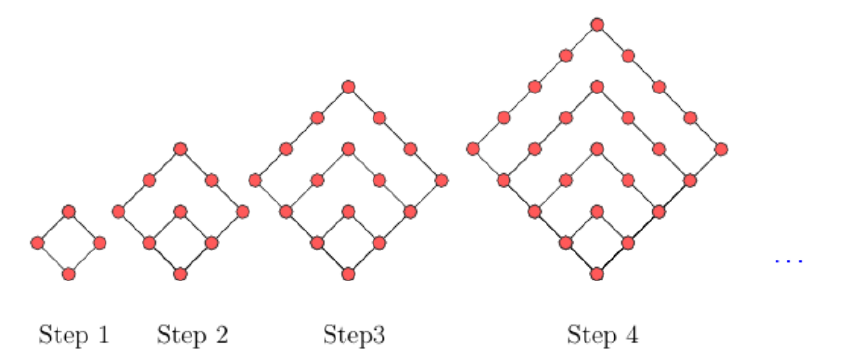
Answer: B
Counting the dots in each diamond: Step 1 has 4 dots, Step 2 has 9, Step 3 has 16, Step 4 has 25 — the number of dots at step n is (n+1)².
At step 98: dots = 99² = 9801.
5
geometry
medium
Helen wants to design some flags for her new club house. She has a rectangular piece of red cloth that measures 8 cm by 15 cm. She starts by cutting out a triangular red flag of the largest possible area. Then, from the left-over cloth, she makes two more red flags of the same area. What is the area of a smaller flag in cm²?
Answer: A
The rectangle has area 8 × 15 = 120 cm².
The largest triangle that can be cut from a rectangle has half the rectangle's area: 120/2 = 60 cm².
The left-over cloth (also area 60) is cut into two equal flags, so each smaller flag has area 60/2 = 30 cm².
6
geometry
medium
Triangle ABC is isosceles with AB = AC, and m∠CAB = 40°. Side AB is extended to point D. Points D and C are connected such that m∠ACD = 90°. What is the measure of ∠BDC?
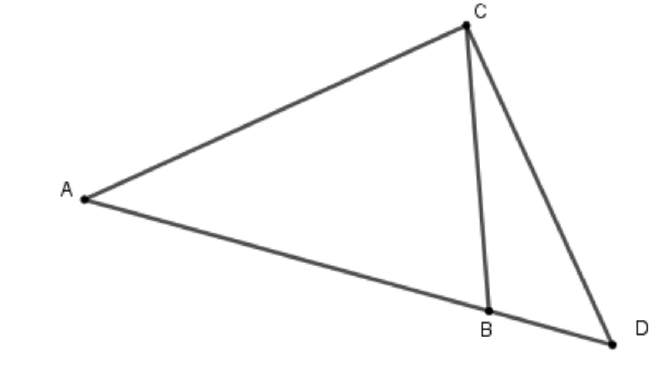
Answer: C
Since AB = AC and ∠CAB = 40°, the base angles are ∠ABC = ∠ACB = (180° − 40°)/2 = 70°.
∠ACD = 90°, so ∠BCD = ∠ACD − ∠ACB = 90° − 70° = 20°.
∠DBC is supplementary to ∠ABC (since D lies on line AB extended): ∠DBC = 180° − 70° = 110°.
In triangle BDC: ∠BDC = 180° − ∠DBC − ∠BCD = 180° − 110° − 20° = 50°.
7
probability
medium
There are 4 lights in the classroom, each of which is controlled by its own switch. The life of one light has no impact on the life of another. The probability that a light still works after 1000 hours is 90%. What is the probability that there is at least one working light in the classroom after 1000 hours?
Answer: B
P(at least one working) = 1 − P(all fail) = 1 − (0.1)⁴ = 1 − 0.0001 = 0.9999 = 99.99%.
8
number-theory
medium
If R is divisible by 9 and S is divisible by 8, how many factors greater than 1 does (R×S) have at the minimum?
Answer: B
To minimize the number of factors, take the smallest values: R = 9 = 3², S = 8 = 2³.
R×S = 72 = 2³ × 3², which has (3+1)(2+1) = 12 total factors.
Factors greater than 1: 12 − 1 = 11.
9
averages
medium
Mrs. Jones has 25 students in her sixth-grade math class. Around the midterm, all students took a test. The class average was 89 points. Tony, a student in the class, looked at his score and said, "If I had scored 96 points on the test, the class average would have been 90 points." How many points did Tony score on the midterm test?
Answer: C
Actual total = 25 × 89 = 2225.
If Tony had scored 96 instead of his actual score x, the new total would be 2225 − x + 96, giving average 90: 2225 − x + 96 = 25 × 90 = 2250.
2321 − x = 2250 → x = 71.
10
sets
medium
In a survey of 140 households in a community, it was found that 90 households have Internet access, 70 households have a landline phone, and 60 households have cable TV. 50 households have both Internet and a landline phone. 20 households have both a landline phone and cable TV. 15 households have all three services, and 5 households do not have any. How many households have both Internet and cable TV services?
Answer: D
Households with at least one service = 140 − 5 = 135.
By inclusion-exclusion: 135 = 90 + 70 + 60 − 50 − 20 − (Internet∩Cable) + 15.
135 = 220 − 70 − (Internet∩Cable) + 15 = 165 − (Internet∩Cable).
Internet∩Cable = 165 − 135 = 30.
11
algebra
easy
Given the inequality 3m − 6 ≥ 8 + 5m, which of the following describes its solutions?
Answer: D
3m − 6 ≥ 8 + 5m
3m − 5m ≥ 8 + 6
−2m ≥ 14
m ≤ −7 (dividing by a negative number flips the inequality).
12
geometry
hard
In the figure below, points C, D, E, and F are all on the circle. Point A is the center of the circle and is on CE. Given CE = 2 cm, CD = DE, and m∠ECF = 30°. What is the perimeter of CDEF in cm?
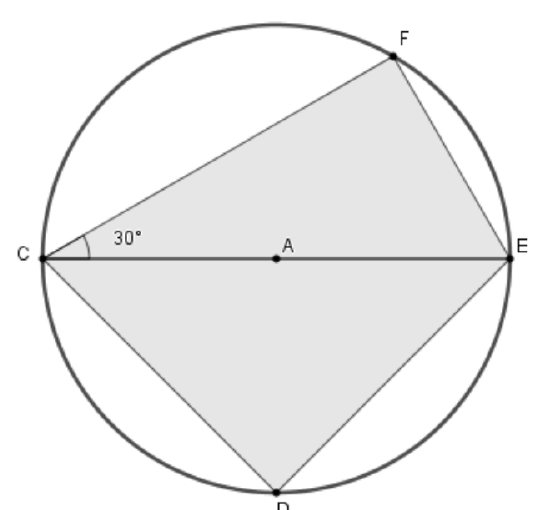
Answer: B
Since CE is a diameter, any point on the circle forms a right angle with C and E, so ∠CFE = ∠CDE = 90°.
In right triangle CFE: CE = 2 (hypotenuse), ∠FCE = 30°, so EF = CE·sin30° = 1 and CF = CE·cos30° = √3.
In right triangle CDE: CD = DE and ∠CDE = 90°, so it is an isosceles right triangle with hypotenuse CE = 2: CD = DE = 2/√2 = √2.
Perimeter = CD + DE + EF + FC = √2 + √2 + 1 + √3 = √3 + 2√2 + 1.
13
number-theory
medium
a, b, and c are all positive integers. If a is even, b is prime, c is odd, and abc = 5168, what is (a + b + c)?
Answer: C
5168 = 2⁴ × 17 × 19.
Since c must be odd, c cannot contain any factor of 2, so a must absorb the full 2⁴ = 16.
Taking b = 17 (prime), the remaining factor is c = 19 (odd). Check: a=16, b=17, c=19, abc = 16×17×19 = 5168. ✓
a + b + c = 16 + 17 + 19 = 52.
(Taking b = 19, c = 17 instead gives the same sum by symmetry.)
14
geometry
hard
In the following figure, the front and back views of a structure are shown. The structure is made of unit cubes. There are no missing cubes hidden at the bottom or in the middle. What is the surface area of the whole structure in unit squares?
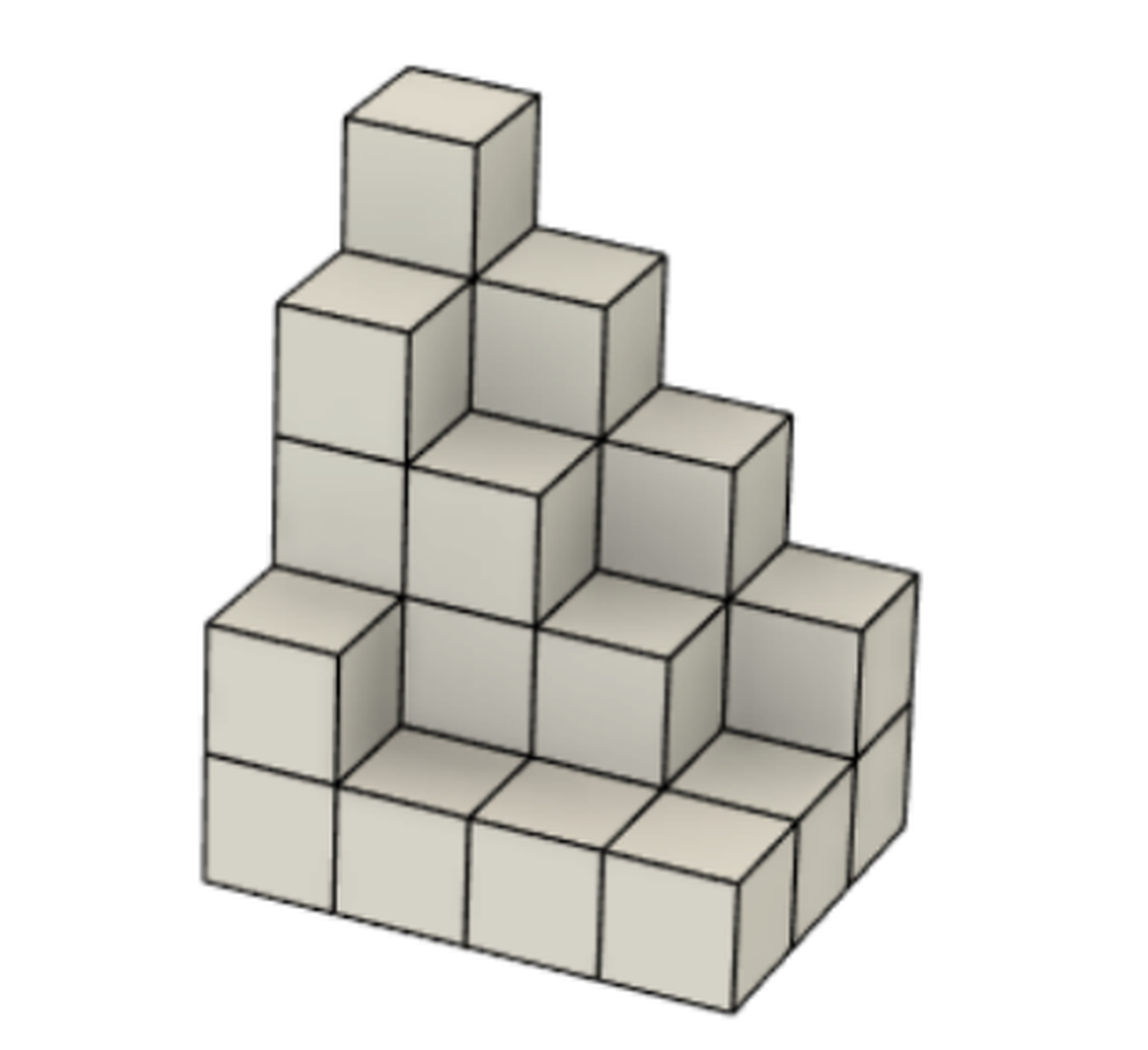
A second reference image shows the back view of the same structure.
Answer: B
Reading the column heights visible along the front and back boundary edges of the structure and reconstructing the height map over the footprint (filling interior columns consistently with the visible boundary heights, since no cubes are hidden at the bottom or middle), the total exposed surface area (top + bottom + all exterior walls) works out to 74 unit squares, matching option B.
15
ratios
easy
In Mrs. Smith's math class, the ratio between the number of boys and the number of girls is 4:6. If six more boys join her class, the ratio between boys and girls will be 1:1. How many students does Mrs. Smith have in her math class right now?
Answer: D
Let boys = 4k, girls = 6k.
(4k + 6)/(6k) = 1 → 4k + 6 = 6k → k = 3.
Boys = 12, girls = 18, total = 30.
Section B
Open-Ended Questions — 5 Questions
(+5)
16
number-theory
medium
Sam has a rectangular piece of paper that measures 24 inches by 60 inches. For a project, he needs to cut it into the least number of squares, without wasting anything. How many squares does he have after cutting the paper?
Answer: 10
To use the least number of squares without waste, use squares of side length GCD(24, 60) = 12 inches.
Number of squares = (24/12) × (60/12) = 2 × 5 = 10.
17
number-theory
medium
If UN + NU = PUP, where digits U, N, and P are different positive integers from 1 to 9. In other words, UN and NU are two-digit numbers, and PUP is a three-digit number. What is the value of (P×U×N)?
Answer: 18
UN + NU = (10U+N) + (10N+U) = 11(U+N) = PUP = 101P + 10U.
So 11U + 11N = 101P + 10U → U + 11N = 101P → U = 101P − 11N.
Trying P=1: U = 101 − 11N must be a digit 1-9, so 11N is between 92 and 100, giving N=9, U=2.
Check: UN=29, NU=92, sum=121=PUP with P=1,U=2. ✓
P×U×N = 1×2×9 = 18.
18
geometry
hard
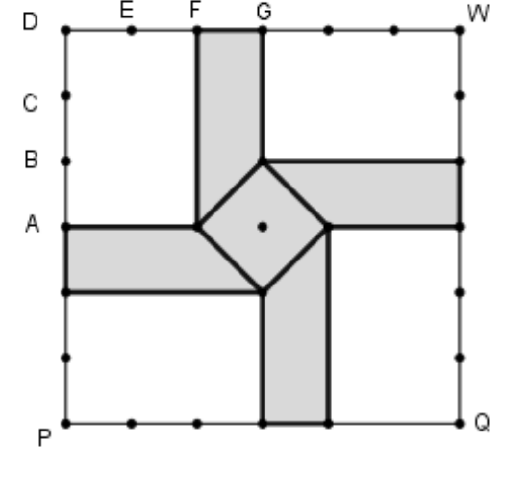
In the following figure, DPQW is a square, along which the distance between any two adjacent points is 1 cm away from each other. For example, AB = CD = DE = EF = FG =1 cm. All the horizontal and vertical segments are parallel to the respective sides of the square. A shaded region is defined within the square. Let s represent the area of the shaded region, and w represent the area of the rest of the square. What is w÷s?
Answer: 2.6
The square DPQW has side length 6 cm (7 grid points per side, 1 cm apart), so its total area is 36 cm².
The shaded region consists of a central square (rotated 45°, formed by connecting the midpoints of a 2×2 unit square) plus three 1-unit-wide rectangular arms extending from it to the top, left, and bottom edges of the square.
Measuring the shaded region directly from the grid gives a shaded area s = 10 cm², so the unshaded area is w = 36 − 10 = 26 cm².
w ÷ s = 26/10 = 2.6.
19
statistics
medium
The data set {13, 5, 9, 18, 43, x, 10, 7, 22, 15, 11, 19} has an unknown number x. The range of the data set is 40. What is the product of the least possible value and the greatest possible value of x?
Answer: 135
Without x, the data set has minimum 5 and maximum 43 (range 38).
For the range to become 40, x must either become the new minimum or the new maximum.
If x is the new minimum: 43 − x = 40 → x = 3 (valid, since 3 < 5).
If x is the new maximum: x − 5 = 40 → x = 45 (valid, since 45 > 43).
Least possible x = 3, greatest possible x = 45.
Product = 3 × 45 = 135.
20
rates
medium
Twelve blenders working at a constant rate can make 36 smoothies in 6 minutes. How many minutes would it take for 3 blenders to make 90 smoothies?
Answer: 60
Rate per blender = 36 / (12 × 6) = 0.5 smoothies per minute.
3 blenders make smoothies at 3 × 0.5 = 1.5 smoothies per minute.
Time for 90 smoothies = 90 / 1.5 = 60 minutes.
Section C
Open-Ended Questions — 5 Questions
(+6)
21
geometry
hard
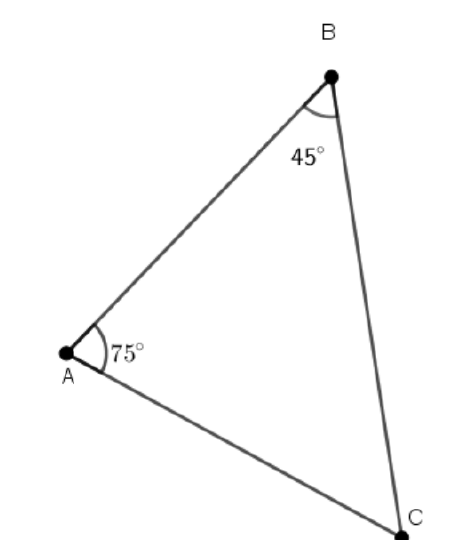
In triangle ABC shown below, m∠ABC = 45°, m∠BAC = 75°, and AC = 12 inches. What is the area of ΔABC in square inches? Please round off your answer to the nearest whole number. √3≈1.732 if it is needed.
Answer: 85
m∠BCA = 180° − 45° − 75° = 60°.
By the Law of Sines, AC/sin B = BC/sin A = AB/sin C, with AC = 12, sin B = sin45° ≈ 0.7071.
Common ratio k = 12/0.7071 ≈ 16.97.
BC = k·sinA = 16.97 × sin75° ≈ 16.97 × 0.9659 ≈ 16.39.
AB = k·sinC = 16.97 × sin60° ≈ 16.97 × 0.8660 ≈ 14.70.
Area = (1/2)·AB·BC·sin(∠ABC) = 0.5 × 14.70 × 16.39 × sin45° ≈ 0.5 × 14.70 × 16.39 × 0.7071 ≈ 85.2 ≈ 85.
22
probability
medium
Two friends, Adam and Bob, are playing a game by tossing three fair coins. If the three coins land with at least two heads up, Adam wins. If the three coins lands with exactly two tails up, Bob wins. Otherwise, there is not a winner. Let p represent the probability that neither Adam nor Bob wins the game. What is (1000p)?
Answer: 125
There are 8 equally likely outcomes for 3 coins.
Adam wins with at least 2 heads: HHH, HHT, HTH, THH (4 outcomes).
Bob wins with exactly 2 tails: HTT, THT, TTH (3 outcomes).
These two sets are disjoint, and the only remaining outcome is TTT (all tails), where neither wins.
p = 1/8 = 0.125.
1000p = 125.
23
averages
easy
Mr. Hagler and Mrs. Kelly both teach mathematics. Mr. Hagler has 20 students in his algebra class. Mrs. Kelly has 30 students in her algebra class. All the students in both classes took a test recently. Mr. Hagler's class scored an average of 70 points. Mrs. Kelly's class scored an average of 80 points. What is the average of the test scores for all the students in both classes?
Answer: 76
Total score = 20×70 + 30×80 = 1400 + 2400 = 3800.
Total students = 20 + 30 = 50.
Average = 3800/50 = 76.
24
coordinate-geometry
hard
In the Cartesian System, A = (1,3), and B = (6,2). A point P is to be chosen on the x-axis so that |AP| + |PB| has the shortest possible value. When |AP| + |PB| has the least distance, what is (|AP| + |PB|)²?
Answer: 50
Reflect A across the x-axis to get A' = (1, −3). The shortest path from A to the x-axis to B has length |A'B| (a straight line), since reflecting removes the bend at the x-axis.
|A'B| = √((6−1)² + (2−(−3))²) = √(25 + 25) = √50.
(|AP| + |PB|)² = (√50)² = 50.
25
geometry
hard
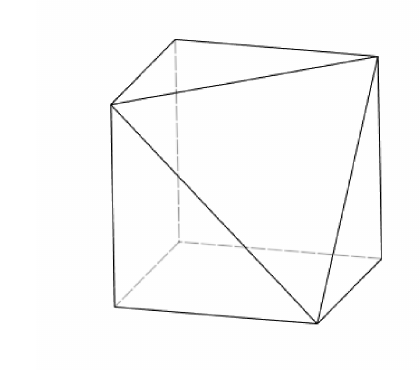
In the following figure, a cube has its top front corner removed using a plane containing three of its vertices. The cube has an edge length of 10 centimeters. What is the volume of the left over in cubic centimeters? Please round off your answer to a whole number. √2≈1.414 if it is needed.
Answer: 833
The cutting plane passes through three vertices adjacent to the removed corner, so the removed piece is a corner tetrahedron whose three mutually perpendicular edges each equal the cube's edge length, 10 cm.
Volume removed = (1/6) × 10 × 10 × 10 = 1000/6 ≈ 166.67 cm³.
Cube volume = 10³ = 1000 cm³.
Leftover volume = 1000 − 166.67 ≈ 833.33 ≈ 833.