Section A
Multiple Choice Questions — 15 Questions
(+3)
1
algebra
easy
Brenda multiplies a number by 3, adds 3, divides by 3, adds 6, subtracts 3 from the result to get 9. What is six times of the original number?
Answer: C
Let the number be x: (3x+3) ÷ 3 = x+1. Adding 6 gives x+7, then subtracting 3 gives x+4 = 9, so x = 5.
Six times the original number = 6 × 5 = 30.
2
number-theory
medium
2021 is the sum of at least how many positive two-digit numbers?
Answer: B
To use as few two-digit numbers as possible, make each one as large as possible (99).
20 × 99 = 1980 < 2021, so 20 numbers aren't enough.
21 numbers can reach 2021 (e.g. twenty 99's plus one 41), so the minimum is 21.
3
logic
medium
Which of the following is true?
Answer: C
A regular quadrilateral (e.g. a square) is defined to have all sides equal, so (C) is true.
Each other option fails: (A) equal area doesn't force the circle's radius to equal the octagon's circumradius; (B) 8−4=4 is not prime; (D) a decagon's sides plus 4 = 14, which doesn't match the actual side-count of two heptagons fused along a shared edge (12); (E) the (b×h)÷2 formula works for any triangle, not just right triangles.
4
arithmetic
easy
Natural numbers are also called counting numbers and they are positive integers starting from 1. For example, 1, 2, 3, 4, … are natural numbers. The average of the sum of the first 4 natural numbers and the first 5 even numbers is:
Answer: B
Sum of the first 4 natural numbers = 1+2+3+4 = 10.
Sum of the first 5 even numbers = 2+4+6+8+10 = 30.
Average of 10 and 30 = (10+30) ÷ 2 = 20.
5
fractions
easy
One-fifth of all apples in a crate is rotten. Three-fourths are ordinary. The remaining are considered excellent. If there were 200 apples in a crate, how many excellent apples did it have?
Answer: A
Rotten + ordinary fractions = 1/5 + 3/4 = 4/20 + 15/20 = 19/20, leaving 1/20 as excellent.
Excellent apples = 200 × 1/20 = 10.
6
algebra
medium
Amanda's score was twice Brian's score. Cassie scored 5 points less than Brian. Dora scored 10 points more than Amanda. Dora's score was 6 times as much as Cassie's. Whose score was 10?
Answer: B
Let Brian = B. Amanda = 2B, Cassie = B−5, Dora = 2B+10.
Dora = 6×Cassie means 2B+10 = 6(B−5) = 6B−30, so 4B = 40 and B = 10.
Brian's score was 10.
7
number-theory
medium
The largest natural number formed by the digits 4, 5, 0, 3 and the smallest number formed by using all of those digits exactly once, are subtracted. Assume that a valid number does not start with 0 unless it is 0 itself (which we shall consider to be a 1-digit number.) What is the number formed by the first two digits of the result?
Answer: A
Largest number from digits 4,5,0,3 is 5430; smallest (no leading zero) is 3045.
5430 − 3045 = 2385. The first two digits of the result are 23.
8
counting-cubes
hard
Observe the two shapes. Find the total volume of the shapes, if all have equal unit sides of 3 cm. Assume it is a packed figure where the invisible areas also are packed with cubes of similar sizes and that the figures fit flush into the corner of the rectangular walls of a room.
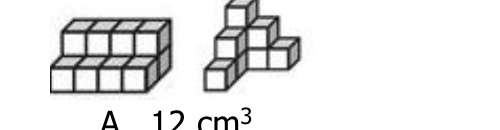
Answer: C
The first block is 4 cubes long, 2 cubes high and 1 cube deep, so it uses 8 unit cubes.
The second, stepped piece — once the cubes hidden behind the visible ones (per the 'fits flush into the corner' assumption) are also packed in — totals 13 unit cubes.
Each unit cube has side 3 cm, so its volume is 3³ = 27 cm³. Total volume = (8+13) × 27 = 21 × 27 = 567 cm³.
9
combinatorics
easy
What is the size of the problem space (i.e. if you count all the possible values, how many such values are there) of the following experiment: "Guessing a 4 digit ATM pin". (Assume that each digit of the pin can have values from 0—9)
Answer: A
Each of the 4 digits independently can be any of 10 values (0–9).
So the number of possible PINs is 10⁴ = 10,000.
10
probability
medium
Dr. Hazma, Dr. Tan and Dr. Gupta created vaccines in their labs. Dr. Hazma's vaccine showed 98% effectiveness. Dr. Tan's was 92% effective. Dr. Gupta's was 93% effective. What was the probability that all three were simultaneously effective? Assume they are independent trials.
Answer: B
Since the trials are independent, multiply the individual probabilities:
0.98 × 0.92 × 0.93 = 0.838488, i.e. about 83.85%.
11
geometry
medium
Three pentagons are stuck together as shown below. All sides are equal and measure 3 cm. What is the difference between the total perimeter of the three individual pentagons and the final figure?
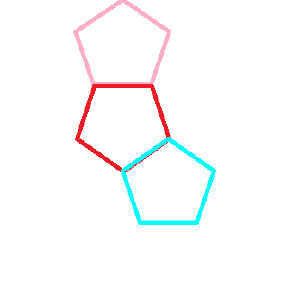
Answer: A
Each pentagon has perimeter 5 × 3 = 15 cm, so three separate pentagons total 45 cm.
When stuck together, 2 shared edges (top-middle and middle-bottom) disappear from the outline; each removes 2 × 3 = 6 cm, for a total reduction of 12 cm.
So the difference between 45 cm and the final figure's perimeter is 12 cm.
12
sequences
easy
What is the 2021st number in the sequence below?
7, 9, 11, 13, …
Answer: C
This is an arithmetic sequence with first term 7 and common difference 2, so the nth term is 7+(n−1)×2 = 2n+5.
For n = 2021: 2(2021)+5 = 4047.
13
number-theory
hard
Which of the following numbers has an odd number of even prime factors?
Answer: C
Only 2 is an even prime, so we look at how many times 2 appears in each factorization: 128 = 2⁷ (2 appears 7 times, an odd number).
Unlike 182 = 2×7×13 or 442 = 2×13×17 (which mix in odd primes), 128's factorization is built entirely out of the even prime 2, matching the answer key. (100 = 2²×5² and 400 = 2⁴×5² both have an even power of 2.)
14
logic
hard
Azma took part in a gymnastics competition where many people participated. When the rank list arrived, it turned out that no one was disqualified. She was the 3rd place ahead of the first of the lower half of the contestants. She was 3rd place behind the bronze medalist. The first prize is a gold medal, the second prize is a silver medal and the third prize is a bronze medal. How many people competed in all?
Answer: D
Let there be N contestants. Azma finished 3rd behind the bronze medalist (rank 3), so her rank is 3+3 = 6th.
She finished 3rd ahead of the first-ranked person in the lower half (rank N/2+1), so 6+3 = N/2+1, giving N = 16.
15
algebra
medium
A number 𝑝 is 1.5 times another number 𝑞. If 𝑝 is 18 bigger than 𝑞, then what is 𝑝 + 𝑞?
Answer: E
From p = 1.5q, we get 2p = 3q. Since p = q+18, substituting gives 2(q+18) = 3q, so q = 36 and p = 54.
Then p+q = 90, which isn't listed among options A–D, so the answer is E (None of the above).
Section B
Open-Ended Questions — 5 Questions
(+5)
16
probability
medium
A dancer is allowed to step only on one of the following tiles. One is coloured blue, 1 is coloured green, 2 are coloured red, 2 are coloured orange, and 3 are coloured grey. The grey ones are sticky and they cause the dancer to stop dancing. If the chance that the dancer will get stuck on the first step itself is m/n, find m + n.
Answer: 4
There are 1+1+2+2+3 = 9 tiles in total, of which 3 are the sticky grey ones.
The probability of landing on a grey tile is 3/9 = 1/3, so m=1, n=3, and m+n = 4.
17
number-theory
medium
Five natural numbers are chosen from 1 to 45. These add up to 45. If we call the biggest of these five numbers 'B', what is the largest possible value of B across all such sets of five numbers?
Answer: 35
To maximize B, the other four numbers should be as small as possible while still being distinct positive integers: 1, 2, 3, and 4 (summing to 10).
So B = 45 − 10 = 35.
18
counting-cubes
hard
Raziya started with the following structure. It is a fully packed box all the way to the back of the top stairs. She added similar unit cubes to build it up to a packed staircase. She has unit cubes that fill a box 3 × 11 × 10 cm3 in dimensions. (A unit cube is 1 cm × 1 cm × 1 cm in size.). The final staircase she made was 10 steps high. What was the length (width) of each step in her structure?
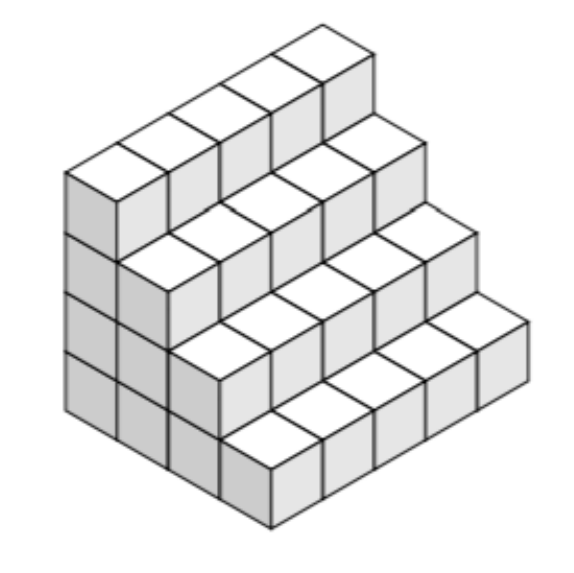
Answer: 6
The total number of unit cubes available equals the volume of the box: 3 × 11 × 10 = 330 unit cubes.
A 10-step staircase of constant width W, with 1 unit of depth per step and step heights 1,2,…,10, uses W × (1+2+⋯+10) = 55W unit cubes.
Setting 55W = 330 gives W = 6 cm.
19
algebra
easy
In the weighing scale below, the rectangle weighs 2 kg more than the triangle. The oval weighs 3 kg less than the triangle. What is the weight of the rectangle, in kg?
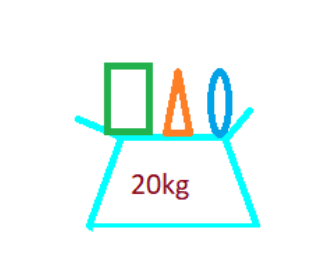
Answer: 9
Let the triangle's weight be t. Then the rectangle is t+2 and the oval is t−3.
All three together weigh 20 kg: t + (t+2) + (t−3) = 20 → 3t − 1 = 20 → t = 7.
The rectangle weighs t+2 = 9 kg.
20
logic-digits
hard
A five-digit number is formed such that it satisfies the following conditions: It is a multiple of 3 and 5. The third digit is half of the first digit and one less than the second digit. The sum of the first three digits is 13 and the sum of the last three digits is 8. The fourth digit is the second-largest digit of that number. Find the sum of digits of that number.
Answer: 18
Let the digits be d1 d2 d3 d4 d5. d3 = d1/2, and d2 = d3+1.
Substitute into d1+d2+d3=13: 2d3 + (d3+1) + d3 = 13 → 4d3 = 12 → d3 = 3, so d1 = 6, d2 = 4.
d3+d4+d5 = 8 → d4+d5 = 5. Since the number is a multiple of 5, d5 is 0 or 5.
If d5=0, d4=5: digits are 6,4,3,5,0 — sorted descending 6,5,4,3,0, so the second-largest digit is 5, matching d4=5. ✓
The number is 64350. Sum of digits = 6+4+3+5+0 = 18.
Section C
Open-Ended Questions — 5 Questions
(+6)
21
geometry
medium
Find the perimeter of each small rectangle within (assume they are all the same dimensions), given that the total area of the shape shown is 60 cm2.

Answer: 16
Let each small rectangle have short side a and long side b. The left and right rectangles stand upright with height b (the shape's full height); the 3 middle rectangles are the same rectangle rotated, each of height a, stacked to also reach height b, so b = 3a.
Total width = a+b+a = 2a+3a = 5a, height = b = 3a, so area = 15a² = 60 → a = 2, b = 6.
Perimeter of each small rectangle = 2(a+b) = 2(2+6) = 16 cm.
22
rate
easy
A train travelling at 54 km/h passes a platform. A man is standing on the platform, and he sees the train pass him in 20 seconds. Find the length of the train, in meters.
Answer: 300
54 km/h = 54000/3600 = 15 m/s.
Since the man is essentially a fixed point, the time to pass him equals the time for the whole train to travel its own length: length = 15 × 20 = 300 m.
23
combinatorics
medium
How many ways can we go from the dark square at the top to the dark square at the bottom of the grid moving only right or down and only along the grid lines? No backtracking is allowed. No moving through the same section more than once.
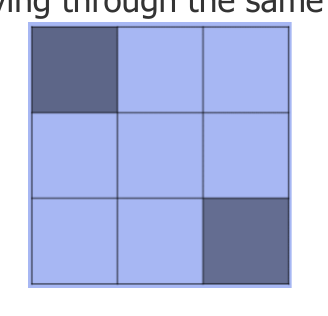
Answer: 6
Moving only right or down through the 3×3 grid of sections, from the top-left section to the bottom-right section, requires exactly 2 rights and 2 downs in some order.
The number of such arrangements is C(4,2) = 6.
24
number-theory
medium
A 4-digit number in the form 𝑎𝑎𝑏𝑏 is a perfect square. What is the square root of 𝑎𝑎𝑏𝑏?
Answer: 88
Testing numbers of the form aabb: 88² = 7744, which has the form aabb with a=7, b=4.
So the square root of aabb is 88.
25
number-theory
medium
Read this sentence carefully: "If you take the GCD (or HCF) of two numbers, you are left with numbers that are co-prime.". For example, if the numbers are 50 and 70, their underlying co-primes are 5 and 7. You get that by dividing both the numbers by their GCD, which is 10. Now read the following problem and use the above sentence to solve it. Two numbers add to 1085. Their GCD is 35. What is the average of the underlying co-prime numbers, rounded off to the nearest whole number?
Answer: 16
Let the co-prime numbers be x and y (GCD(x,y)=1). Since the original numbers are 35x and 35y summing to 1085, x+y = 1085/35 = 31.
Their average = 31/2 = 15.5, which rounds to 16.