Section A
Multiple Choice Questions — 15 Questions
(+3)
1
fractions
medium
There are three numbers, A, B, and C. B is one-third more than A, C is one-fourth less than B. Which of the following is true about A and C?
Answer: B
B is one-third more than A: B = A + (1/3)A = (4/3)A.
C is one-fourth less than B: C = B − (1/4)B = (3/4)B = (3/4)(4/3)A = A.
So C = A, meaning A is the same as C.
2
factors
easy
A bag of letter blocks is arranged into a rectangular shape that is 18 blocks long and 8 blocks wide. If they are all arranged into a square shape, what is the width of the square?
Answer: D
Total blocks = 18 × 8 = 144.
A square with area 144 has side length √144 = 12 blocks.
3
fractions
easy
Three-sevenths of a number is 60. What is two-fifths of the number?
Answer: C
(3/7) of the number = 60, so the number = 60 × (7/3) = 140.
(2/5) of 140 = 56.
4
patterns
medium
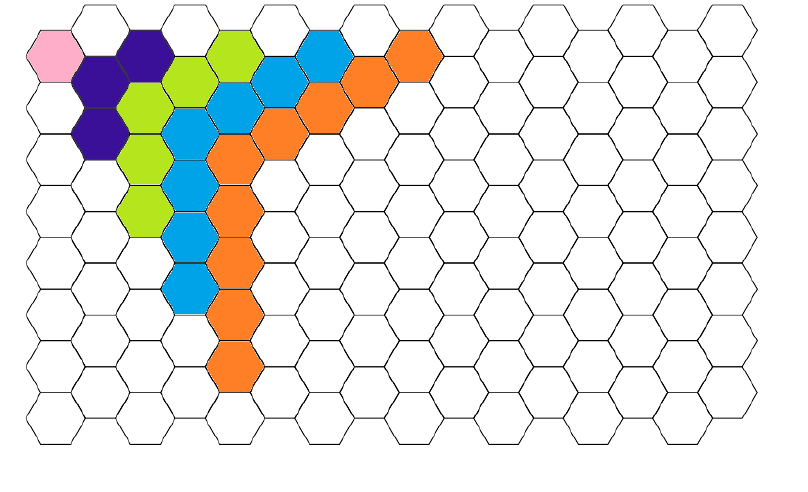
Harvey was coloring a growing pattern on a large sheet of paper with small hexagons. He started from the upper left corner with one hexagon and then three hexagons, and so on. He was able to complete five steps before taking a rest, as shown in the picture. If he is able to complete the sixth step, how many small hexagons will he have colored in total?
Answer: D
The number of hexagons colored at step n is 2n − 1 (the odd numbers 1, 3, 5, 7, 9, ...).
The total after 6 steps is the sum of the first 6 odd numbers, which is 6² = 36.
5
divisors
easy
What is the product of all the natural numbers that divide evenly into ten? (Natural numbers are whole numbers.)
Answer: A
The divisors of 10 are 1, 2, 5, 10.
Their product is 1 × 2 × 5 × 10 = 100.
6
counting-triangles
medium
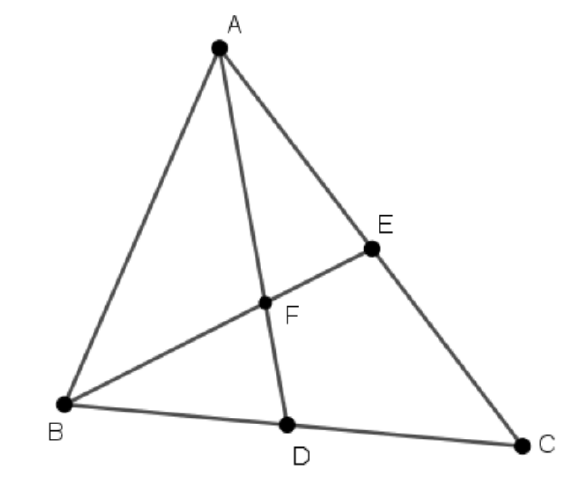
How many triangles, of all sizes, are there in the following figure?
Answer: C
Triangle ABC has cevian AD (A to a point D on BC) and cevian BE (B to a point E on AC), crossing at interior point F.
Using only the drawn segments (AB, BC, CA, AD, BE), the triangles are: ABC, ABD, ADC, ABE, BEC, ABF, AFE, BFD — 8 triangles in total.
7
counting
easy
Katie has five different shirts, six different skirts, and five different hats, and four different pairs of shoes. In how many ways can she dress herself if we do not include other things?
Answer: D
By the multiplication principle: 5 × 6 × 5 × 4 = 600.
8
percentage
medium
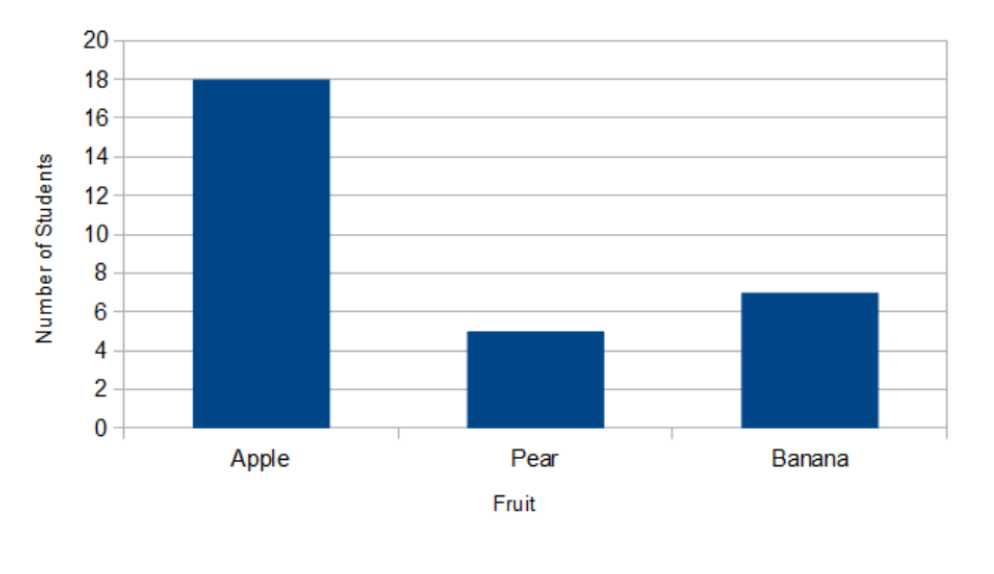
Jake did a short survey of his classmates about their favorite fruit and made the following chart. Everybody took his survey. What percent of his classmates like apples?
Answer: C
From the chart: 18 students like apples, 5 like pears, 7 like bananas, for a total of 18 + 5 + 7 = 30 students.
Percent who like apples = 18/30 = 60%.
9
counting
easy
Linda uses a passcode for her smartphone, which has four digits. Each digit is one of the 10 digits from {0, 1, 2, 3, 4, 5, 6, 7, 8, 9}. How many choices does she have for her passcode?
Answer: C
Each of the 4 digits has 10 possible choices, independently, so the total is 10 × 10 × 10 × 10 = 10⁴ = 10000.
10
average
medium
The average of three numbers is 16. When one of the numbers is changed to four, the average becomes ten. What is the original value of the changed number?
Answer: C
Original sum = 3 × 16 = 48. New sum = 3 × 10 = 30.
The sum decreased by 48 − 30 = 18 when the number was changed to 4, so the original number was 4 + 18 = 22.
11
linear-equations
easy
John says, "If you triple my age and then add five, you will get 38." What is John's age?
Answer: C
3x + 5 = 38 → 3x = 33 → x = 11.
12
fractions
medium
Matt has a small fish tank that has one gallon of water in it. It loses three-tenths of the water every month. Now Matt is out of town and cannot refill the tank. How many months does it take for the tank to lose more than one-half of its water? (A gallon is a unit of measurement of liquid capacity in the United States.)
Answer: B
Each month the tank loses three-tenths of the water still remaining.
After month 1: remaining = 1 × 0.7 = 0.7, so 0.3 gallon lost (30%, not yet over half).
After month 2: remaining = 0.7 × 0.7 = 0.49, so 0.51 gallon lost — this is more than half.
So it takes two months.
13
factors
easy
The product of two natural numbers is 65. We know that both numbers are greater than one. What is the sum of the two numbers?
Answer: D
65 = 5 × 13 is the only way to write 65 as a product of two factors both greater than 1.
Sum = 5 + 13 = 18.
14
digits
easy
Bill is playing with numbers. He uses all the three digits in {7, 2, 5} to make a three-digit number. What is the difference between the largest number and the smallest number he can make?
Answer: B
Largest number: 752. Smallest number: 257.
Difference = 752 − 257 = 495.
15
coordinate-geometry
easy
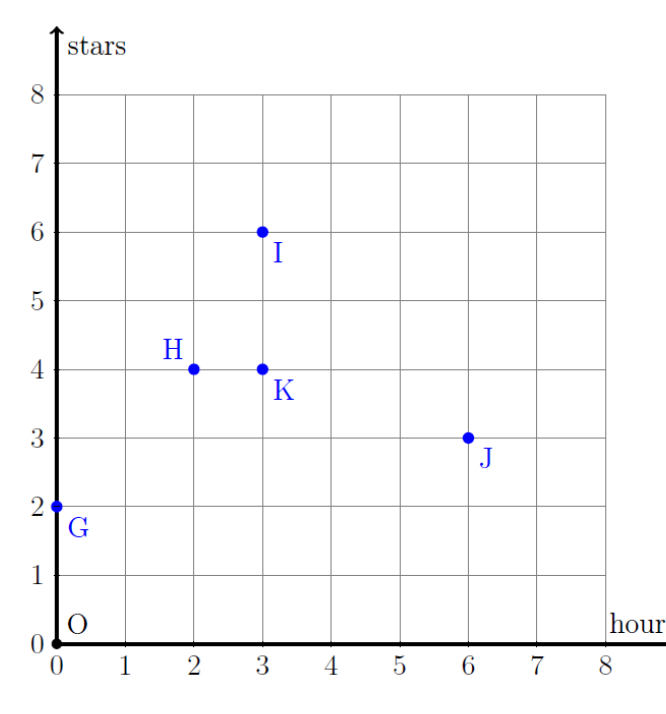
Hailey is making special paper stars for a school project. She can make 2 stars per hour. Which of the points in the following figure represents the number of stars Hailey made after three hours?
Answer: C
After three hours, Hailey has made 2 × 3 = 6 stars, corresponding to the point at (hours=3, stars=6), which is point I.
Section B
Open-Ended Questions — 5 Questions
(+5)
16
arithmetic-series
medium
What is the sum of all the whole numbers between 1 and 100 that are multiples of three?
Answer: 1683
The multiples of 3 from 1 to 100 are 3, 6, 9, ..., 99 — an arithmetic sequence with 33 terms.
Sum = 33 × (3 + 99)/2 = 33 × 51 = 1683.
17
fractions
easy
What is the sum of 7/2 + 7/3 + 7/6?
Answer: 7
7/2 + 7/3 + 7/6 = 7 × (1/2 + 1/3 + 1/6) = 7 × (3/6 + 2/6 + 1/6) = 7 × (6/6) = 7 × 1 = 7.
18
percentage
easy
For a special event, an online store reduced the price of a toy car by 25%, selling for $24. What was the original price of the toy car in dollars?
Answer: 32
After a 25% reduction, the price is 75% of the original.
0.75 × original = 24 → original = 24 / 0.75 = 32.
19
gear-ratios
medium
Two gears are turning at the same time in the figure shown below. At a certain time, the small gear has made 60 turns. How many turns has the big gear made at that time?

Answer: 40
The small gear has 6 teeth and the big gear has 9 teeth (counted from the figure).
Since the gears mesh, the number of teeth that pass the contact point must match: 60 × 6 = 360 teeth pass by.
Big gear turns = 360 / 9 = 40.
20
coordinate-geometry
easy
In the xy-plane, a turtle is currently at the point (2, −5). There is a worm at point (5, 6). The turtle can only move horizontally or vertically along the grid one step at a time. One step is one unit. How many steps does the turtle have to walk to get to the worm as soon as possible?
Answer: 14
The shortest grid (Manhattan) distance is |5 − 2| + |6 − (−5)| = 3 + 11 = 14 steps.
Section C
Open-Ended Questions — 5 Questions
(+6)
21
combinatorics
medium
A spider is currently at point A on a cube shown in the figure below. There is a bug at point G. The spider needs to get to the bug as soon as possible along the edges of the cube. In how many ways can the spider get to the bug?
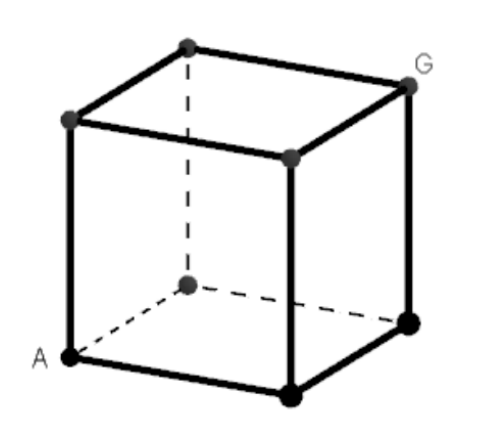
Answer: 6
A and G are opposite corners of the cube (connected by a space diagonal), so the shortest path along the edges is 3 edges long, one step in each of the 3 perpendicular directions.
The number of shortest paths is the number of orderings of these 3 directions: 3! = 6.
22
fractions
medium
Mary has a bag of colored marbles. She is told that one-fifth of the marbles are red, one-third are blue, and the rest are green. She found that there are 14 green marbles. How many red marbles are in the bag?
Answer: 6
Green fraction = 1 − 1/5 − 1/3 = 15/15 − 3/15 − 5/15 = 7/15.
Total marbles = 14 ÷ (7/15) = 14 × 15/7 = 30.
Red marbles = (1/5) × 30 = 6.
23
average
medium
The average of three different whole numbers is 14. The smallest is two less than the middle number; the largest is ten more than the smallest number. What is the largest number?
Answer: 20
Let the smallest number be s. Middle = s + 2, largest = s + 10.
Sum = s + (s + 2) + (s + 10) = 3s + 12 = 3 × 14 = 42 → 3s = 30 → s = 10.
Largest = 10 + 10 = 20.
24
number-theory
hard
Jason has a box of flower stickers. The number is between 10 and 40. When he counts by five, he has four left. When he counts by three, he has two left. How many flower stickers does Jason have in the box?
Answer: 29
The number satisfies n ≡ 4 (mod 5) and n ≡ 2 (mod 3). By the Chinese Remainder Theorem, n ≡ 14 (mod 15).
Within the range 10 to 40, the values satisfying this are 14 and 29 — the source problem is ambiguous between these two (see notes).
25
percentage
medium
A certain type of hand sanitizer can kill 50% of the germs after one use. It has the same power when used repeatedly. Let P be the percentage of the germs that will be killed after two applications. What is 100×P?
Answer: 7500
After the first use, 50% of germs are killed, leaving 50% alive.
The second use kills 50% of the remaining germs, i.e. another 25% of the original total, killed.
Total killed after two uses: 50% + 25% = 75%, so P = 75 and 100×P = 7500.