Section A
Multiple Choice Questions — 15 Questions
(+4)
1
algebra
easy
The cost of a shirt and a tie is $300. If the tie is cheaper than the shirt by $60, find the cost of the tie.
Answer: B
Let Shirt = Tie + 60, and Shirt + Tie = 300.
Substituting, (Tie + 60) + Tie = 300, so 2 × Tie = 240.
Tie = 240 ÷ 2 = $120.
2
arithmetic
medium
If all the numbers from 561 to 569 are added, what will be their sum?
Answer: C
Split every addend into 500 + 60 + (units digit):
561 + 562 + ... + 569 = (500 × 9) + (60 × 9) + (1 + 2 + ... + 9)
= 4500 + 540 + 55
= 5095.
3
algebra
medium
In a town of 10 905 residents, the number of male voters is more than the number of female voters by 2500. If 911 people are not allowed to vote, how many female voters are there?
Answer: D
Number of people who voted = 10905 − 911 = 9994.
Male voters = Female voters + 2500.
So, twice the female voters = 9994 − 2500 = 7494.
Female voters = 7494 ÷ 2 = 3747.
4
number-theory
medium
What is the largest 3-digit number which is divisible by 11 and 5?
Answer: D
Any number divisible by both 11 and 5 must be divisible by 11 × 5 = 55.
999 ÷ 55 = 18 remainder 9.
So, the largest 3-digit multiple of 55 is 55 × 18 = 990.
5
algebra
medium
If EAT + EAT + EAT = 444, what is E × A × T?
Answer: B
Since 3 × EAT = 444, EAT = 444 ÷ 3 = 148.
So, E = 1, A = 4, T = 8.
E × A × T = 1 × 4 × 8 = 32.
6
number-theory
medium
If the 5-digit number 83m24 is divisible by 3 and 4, what is the smallest possible value of m?
Answer: C
Since the last two digits, 24, are divisible by 4, the whole number 83m24 is divisible by 4 no matter what m is.
For divisibility by 3, the digit sum 8 + 3 + m + 2 + 4 = 17 + m must be a multiple of 3.
The closest multiple of 3 to 17 is 18, so m = 18 − 17 = 1.
7
patterns
medium
In the following pattern, what is the sum of A + B?
15, 17, 21, A, 35, 45, B, ...
Answer: A
The gaps between consecutive terms grow by +2, +4, +6, +8, +10, ...
So, the sequence continues as 15, 17, 21, 27, 35, 45, 57.
A = 27 and B = 57, so A + B = 27 + 57 = 84.
8
number-theory
hard
How many times does the digit 5 appear in a book that has 350 pages?
Answer: E
For every block of 100 pages, digit 5 appears 10 times in the ones place (5, 15, ..., 95) and 10 times in the tens place (50-59), so 20 times per 100 pages.
Pages 1-100, 101-200 and 201-300 each contribute 20 occurrences: 3 × 20 = 60.
On pages 301-350, digit 5 appears in 305, 315, 325, 335, 345 and 350, i.e. 6 times.
Total = 60 + 6 = 66.
9
arithmetic
easy
Find the sum of digits of the product of 5 × 8 × 15.
Answer: C
5 × 8 × 15 = 600.
Sum of digits = 6 + 0 + 0 = 6.
10
ratio
medium
Three fruit vendors make 3 fruit baskets in 3 minutes. How many fruit baskets will be ready if 10 fruit vendors work for 15 minutes?
Answer: D
3 vendors make 3 baskets in 3 minutes, so 1 vendor makes 1 basket in 3 minutes.
15 minutes is 5 lots of 3 minutes, so 1 vendor makes 5 baskets in 15 minutes.
10 vendors then make 10 × 5 = 50 baskets in 15 minutes.
11
fractions
hard
Anthony has to finish not more than 100 exercises of Math homework during his summer break. If he finished two-fifths in the first week and three-sevenths in the second week and a total of 12 exercises were left unfinished, how many exercises of Math homework were given to complete during the break?
Answer: D
2/5 + 3/7 = 14/35 + 15/35 = 29/35 of the exercises were completed, so the remaining 6/35 were left unfinished.
6/35 of the total = 12 exercises, so 1/35 of the total = 2 exercises.
Total exercises (35/35) = 2 × 35 = 70.
12
place-value
medium
What is the greatest number smaller than 425 and has the sum of the digits of 11?
Answer: D
Since the number must be smaller than 425, keep the hundreds digit as 4.
The last two digits then need to sum to 11 − 4 = 7, and should be as large as possible while staying below 25.
The greatest such pair is 1 and 6 (16), giving the number 416, whose digits sum to 4 + 1 + 6 = 11.
13
patterns
hard
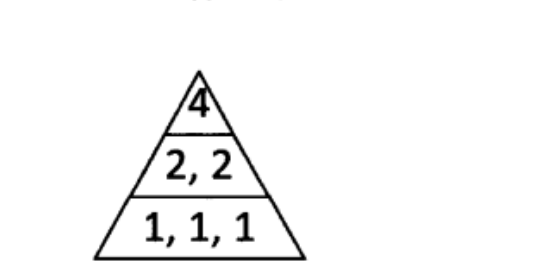
The pyramid below is made in such a way that at each layer, a number is the sum of two numbers exactly below it. For example, since there are three 1's at the lowest layer, there are two 2's directly above it and one 4 above the two 2's.
If the lowest layer has five 1s of a similar pyramid, what will be the sum of numbers on the topmost layer?
Answer: D
Building the layers upward from five 1's: 1,1,1,1,1 → 2,2,2,2 → 4,4,4 → 8,8 → 16.
The topmost layer has the single number 16.
14
geometry
medium
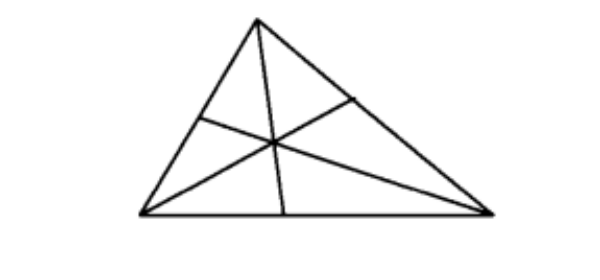
Count the number of triangles in the following figure.
Answer: A
Counting triangles made from a single region, from two regions together, from three regions together, and the whole outer triangle:
6 (single-region triangles) + 3 (two-region triangles) + 6 (three-region triangles) + 1 (the whole triangle) = 16.
15
fractions
medium
A box contains balls and bats. If three-sevenths of items are balls and there are 32 bats in the box, what is the total number of balls and bats in the box?
Answer: A
Since three-sevenths of the items are balls, the remaining four-sevenths must be bats.
Since there are 32 bats, the total = 32 ÷ 4 × 7 = 56.
Section B
Open-Ended (Integer) Questions — 10 Questions
(+5)
16
number-theory
medium
What is the greatest 3-digit multiple of 19 that is divisible by 3?
Answer: 969
999 ÷ 19 = 52 remainder 11, so the 3-digit multiples of 19 counting down from 999 − 11 = 988 are 988, 969, 950, ...
A number is divisible by 3 if its digit sum is divisible by 3. 9+8+8=25 is not divisible by 3, but 9+6+9=24 is.
Thus, 969 is the greatest 3-digit multiple of 19 that is also divisible by 3.
17
number-theory
hard
In a book of 100 pages, all the pages with digits that are factors of 5 are torn. How many pages are left now?
Answer: 62
Factors of 5 are 1 and 5.
Pages with 1 in the ones place: 1, 11, 21, ..., 91 — 10 pages.
Pages with 1 in the tens place: 10-19 — 10 pages.
Pages with 5 in the ones place: 5, 15, ..., 95 — 10 pages.
Pages with 5 in the tens place: 50-59 — 10 pages.
Page 11 and page 55 are each counted twice above, so the number of torn pages = 10+10+10+10 − 1 − 1 = 38.
Number of pages left = 100 − 38 = 62.
18
logic-puzzle
hard
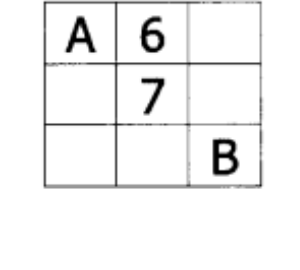
Fill the numbers 1 to 9 in the box above in such a way that:
• Sum of first row = sum of first column = 16
• Sum of second row = sum of second column = 15
• Sum of third row = sum of third column = 14
Then, find the value of A × B.
Answer: 72
The second column already has 6 and 7, and it must sum to 15, so the third entry in that column is 15 − 6 − 7 = 2.
For the first row to sum to 16 using distinct digits 1-9, the only way is A = 9 with the remaining cell being 1 (giving 9+6+1=16).
Filling in the rest so every row and column works out gives the grid:
Row 1: 9, 6, 1 (sum 16) Row 2: 3, 7, 5 (sum 15) Row 3: 4, 2, B (sum 14, so B = 8).
Checking columns: 9+3+4=16, 6+7+2=15, 1+5+8=14 — all correct.
A × B = 9 × 8 = 72.
19
arithmetic
medium
During a festival, 3500 chairs were required. If one batch has 85 chairs, how many batches of chairs need to be ordered?
Answer: 42
3500 ÷ 85 = 41 remainder 15.
Ordering only 41 batches would leave a shortage of 15 chairs, so a 42nd batch must be ordered.
Thus, 42 batches need to be ordered.
20
fractions
hard
On Monday, only five-sixths of the students were present in a class. All the absent students were girls. If two-thirds of the students present were boys and the number of girls who were present on Monday is 15, find the number of students in the class.
Answer: 54
Since two-thirds of the students present were boys, the remaining one-third of the students present were girls.
Since 15 girls were present, one-third of the present students is 15, so the number present = 15 × 3 = 45.
Since 45 is five-sixths of the total, the total number of students = 45 ÷ 5 × 6 = 54.
21
ratio
hard
Paul can fill a pit in 4 hours. The same pit is filled by Renny in 6 hours. If both of them work together, how many minutes will it take for them to fill the pit?
Answer: 144
The lowest common multiple of 4 and 6 is 12.
In 12 hours, Paul can fill the pit 12 ÷ 4 = 3 times, and Renny can fill it 12 ÷ 6 = 2 times.
Working together, they fill the pit 3 + 2 = 5 times in 12 hours, i.e. in 12 × 60 = 720 minutes.
So, they fill the pit once every 720 ÷ 5 = 144 minutes.
22
number-theory
hard
Robin thought of a five-digit number that begins with 8. Her number is the smallest such number that is divisible by 9. If all digits are different, find the last 4 digits in the number.
Answer: 127
A number is divisible by 9 when its digit sum is divisible by 9.
To make the smallest possible number starting with 8 with all different digits, try the next smallest digits for the following three places: 8, 0, 1, 2, giving a digit sum so far of 8+0+1+2=11.
The smallest multiple of 9 greater than 11 is 18, so the last digit must be 18 − 11 = 7 (which hasn't been used yet).
The number is 80127, so its last four digits are 0127.
23
number-theory
hard
Scott, Emily, and Jack chose a number. Emily claimed that the number was an even multiple of 13. Scott mentioned that the number was divisible by 35. Jack said that the number was 4-digit and the sum of the digits was 15. Find the number.
Answer: 5460
Since the number is even and a multiple of both 13 and 35, it must be divisible by the lowest common multiple of 2, 13 and 35, which is 910.
Listing 4-digit multiples of 910 and their digit sums: 910 (10), 1820 (11), 2730 (12), 3640 (13), 4550 (14), 5460 (15).
Only 5460 has a digit sum of 15, so the number is 5460.
24
time
hard
Yasmine set an alarm for every 4 hours. When the 12th alarm rang, the hour hand was on 7. What number on the clock did the hour hand point to when her first alarm rang?
Answer: 11
There are 12 − 1 = 11 intervals of 4 hours between the 1st and 12th alarms, so 11 × 4 = 44 hours passed.
44 ÷ 12 = 3 remainder 8, so the hour hand made 3 full turns plus an extra 8 hours by the time of the 12th alarm.
Working backwards 8 hours from 7 o'clock (the 12th alarm) gives 7 − 8 = −1, which is 11 on the clock.
So, the first alarm rang when the hour hand was on 11.
25
algebra
hard
Mangoes were bought and placed into baskets to be distributed in an orphanage. If each basket was filled with 13 mangoes, 54 mangoes were left. But when 16 mangoes were put in the baskets, there was a shortage of 27 mangoes. What is the total number of mangoes bought?
Answer: 405
Putting 13 mangoes per basket leaves an excess of 54 mangoes; putting 16 per basket creates a shortage of 27.
The total gap between these two scenarios is 54 + 27 = 81 mangoes, and each basket accounts for 16 − 13 = 3 of that gap.
So, there are 81 ÷ 3 = 27 baskets.
Total mangoes bought = 13 × 27 + 54 = 405.