Section A
Multiple Choice Questions — 15 Questions
(+4)
1
number-theory
easy
What is the greatest 3-digit number divisible by 5 and 11?
Answer: B
Any number divisible by both 5 and 11 must be divisible by 5 × 11 = 55.
The greatest 3-digit number is 999; 999 ÷ 55 = 18 remainder 10.
So the greatest 3-digit multiple of 55 is 55 × 18 = 990.
2
arithmetic
medium
Calculate: 450 × 3 + 450 × 17 − 45 × 190
Answer: A
Note that 45 × 190 = 450 × 19, so the expression becomes 450×3 + 450×17 − 450×19.
= 450 × (3 + 17 − 19) = 450 × 1 = 450.
3
calendar
hard
In a leap year, the number of Saturdays was 53. What is the greatest number of Tuesdays possible in such a year?
Answer: C
A leap year has 366 days = 52 weeks + 2 extra days.
Since there are 53 Saturdays, the 2 extra days must be Friday–Saturday or Saturday–Sunday.
Tuesday is not part of either possible pair, so Tuesday can occur at most 52 times.
4
fractions
medium
What is 1/2 of 2/3 of 6/9 of 549?
Answer: D
6/9 simplifies to 2/3, so the product is 1/2 × 2/3 × 2/3 × 549.
1/2 × 2/3 × 2/3 = 4/18 = 2/9.
549 × 2/9 = 122.
5
measurement
easy
The perimeter of a square is 124 cm. What is the area of the square in cm²?
Answer: D
Side of the square = perimeter ÷ 4 = 124 ÷ 4 = 31 cm.
Area = side × side = 31 × 31 = 961 cm².
6
division-remainder
easy
When 500 chairs were distributed equally in 18 rooms, 14 chairs were left over. How many chairs were distributed in each room?
Answer: C
500 − 14 = 486 chairs were actually shared evenly among the 18 rooms.
486 ÷ 18 = 27 chairs per room.
7
number-theory
medium
What is the greatest two-digit number to be added to 95 so that it is divisible by 3?
Answer: D
A number is divisible by 3 when the sum of its digits is divisible by 3.
Trying 99: digit sums 9+5=14 and 9+9=18, and 14+18=32 is not divisible by 3.
Trying 98: 14+17=31 is not divisible by 3.
Trying 97: 14+16=30 is divisible by 3.
So 97 is the greatest two-digit number that works.
8
algebra
medium
If A+B=28, B+C=40 and A+C=36, what is the sum of 5×A+5×B+5×C?
Answer: E
Adding all three equations: (A+B)+(B+C)+(A+C) = 28+40+36 = 104, which equals 2×(A+B+C).
So A+B+C = 104 ÷ 2 = 52.
5×A+5×B+5×C = 5×(A+B+C) = 5×52 = 260.
9
number-patterns
medium
Find the 10th term in the sequence below.
550, 490, 520, 460, 490, 430, ...
Answer: B
The sequence interleaves two series that each decrease by 30: the odd-position terms 550,520,490,460,430,... and the even-position terms 490,460,430,400,370,...
The 10th term is the 5th term of the even-position series: 490,460,430,400,370.
So the 10th term is 370.
10
logic-puzzle
medium
Four friends Kevin, Larry, Pam and Sam had 4 bags of 30, 32, 35 and 38 marbles. Sam had more marbles than Pam but did not have the greatest number of marbles. Kevin had the least number of marbles. Which two friends have a total of 70 marbles?
Answer: B
Kevin had the least marbles, so Kevin = 30.
Sam did not have the greatest number, so the largest bag (38) must belong to Larry, leaving Sam and Pam with 35 and 32.
Since Sam had more than Pam, Sam = 35 and Pam = 32.
Larry + Pam = 38 + 32 = 70 marbles.
11
algebra
medium
Charlie's age is half of the combined age of Suzy and Brad. Suzy is 4 years younger than Brad who is 10 years old. What is the sum of the ages of 3 of them?
Answer: B
Brad = 10, and Suzy = 10 − 4 = 6.
Brad + Suzy = 10 + 6 = 16, so Charlie = 16 ÷ 2 = 8.
Sum of Brad, Suzy and Charlie = 10 + 6 + 8 = 24.
12
rate-distance
medium
Josh left his house by car to go to his aunt's house which is 15 km away. He travelled 3 km in the first hour and then started driving at a speed of 2.5 km per hour. How far was he from his aunt's house 4 hours after he left his house?
Answer: C
In the first hour Josh travels 3 km, then for the remaining 3 hours he travels at 2.5 km/h, covering 3 × 2.5 = 7.5 km.
Total distance covered in 4 hours = 3 + 7.5 = 10.5 km.
Distance remaining to his aunt's house = 15 − 10.5 = 4.5 km.
13
counting-figures
hard
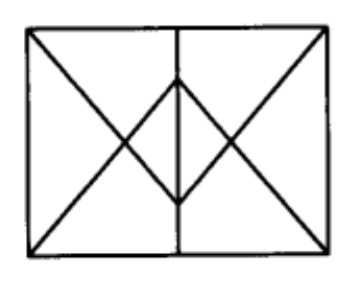
How many triangles are there in the figure below?
Answer: D
Counting by size: there are 4 smallest triangles (each made of 1 basic piece, one in each of the 4 positions around the two crossing points), 4 medium triangles (each made of 2 basic pieces, sharing the centre vertical line), and 2 large triangles (each made of 4 basic pieces, formed by the full top or bottom edge together with the two outer diagonals meeting at the opposite middle point).
4 + 4 + 2 = 10 triangles in total.
14
calendar
medium
Brian takes a day off from work every 4th day and David takes a day off on every 5th day. If they have a day off today and their next day off falls on a Monday, what day is today?
Answer: A
Brian and David are off together every LCM(4,5) = 20th day.
20 ÷ 7 = 2 weeks and 6 days.
If the day 20 days from today is a Monday, then 2 weeks before Monday is still Monday, and 6 days before Monday is Tuesday.
So today is Tuesday.
15
area-ratio
hard
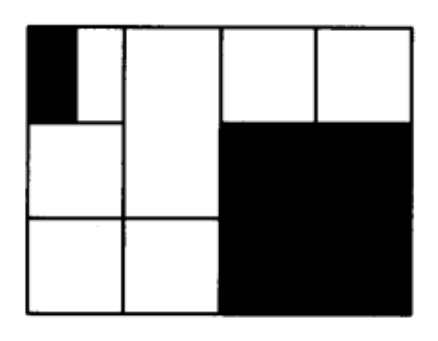
The large rectangle below is made of 6 squares and 3 rectangles. How many times is the largest square larger than the smallest rectangle?
Answer: B
The figure is built from a base unit square. The largest square (the shaded region) spans a 2×2 block of base units, so its area is 4 times the area of one base unit square.
The smallest rectangle shares the unit square's height but is only half its width, so its area is half of one base unit square.
The largest square is therefore 4 ÷ (1/2) = 8 times the size of the smallest rectangle.
Section B
Open-Ended (Integer) Questions — 10 Questions
(+5)
16
volume
medium
A small cube with a side of 6 units is inserted inside the big cube with a side of 8 units. Then some liquid is poured into the big cube. What is the volume (in cubic units) of the liquid poured in?

Answer: 296
Volume of the big cube = 8×8×8 = 512 cubic units.
Volume of the small cube = 6×6×6 = 216 cubic units.
Volume of liquid poured in = 512 − 216 = 296 cubic units.
17
number-patterns
medium
(A − 15) is an even number. What will be the 10th odd number after it when A = 21?
Answer: 25
When A = 21, A − 15 = 21 − 15 = 6.
Counting 10 odd numbers after 6: 7, 9, 11, 13, 15, 17, 19, 21, 23, 25.
The 10th odd number after 6 is 25.
18
algebra
medium
The weight of all mangoes in a cart was 3 kg after 10 mangoes were removed. The weight of all mangoes in the cart was 3400 grams if only 8 mangoes were removed. How many mangoes were there in the cart?
Answer: 25
If 10 mangoes were removed, the remaining mangoes weigh 3 kg = 3000 g; if only 8 were removed, the remaining mangoes weigh 3400 g.
The extra 2 mangoes kept in the second case account for 3400 − 3000 = 400 g, so each mango weighs 400 ÷ 2 = 200 g.
When 10 mangoes were removed, the 3000 g remaining is made up of 3000 ÷ 200 = 15 mangoes.
So the cart originally had 15 + 10 = 25 mangoes.
19
number-theory
hard
The product of k and 1260 is a square number. If k is a whole number, what is the least possible value of k?
Answer: 35
1260 = 2²×3²×5×7. For k×1260 to be a perfect square, every prime factor must appear an even number of times.
2 and 3 already appear an even number of times, but 5 and 7 each appear only once, so k must supply one more 5 and one more 7.
The least possible value is k = 5×7 = 35.
20
counting-intervals
easy
On a running track of 100 metres, a flag needs to be placed after every 4 metres, both ends included. How many flags are required?
Answer: 26
Flags are placed at both ends and every 4 m in between, giving 100 ÷ 4 = 25 equal intervals.
Since a flag stands at the boundary of every interval, including both the start and the end, the number of flags = 25 + 1 = 26.
21
patterns
medium
200 flowers were used to make a garland in this pattern, 4 red, 3 orange, 5 yellow, 4 red, 3 orange, 5 yellow and so on. What is the difference between the number of red and yellow flowers?
Answer: 13
Group the pattern into repeating sets of 4 red, 3 orange and 5 yellow — 12 flowers per set.
200 ÷ 12 = 16 full sets with 8 flowers left over.
The leftover 8 flowers continue the pattern: 4 red, 3 orange, 1 yellow.
Total red = 16×4 + 4 = 68; total yellow = 16×5 + 1 = 81.
Difference = 81 − 68 = 13.
22
algebra
medium
A boy sat for an exam that had 10 problems to be answered. He got 5 points if answered correctly and 2 points were deducted if answered wrongly or left unanswered. If his final score was 22, how many correct answers did he get?
Answer: 6
If all 10 problems were correct, the score would be 10×5 = 50, which is 50 − 22 = 28 more than his actual score.
Each wrong or blank answer costs 5 + 2 = 7 points compared to a correct one (the 5 points not earned plus the 2-point deduction).
Number of wrong/blank answers = 28 ÷ 7 = 4, so correct answers = 10 − 4 = 6.
23
algebra
hard
At a function, the valet charged $10 for a motorbike and $25 for a car. If there were a total of 150 vehicles and 360 tires, how much did the valet earn from only cars?
Answer: 750
If all 150 vehicles were motorbikes, there would be 150×2 = 300 tires, which is 360 − 300 = 60 fewer than the actual count.
Changing one motorbike to a car adds 4 − 2 = 2 tires, so 60 ÷ 2 = 30 of the vehicles must actually be cars.
Earnings from cars = 30 × $25 = $750.
24
measurement
hard
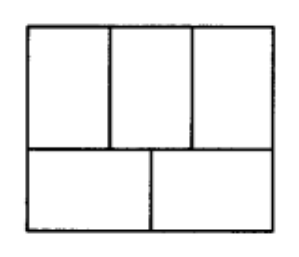
A large rectangle was divided into 5 identical rectangles. The small rectangle has a width of 8 cm. What is the perimeter of the large rectangle in cm?
Answer: 88
The 3 small rectangles across the top span the same width as the large rectangle, as do the 2 small rectangles across the bottom, so 3 widths of a small rectangle equal 2 lengths of a small rectangle.
Top width = 3×8 = 24 cm = 2×(length of small rectangle), so the length of the small rectangle = 24÷2 = 12 cm.
Height of the large rectangle = length + width of the small rectangle = 12 + 8 = 20 cm.
Perimeter of the large rectangle = 2×(24+20) = 2×44 = 88 cm.
25
combinatorics
hard
The keys to nine rooms are all mixed up in a box. What is the least number of times you must try the keys such that you match the correct key to its room lock?
Answer: 36
Once 8 of the 9 keys have been correctly matched to their locks, the 9th key must automatically fit the last lock, so it never needs to be tried.
In the worst case, matching the first lock could take up to 8 tries, the next lock up to 7 tries among the remaining keys, and so on down to 1 try for the second-last lock.
Least number of tries needed to guarantee matching all keys = 8+7+6+5+4+3+2+1 = 36.