Section A
Multiple Choice Questions — 15 Questions
(+3)
1
proportion
easy
Four kids can paint four balls in four minutes. If everyone works at the same speed, how many kids can paint 12 balls in 12 minutes?
Answer: A
4 kids painting 4 balls in 4 minutes means each kid paints 1 ball every 4 minutes.
In 12 minutes, each kid can paint 12 ÷ 4 = 3 balls.
To paint 12 balls, we need 12 ÷ 3 = 4 kids.
2
arithmetic
easy
Find the value of 25 × 48 + 32 × 25 + 25 × 20
Answer: C
Factor out 25: 25 × 48 + 25 × 32 + 25 × 20 = 25 × (48 + 32 + 20).
48 + 32 + 20 = 100.
25 × 100 = 2500.
3
number-theory
medium
How many natural numbers from 1 to 100 are not divisible by 5 or 7?
Answer: A
Multiples of 5 up to 100: 100 ÷ 5 = 20.
Multiples of 7 up to 100: ⌊100 ÷ 7⌋ = 14.
Multiples of 35 (both 5 and 7) up to 100: ⌊100 ÷ 35⌋ = 2.
Divisible by 5 or 7 = 20 + 14 − 2 = 32.
Not divisible by 5 or 7 = 100 − 32 = 68.
4
magic-square
medium
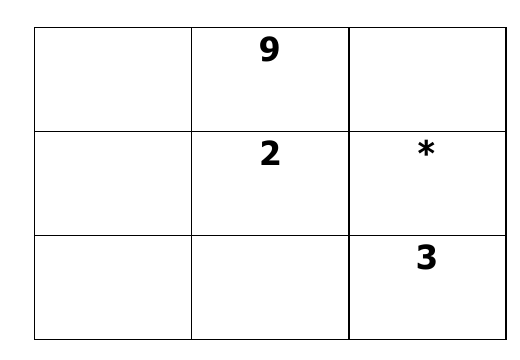
The following 3 × 3 grid is filled with numbers from 1 to 9. The numbers in all sides add up to 15 horizontally and vertically. Find the value of *.
Answer: D
Label the grid a b c / d e f / g h i, with b=9, e=2, f=*, i=3.
Column 2: b+e+h=15 → 9+2+h=15 → h=4. Row 3: g+h+i=15 → g+4+3=15 → g=8.
Used so far: 9,2,3,4,8. Remaining digits {1,5,6,7} go to a,c,d,f.
Row 1: a+c=6, so {a,c}={1,5} (only pair from the remaining set summing to 6).
That leaves {d,f}={6,7}. Column 1: a+d=7; taking a=1 gives d=6, c=5, f=7 (check: c+f=5+7=12=15−i ✓, d+f=6+7=13=15−e ✓).
So * = f = 7.
5
cryptarithm
medium
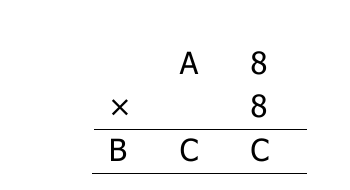
In the multiplication shown, A8 × 8 = BCC. Find the sum of A + B + C if different letters stand for different digits.
Answer: A
We need a two-digit number ending in 8, times 8, giving a three-digit number of the form BCC (last two digits equal).
68 × 8 = 544 → B = 5, C = 4, and A = 6. All three digits (6, 5, 4) are different.
A + B + C = 6 + 5 + 4 = 15.
6
number-theory
easy
What is the largest 3-digit number which is divisible by 24?
Answer: D
999 ÷ 24 = 41.625, so the largest multiple of 24 that is a 3-digit number uses 41.
41 × 24 = 984.
7
counting-squares
medium
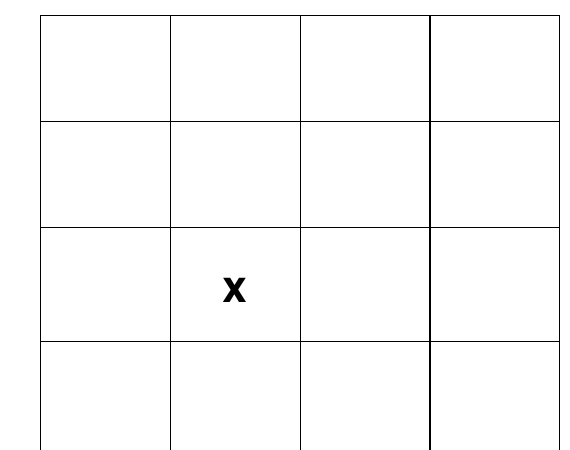
The following picture shows a 4 × 4 square. How many squares of any sizes are there comprised of the one marked with X?
Answer: D
Count squares of each size that contain the X cell:
• 1×1: just the X cell itself → 1
• 2×2: 4 such squares contain X
• 3×3: 4 such squares contain X
• 4×4: the whole grid → 1
Total = 1 + 4 + 4 + 1 = 10.
8
cryptarithm
medium
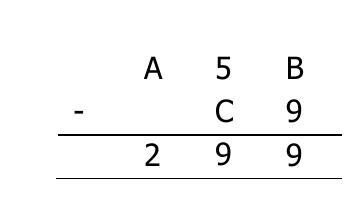
In the subtraction shown, A5B − C9 = 299. Find the value of A5B + C9.
Answer: B
Work the subtraction column by column, from the units:
Units: B − 9 needs a borrow, so B + 10 − 9 = 9 → B = 8 (borrow 1 from tens).
Tens: 5 − 1 (borrow) − C needs a borrow too: (5 − 1) + 10 − C = 9 → C = 5 (borrow 1 from hundreds).
Hundreds: A − 1 (borrow) = 2 → A = 3.
So A5B = 358 and C9 = 59. Check: 358 − 59 = 299 ✓.
A5B + C9 = 358 + 59 = 417.
9
fractions
medium
Sarah and Rose have few pencils. Two-fifths of Sarah's pencils and eight-ninths of Rose's pencils are both 40 each. Who has more pencils and by how much?
Answer: E
Sarah: (2/5) × S = 40 → S = 40 × 5 ÷ 2 = 100.
Rose: (8/9) × R = 40 → R = 40 × 9 ÷ 8 = 45.
Sarah has more, by 100 − 45 = 55.
10
pigeonhole
medium
There are 5 green, 9 orange, 6 red, and 4 blue candies in the bag. At least how many candies must Sam take to ensure he gets the first red candy?
Answer: A
In the worst case, Sam picks every non-red candy first: 5 green + 9 orange + 4 blue = 18 candies.
The very next candy must be red, so he needs 18 + 1 = 19 candies to guarantee a red one.
11
counting-cubes
hard
The following 4 × 4 × 4 cube is painted red on all its faces. Find the number of smaller cubes with at most two faces painted.
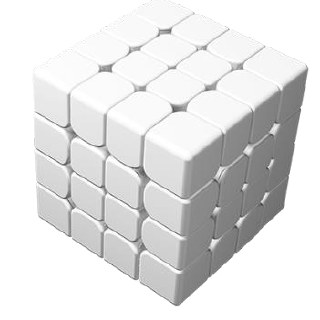
Answer: E
A 4×4×4 cube has 64 unit cubes. Only the 8 corner cubes have 3 faces painted.
So cubes with at most 2 faces painted = 64 − 8 = 56.
12
algebra
medium
The combined age of Ram and Shyam five years from now will be 37. Ram was twice as old as Shyam 3 years ago. How old is Ram now?
Answer: D
Let Ram = R, Shyam = S now. (R+5)+(S+5)=37 → R+S=27.
3 years ago: R−3 = 2(S−3) → R = 2S−3.
Substitute: (2S−3)+S=27 → 3S=30 → S=10, R=17.
13
logic-dice
medium
Two regular 6-sided dice were thrown on the ground. All the numbers visible on the dice were added. The sum of numbers on all the visible faces was 31. What is the difference between the numbers facing the ground?
Answer: B
Each die's six faces sum to 1+2+3+4+5+6=21, so two dice total 42.
Visible faces sum = 42 − (sum of the two faces touching the ground) = 31, so the two bottom faces sum to 11.
The only pair of numbers on a die (1-6) that sum to 11 is 5 and 6.
Difference = 6 − 5 = 1.
14
number-theory
medium
Ron and Vanda each thought of a two-digit number. The product of their digits was 24 and 35 respectively. The difference between their numbers was 37. What is the sum of their numbers?
Answer: C
Digit product 24 (Ron): possible numbers are 38, 83, 46, 64.
Digit product 35 (Vanda): possible numbers are 57, 75.
Check differences of 37 between a Ron-number and a Vanda-number: 75 − 38 = 37 ✓ (no other pair works).
So Ron = 38, Vanda = 75. Sum = 38 + 75 = 113.
15
counting-digits
medium
Ann read a book with 1000 pages. How many digits were used to print the page numbers on the book?
Answer: E
Pages 1-9: 9 pages × 1 digit = 9.
Pages 10-99: 90 pages × 2 digits = 180.
Pages 100-999: 900 pages × 3 digits = 2700.
Page 1000: 1 page × 4 digits = 4.
Total = 9 + 180 + 2700 + 4 = 2893.
Section B
Open-Ended Questions — 5 Questions
(+5)
16
algebra
medium
Sam filled up some boxes with sweets. If he put 5 sweets in each box, he was left with 4 extra sweets. If he put 6 sweets in each box, the last box would have only 2 sweets. Find the number of sweets Sam had.
Answer: 44
Let B be the number of boxes he used (the same boxes either way).
With 5 per box and 4 left over: total sweets N = 5B + 4.
With 6 per box, all but the last box full, and the last box has only 2: N = 6(B−1) + 2 = 6B − 4.
Set equal: 5B + 4 = 6B − 4 → B = 8.
N = 5(8) + 4 = 44.
17
algebra
easy
When the product of 9 and a number is divided by 4 and then multiplied by 25, the result is 19800. Find the number.
Answer: 352
Let the number be n. (9n ÷ 4) × 25 = 19800.
9n ÷ 4 = 19800 ÷ 25 = 792.
9n = 792 × 4 = 3168.
n = 3168 ÷ 9 = 352.
18
number-theory
easy
What is the largest possible value of 'm' in 653m2 such that it is divisible by 3?
Answer: 8
Digit sum of 653m2 = 6+5+3+m+2 = 16+m.
For divisibility by 3, 16+m must be a multiple of 3, so m ≡ 2 (mod 3).
Single digits satisfying this: 2, 5, 8. The largest is 8.
19
logic-digits
hard
A five-digit number is formed such that it satisfies the following conditions: It is a multiple of 3 and 5. The third digit is half of the first digit and one less than the second digit. The sum of the first three digits is 13 and the sum of the last three digits is 8. The fourth digit is the second-largest digit of that number. Find the sum of digits of that number.
Answer: 18
Let the digits be d1 d2 d3 d4 d5. d3 = d1/2, and d2 = d3+1.
Substitute into d1+d2+d3=13: 2d3 + (d3+1) + d3 = 13 → 4d3 = 12 → d3 = 3, so d1 = 6, d2 = 4.
d3+d4+d5 = 8 → d4+d5 = 5. Since the number is a multiple of 5, d5 is 0 or 5.
If d5=0, d4=5: digits are 6,4,3,5,0 — sorted descending 6,5,4,3,0, so the second-largest digit is 5, matching d4=5. ✓
If d5=5, d4=0: the second-largest digit would still be 5, but d4=0 doesn't match, so this case fails.
The number is 64350. Check: digit sum 6+4+3+5+0=18, divisible by 3 ✓; ends in 0, divisible by 5 ✓.
Sum of digits = 18.
20
sequences
medium
Find the sum of the numbers in the 12th group of the following sequence: (1, 4, 6), (2, 6, 10), (3, 8, 14), …
Answer: 88
In group n, the first number is n, the second is 2n+2, and the third is 4n+2 (checked against groups 1-3).
For n = 12: first = 12, second = 2(12)+2 = 26, third = 4(12)+2 = 50.
Sum = 12 + 26 + 50 = 88.
Section C
Open-Ended Questions — 5 Questions
(+6)
21
arithmetic
easy
16 trees are planted on one side of the road. Two cars are parked between every two trees. How many cars are there?
Answer: 30
16 trees create 16 − 1 = 15 gaps between consecutive trees.
Each gap has 2 cars, so total cars = 15 × 2 = 30.
22
measurement
medium
Ten small ropes of the same length were knotted together to form a big rope of 81 cm. If the knotted area was 1 cm for every rope, how long was each rope?
Answer: 9
Joining 10 ropes into one needs 9 knots, and each knot uses up 1 cm.
Total rope length used = 81 + 9 = 90 cm.
Each rope = 90 ÷ 10 = 9 cm.
23
number-theory
hard
Find the value of the digit at the ones place of the following expression: 99 × 101 × 103 × 105 × 107 − 100 × 102 × 104 × 106 × 108.
Answer: 5
The first product's units digit: 9×1×3×5×7 → ...×5 makes the running units digit 5 no matter what odd digit follows, so it ends in 5.
The second product includes a factor of 100, so it ends in 0.
Whichever number is larger, the units digit of their difference is |5 − 0| = 5 (a borrow from the tens place doesn't change this, since 5+10−0=15 still ends in 5).
So the ones digit is 5. (Note: since each factor on the right, 100-108, exceeds its counterpart on the left, 99-107, the exact value of the expression is actually negative — but the ones digit of its magnitude is still 5, matching the official key.)
24
logic-deduction
hard
Among Jack, Jade and James, one of them is a painter, the other is a lawyer and the third is a firefighter. Jack is older than the firefighter while the lawyer is younger than James. Also, Jade and lawyer are not the same age. Find who the firefighter is. (Put Jack=1, Jade=2 and James=3 in your answer)
Answer: 2
Jack is older than the firefighter, so Jack isn't the firefighter (can't be older than himself).
The lawyer is younger than James, so James isn't the lawyer. Jade isn't the same age as the lawyer, so Jade isn't the lawyer either.
So the lawyer must be Jack.
If James were the firefighter, then Jack (lawyer) would need to be both older than James (since Jack > firefighter) and younger than James (lawyer < James) — a contradiction.
So the firefighter is Jade, and James is the painter.
Using the given code (Jack=1, Jade=2, James=3), the firefighter Jade = 2.
25
averages
easy
Patrick scored 82 and 85 marks respectively in English and Science. If the total marks of these papers are 100, how many marks should he score in Mathematics so that his average marks in these three subjects becomes 87?
Answer: 94
For an average of 87 across 3 subjects, the total must be 87 × 3 = 261.
Mathematics score = 261 − 82 − 85 = 261 − 167 = 94.