Section A
Multiple Choice Questions — 15 Questions
(+3)
1
days-of-week
easy
If it was Monday yesterday, what day of the week will it be in 100 days?
Answer: D
If yesterday was Monday, today is Tuesday.
100 ÷ 7 = 14 remainder 2, so 100 days from today lands 2 days after Tuesday.
Tuesday + 2 days = Thursday.
2
book-pages
easy
A book is open, showing two pages with page numbers. If the sum of the two page numbers is 167, what is the page number of the next page?
Answer: C
Facing pages are consecutive numbers n and n+1, so n + (n+1) = 167 → 2n = 166 → n = 83.
The two pages are 83 and 84, so the next page after 84 is 85.
3
linear-equations
medium
At a local store, there is no tax for school supplies. Matt paid 90 cents for three pencils and two erasers. Nancy paid 35 cents for one pencil and one eraser of the same types. How much does a pencil cost?
Answer: D
Let p = pencil price, e = eraser price. 3p + 2e = 90, and p + e = 35 → e = 35 − p.
Substitute: 3p + 2(35 − p) = 90 → 3p + 70 − 2p = 90 → p = 20 cents.
4
money
medium
Alice made two purchases at the farmer's market. First, she used a 10-dollar bill to buy a watermelon and received $4 in change. Then, she used a 20-dollar bill for some apples and received $7 in change. She still had $17 left after these two purchases. How much money did she have at the beginning?
Answer: B
The watermelon cost 10 − 4 = $6, and the apples cost 20 − 7 = $13.
Total spent = 6 + 13 = $19. Since $17 was left after spending $19, she started with 19 + 17 = $36.
5
coordinate-geometry
medium
In the following figure, each dot is one inch away from its horizontal and vertical neighbors. What is the area of the quadrilateral in square inches?

Answer: C
Placing the dot grid on coordinates, the quadrilateral's vertices are (2,0), (4,2), (3,4), (0,2) (top, right, bottom, left).
Using the shoelace formula: Area = ½|x_A(y_B−y_D) + x_B(y_C−y_A) + x_C(y_D−y_B) + x_D(y_A−y_C)| = ½|2(2−2) + 4(4−0) + 3(2−2) + 0(0−4)| = ½|16| = 8 square inches.
6
work-rate
medium
If two workers can paint a house in 2 days, how many houses can 12 workers paint in 12 days under the same conditions?
Answer: C
2 workers × 2 days = 4 worker-days to paint 1 house.
12 workers × 12 days = 144 worker-days.
144 ÷ 4 = 36 houses.
7
fractions
medium
Oliver bought a new book of 240 pages. He read 1/5 of the book yesterday and 1/4 of the remaining pages today. How many pages of the book are there left to be read?
Answer: C
Yesterday: 1/5 × 240 = 48 pages read, leaving 240 − 48 = 192 pages.
Today: 1/4 × 192 = 48 pages read, leaving 192 − 48 = 144 pages.
8
geometry-perimeter
medium
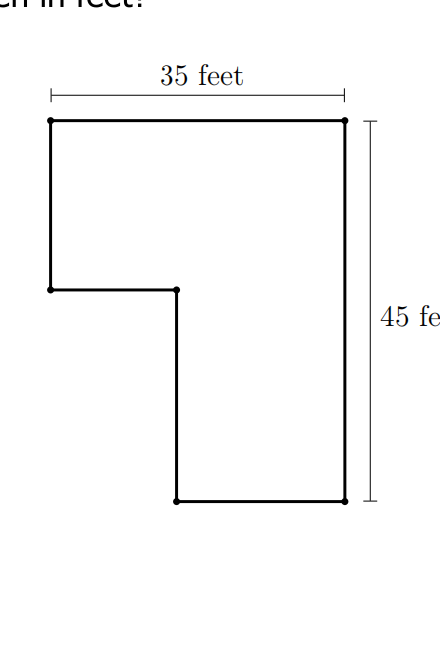
A garden is marked out in the school yard, as shown in the picture below. What is the perimeter of the garden in feet?
Answer: E
This is a staircase shape cut from the top-left corner of a 35 ft × 45 ft rectangle. For such a staircase, all horizontal segments together still total the original width (35 ft), and all vertical segments together still total the original height (45 ft).
Perimeter = 2 × (35 + 45) = 160 feet.
9
coin-problems
medium
Emily has some coins in her pocket. There are only quarters and dimes. The number of the quarters is 6 more than the number of the dimes. Each quarter is worth 25 cents; each dime is worth 10 cents. The total value of coins is 290 cents. How many quarters does Emily have?
Answer: D
Let d = dimes, so quarters = d + 6.
25(d + 6) + 10d = 290 → 25d + 150 + 10d = 290 → 35d = 140 → d = 4.
Quarters = 4 + 6 = 10.
10
average
medium
The average weight of a group of four children is 50 pounds. A fifth child joins the group. The average weight of the group becomes 53 pounds. How heavy is the fifth child?
Answer: E
Total weight of 4 children = 4 × 50 = 200 pounds.
Total weight of 5 children = 5 × 53 = 265 pounds.
Fifth child's weight = 265 − 200 = 65 pounds.
11
logic-sequences
hard
There are 205 marbles in the box. Andrew, Blake, Carter, and David take turns to remove marbles from the box. Andrew first takes 1 marble, Blake takes 2 marbles, Carter takes 3 marbles, and David takes 4 marbles. Then, Andrew takes another 1, Blake another 2, Carter another 3, and David another 4. They will continue until all the marbles are taken. Who will take the last marble from the box?
Answer: C
Each full round removes 1+2+3+4 = 10 marbles. 205 ÷ 10 = 20 full rounds (200 marbles), leaving 5 marbles.
In the next round: Andrew takes 1 (4 left), Blake takes 2 (2 left), Carter's turn is to take 3 but only 2 remain, so Carter takes the last 2 marbles, ending the game.
12
linear-equations
medium
Eight children are each riding a bicycle or tricycle in the park. John counts 19 wheels altogether. How many bicycles are there?
Answer: D
Let b = bicycles, t = tricycles. b + t = 8, and 2b + 3t = 19.
From the first equation, t = 8 − b. Substituting: 2b + 3(8 − b) = 19 → 2b + 24 − 3b = 19 → −b = −5 → b = 5.
13
counting-triangles
medium
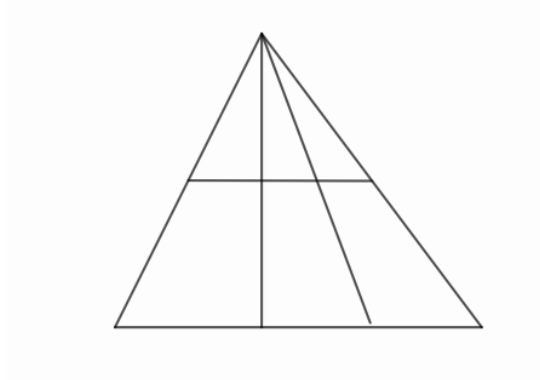
How many triangles can you identify in the following figure?
Answer: B
From the apex, four lines (the two sides plus two cevians) reach the base, splitting it into 3 segments — any 2 of these 4 lines with the base between them forms a triangle: C(4,2) = 6 triangles.
A horizontal segment crosses the left side, the vertical cevian, and the second cevian at three points; using the apex with any 2 of those 3 points gives C(3,2) = 3 more (smaller) triangles.
Total = 6 + 3 = 9 triangles.
14
combinatorics
hard
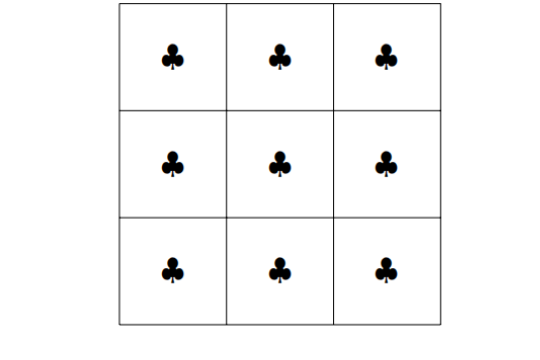
Michael has 9 stickers on a three-by-three grid. He wants to give his friend 3 stickers that are connected on at least one edge. In how many different ways can he cut out the three stickers?
Answer: D
Straight (I-shaped) trominoes: each of the 3 rows and each of the 3 columns gives exactly one, for 3 + 3 = 6.
L-shaped trominoes: each 2×2 block of the grid yields 4 L-trominoes (one for each of the 4 corners left out). There are 2×2 = 4 such blocks, giving 4 × 4 = 16.
Total = 6 + 16 = 22.
15
arithmetic
easy
What is the value of the following expression?
11 − 13 + 15 − 17 + 19 − 21 + 23 − 25 + 27 − 29 + 31
Answer: D
Grouping in pairs: (11−13) + (15−17) + (19−21) + (23−25) + (27−29) + 31 = (−2) + (−2) + (−2) + (−2) + (−2) + 31 = −10 + 31 = 21.
Section B
Open-Ended Questions — 5 Questions
(+5)
16
geometry-perimeter
medium
If the length of a rectangle is increased by 2 cm, its area increases by 14 cm². If its width is increased by 3 cm, the area increases by 24 cm², what is the perimeter of the rectangle?
Answer: 30
Increasing the length by 2 cm adds a strip of area 2 × width = 14, so width = 7 cm.
Increasing the width by 3 cm adds a strip of area 3 × length = 24, so length = 8 cm.
Perimeter = 2 × (8 + 7) = 30 cm.
17
linear-equations
medium
The sum of three integers A, B, C is 115. If A is 3 times as big as B, and C is greater than B by 15. What is the value of the number B?
Answer: 20
A = 3B, C = B + 15. Sum: 3B + B + (B + 15) = 115 → 5B + 15 = 115 → 5B = 100 → B = 20.
18
weight
medium
Jenny fills a glass with water. The glass with the water weighs 750 grams. If she pours out half of the water, then the glass with the remaining water weighs 400 grams. How heavy is the glass itself in grams?
Answer: 50
Let glass = g, water = w. g + w = 750, and g + w/2 = 400.
Subtracting: (g+w) − (g+w/2) = 750 − 400 → w/2 = 350 → w = 700.
So g = 750 − 700 = 50 grams.
19
digits
hard
A number has 4 digits. The number can be divided evenly by 5. The digit in the hundred's place is 4 times the digit in the ten's place. And the sum of all the digits is 21. What is value of the number?
Answer: 6825
Let the digits be a (thousands), b (hundreds), c (tens), d (units), with b = 4c and d = 0 or 5 (divisible by 5).
Since b ≤ 9, c can only be 0, 1, or 2, giving b = 0, 4, or 8.
Testing c=2, b=8: a + 8 + 2 + d = 21 → a + d = 11. With d=5, a=6 (valid digit). This gives 6825.
Check: hundreds digit 8 = 4 × tens digit 2 ✓; ends in 5 (divisible by 5) ✓; digit sum 6+8+2+5=21 ✓.
20
patterns
hard
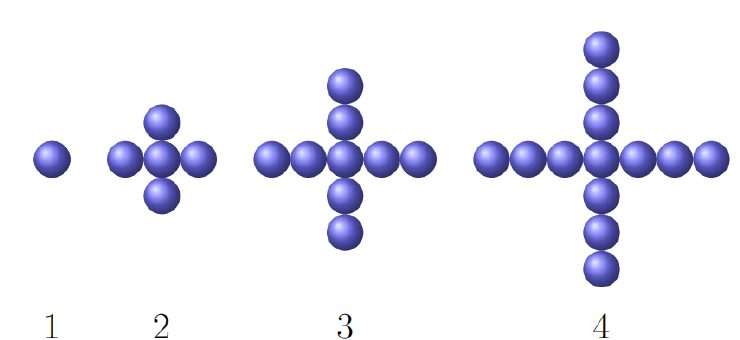
Maria was making a sequence of growing patterns with marbles. She started with one marble in the first step. Then, she moved on to five marbles in the second step, and nine marbles in the third step. Using all her marbles, she was able to finish the ninth step. How many marbles did she have in total?
Answer: 153
The number of marbles in step n follows 1, 5, 9, ... — an arithmetic sequence with common difference 4, so step n = 4n − 3.
Total marbles for steps 1 through 9 = Σ(4n−3) for n=1 to 9 = 4×(1+2+...+9) − 3×9 = 4×45 − 27 = 180 − 27 = 153.
Section C
Open-Ended Questions — 5 Questions
(+6)
21
digits
hard
The first and last digit of an 8-digit number is shown in the following figure. If the sum of any three adjacent (or neighboring) digits is 17. What is the sum of all the digits of the number?

Answer: 48
Since every 3 consecutive digits sum to 17, comparing digit i+1..i+3 with digit i..i+2 shows digit(i+3) = digit(i) — the digits repeat with period 3.
So d1=d4=d7=8 (given first digit), and d2=d5=d8=6 (given last digit). Then d1+d2+d3=17 → 8+6+d3=17 → d3=3, so d3=d6=3.
Digits: 8,6,3,8,6,3,8,6. Sum = 8×3 + 6×3 + 3×2 = 24+18+6 = 48.
22
cryptarithm
hard
In the following multiplication problem, each letter represents a different digit from {0, 1, 2, 3, 4, 5, 6, 7, 8, 9}. What four-digit number is represented by STEP?
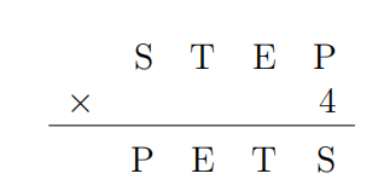
STEP × 4 = PETS
Answer: 2178
Since STEP's units digit is P and PETS's units digit is S, 4×P must end in S; since 4×P is always even, S is even.
Because 4×STEP must still be a 4-digit number, STEP < 2500, and since PETS starts with P (the thousands digit of a number near 8000-9996), S must be small: S=2 works, forcing STEP between 2000-2499 and PETS between 8000-9996, so P is 8 or 9.
From 4×P ending in 2: P=3 or P=8; combined with P∈{8,9}, P=8.
So STEP = 2 T E 8 and PETS = 8 E T 2. Expanding 4×(2000+100T+10E+8) = 8000+100E+10T+2 gives 390T + 30 = 60E → 13T + 1 = 2E. Testing T=1 gives E=7 (a valid digit).
STEP = 2178. Check: 2178 × 4 = 8712 = PETS ✓.
23
number-theory
medium
Kevin has a collection of toy cars. The number is between 50 and 80. If he groups the toy cars by four, there will be one car left. If he groups the cars by nine, there is also one car left. How many toy cars does Kevin have?
Answer: 73
The number minus 1 must be divisible by both 4 and 9, i.e. by 36. Within 49-79 (since the number is 50-80), the only multiple of 36 is 72.
So the number = 72 + 1 = 73. Check: 73 ÷ 4 = 18 remainder 1; 73 ÷ 9 = 8 remainder 1.
24
logic-grid
hard
Four numbers {1, 2, 3, 4} are placed in the following table so that each row, column, and diagonal contains each of the four numbers exactly once. What is the number in the square marked by ★?
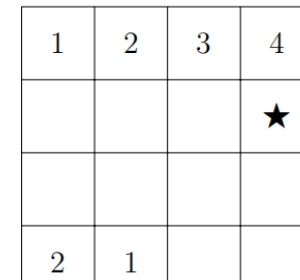
Answer: 2
Working from row 1 (1,2,3,4) and row 4 (2,1,?,?), and using the column and diagonal constraints step by step: row 4's remaining cells must be {3,4}; column 4 (already containing 4) forces its own remaining cells to {1,2,3}, pinning cell (4,4)=3 and therefore (4,3)=4.
The main diagonal (1,?,?,3) needs {2,4} in the middle; combined with column 2 needing {3,4} in rows 2-3, cell (2,2)=4 and (3,2)=3.
Continuing this deduction through column 1 and row 3 pins (3,1)=4, (3,4)=1, and finally the ★ cell at (row 2, column 4) = 2.
25
geometry-perimeter
medium
In the following figure, all the segments cross each other at right angles. What is the perimeter of the following figure in cm?
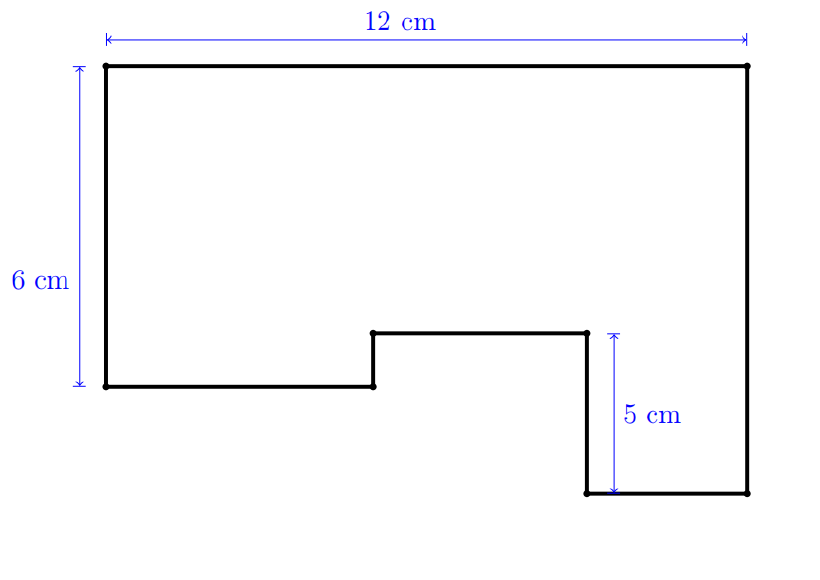
Answer: 46
This is a staircase shape cut from the bottom-right corner of a 12 cm × 11 cm rectangle, where the total height (11 cm) is the left profile's 6 cm plus the lower segment's 5 cm.
For such a staircase, all horizontal segments together still total the width (12 cm), and all vertical segments together still total the height (11 cm).
Perimeter = 2 × (12 + 11) = 46 cm.