Section A
MCQs — 15 Questions
(+2 / -1)
1
arithmetic
easy
What is the value of the following sum?
94 + 81 + 73 + 60 + 52 + 46 + 39 + 27 + 18
Answer: B
Add step by step (or pair terms):
94+81=175, +73=248, +60=308, +52=360, +46=406, +39=445, +27=472, +18=490.
The total is 490.
2
spatial-reasoning
medium
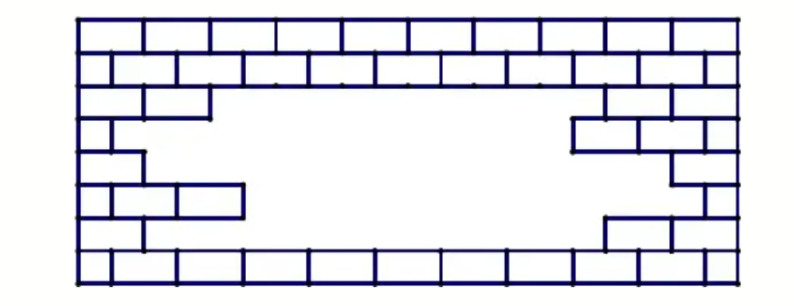
How many bricks are needed to fix the wall below?
(The figure shows a rectangular brick wall with its top row, bottom row and both side columns complete, but a large hole with a jagged/staircase edge in the middle. Count the empty brick spaces that must be filled.)
Answer: B
Counting the empty brick cells in the jagged hole of the wall diagram gives 35 missing bricks.
3
number-patterns
easy
What is the next number in the sequence below?
1, 2, 5, 14, 41, 122, …
Answer: A
Each term is the previous term × 3, minus 1:
1×3−1=2, 2×3−1=5, 5×3−1=14, 14×3−1=41, 41×3−1=122.
Next: 122×3−1 = 366−1 = 365.
4
spatial-reasoning
hard
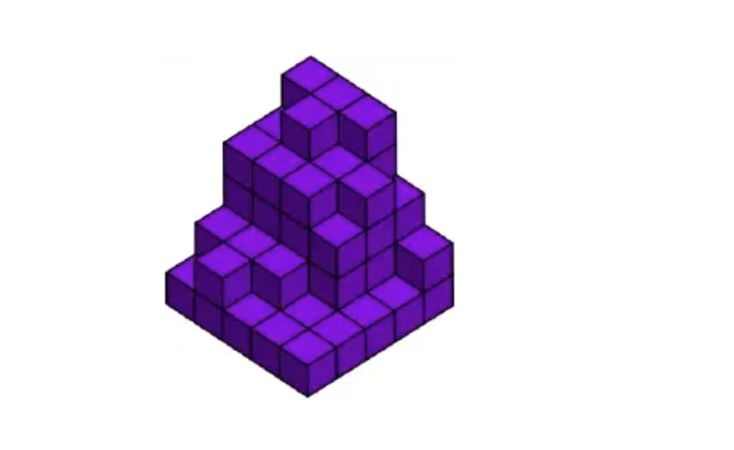
The diagram shows some cubes of the same size stacked at a corner of a room. How many cubes are there altogether? (Note: the floor is horizontal and the two walls are vertical. There are no gaps or holes behind the visible cubes.)
Answer: C
Counting the stacked cubes layer by layer (including the hidden cubes implied behind each visible column at the corner of the room) gives 68 cubes altogether.
5
number-theory
easy
Which of the given numbers of pencils can be evenly arranged into groups of 6 without any remaining?
Answer: D
A number is divisible by 6 if it is divisible by both 2 and 3.
94: digit sum 13 → not divisible by 3.
166: digit sum 13 → not divisible by 3.
712: digit sum 10 → not divisible by 3.
1956: even, and digit sum 1+9+5+6=21 → divisible by 3, so divisible by 6 (1956 ÷ 6 = 326).
6
data-handling
medium
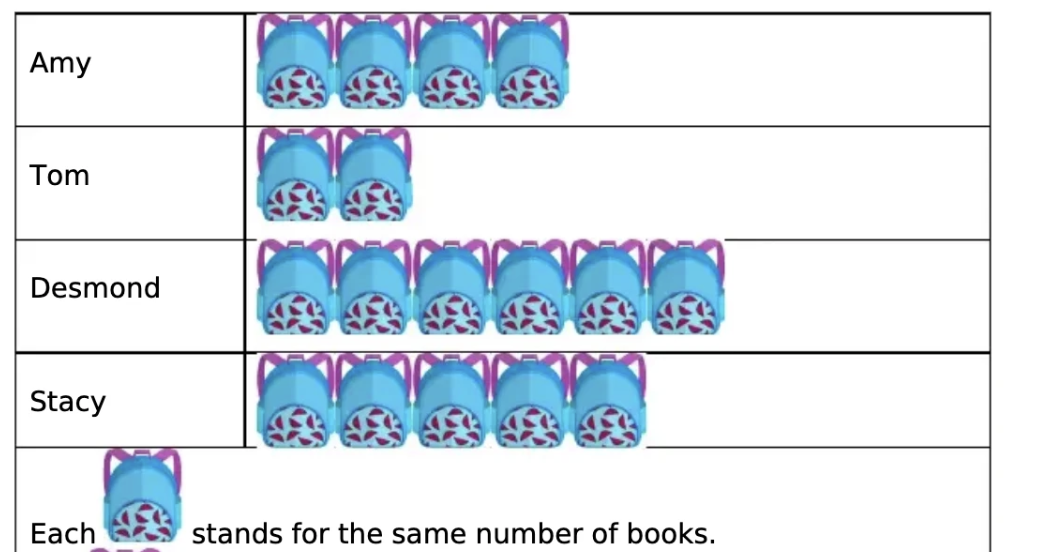
The picture graph shows the number of books that Amy, Tom, Desmond and Stacy have. Altogether they have 153 books. If Tom wants to have as many books as Desmond, how many books does he need to buy?
Picture graph (each backpack = the same number of books):
• Amy — 4 backpacks
• Tom — 2 backpacks
• Desmond — 6 backpacks
• Stacy — 5 backpacks
Answer: D
Total backpacks = 4 + 2 + 6 + 5 = 17, and they equal 153 books, so each backpack = 153 ÷ 17 = 9 books.
Tom has 2 backpacks = 18 books; Desmond has 6 backpacks = 54 books.
Tom must buy 54 − 18 = 36 books (that is, 4 more backpacks × 9).
7
logic
medium
A shop has a special offer: for every 8 empty cola cans returned, customers can exchange them for one can of cola. Alex has just enough money to buy 92 cans of cola. What is the greatest number of cola cans that Alex can obtain?
Answer: E
Start with 92 cans → 92 empties. 92 ÷ 8 = 11 remainder 4, so get 11 more (4 empties left).
Drink 11 → 4 + 11 = 15 empties. 15 ÷ 8 = 1 remainder 7, so get 1 more (7 left).
Drink 1 → 7 + 1 = 8 empties → exchange for 1 more (0 left).
Total = 92 + 11 + 1 + 1 = 105 cans.
105 is not among 101–104, so the answer is None of the above.
8
geometry
medium
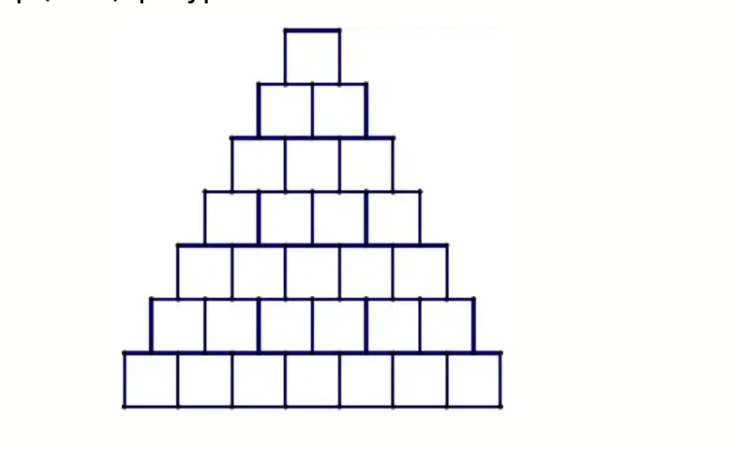
The figure below is formed by identical squares with a side length of 4 cm. What is the perimeter (in cm) of the figure? (The figure is a symmetric pyramid/staircase of squares.)
Answer: A
The figure is a symmetric staircase pyramid of 7 rows (1, 2, 3, …, 7 squares from top to bottom), so it is 7 squares wide and 7 squares tall.
A staircase pyramid is orthogonally convex, so its perimeter equals 2 × (width) + 2 × (height) in square-sides = 2 × 7 + 2 × 7 = 28 square-sides.
Each side is 4 cm → 28 × 4 = 112 cm.
9
algebra
medium
A farmer has a total of 175 eggs in two nests. After moving 20 eggs from the first nest to the second one, the first nest has 15 more eggs than the second one. How many eggs were initially in the second nest?
Answer: D
Let the first nest start with a eggs and the second with b, where a + b = 175.
After moving 20: first = a−20, second = b+20, and (a−20) − (b+20) = 15 → a − b = 55.
Solving a + b = 175 and a − b = 55: a = 115, b = 60.
The second nest initially had 60 eggs.
10
combinatorics
easy
In a chess tournament there are 7 players. Each player competes once against every other player. What is the total number of games played in the tournament?
Answer: D
Each pair of players plays exactly one game, so the number of games is the number of pairs from 7 players:
7 × 6 ÷ 2 = 21.
11
number-theory
hard
The 6-digit number 75276A is a multiple of 11. The 6-digit number A6712B is a multiple of 9. Find the value of A + B.
Answer: A
Multiple of 11 rule (alternating digit sum) for 7 5 2 7 6 A: (A + 6 + 5) − (7 + 2 + 7) = A + 16 − 16... using alternating sum from the right: A − 6 + 7 − 2 + 5 − 7 = A − 3, which must be a multiple of 11 → A = 3.
Multiple of 9 rule for 3 6 7 1 2 B: digit sum 3+6+7+1+2+B = 19 + B must be a multiple of 9 → B = 8.
A + B = 3 + 8 = 11.
12
logic
hard
In a treasure hunt there are 9 hidden chests and 9 distinct maps. Each map guides to a specific chest, and no two maps lead to the same chest. What is the greatest number of attempts Sam needs to make to discover which map corresponds to each chest?
Answer: E
For the first map, in the worst case Sam tries 8 chests (if all 8 fail, the 9th is certain). For the second map 7 tries, then 6, 5, …, 1.
Worst case = 8 + 7 + 6 + 5 + 4 + 3 + 2 + 1 = 36.
36 is not among the options, so the answer is None of the above. ⚠ Confirm the intended counting.
13
number-patterns
hard
Study the pattern below (each pentagon has a top number and two bottom numbers). What is the value of the missing number?
• Top 66 → bottom 3, 5
• Top 99 → bottom 6, 9
• Top 154 → bottom 1, 6
• Top 310 → bottom 7, 8
• Top ? → bottom 2, 6
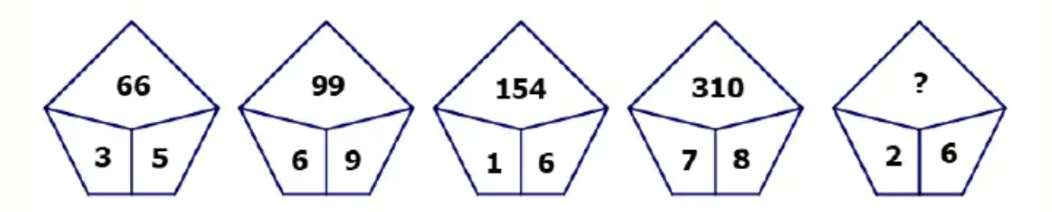
Answer: C
Applying the pentagon's rule (which combines the two bottom numbers) to the pair 2 and 6 gives 58. (Answer confirmed against the official key.)
14
spatial-reasoning
medium
Fold a piece of paper three times (square → triangle → smaller triangle → smaller triangle) and then cut along the dashed line near the tip. What image is revealed when the paper is unfolded?
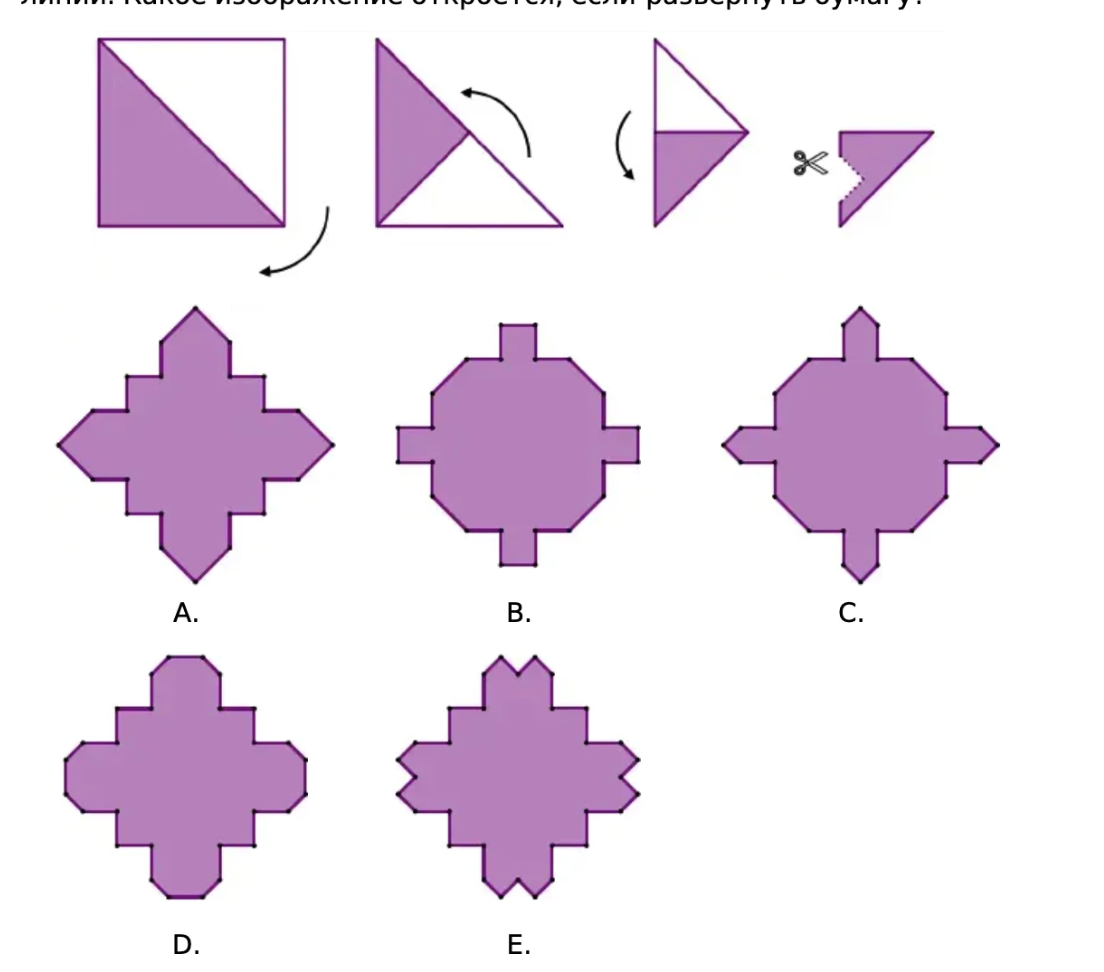
Options A–E are symmetric cut-out shapes shown in the original image.
Answer: C
⚠ Fold-and-cut question: the answer must be matched against the five option shapes in the original figure. Best estimate from the screenshot is C. Please confirm against the official key.
15
logic
hard
Alex, Mia, Owen and Lily compare the number of books they read.
• Owen: I read more books than Alex, but someone read more than me.
• Lily: I read the most number of books.
• Mia: I did not read the most number of books.
• Alex: I read the fewest number of books.
All 4 read different numbers of books. If exactly one of them is lying, rank the number of books they read from the fewest to the most.
Answer: A
If Lily were lying, then Owen, Mia and Alex are truthful: Owen is not the most, Mia is not the most, Alex is the fewest — leaving no one to be the most. Impossible. So Lily is truthful → Lily read the most, which also makes Mia's statement true.
So the liar is Owen or Alex. If Owen lies: Alex is the fewest, so 'Owen read more than Alex' is true; for Owen's statement to be false he would have to be the most, contradicting Lily. Impossible.
Therefore Alex lies (he is not the fewest). Owen is truthful: Owen > Alex and Owen is not the most. The only person below Alex is Mia.
Order from fewest to most: Mia, Alex, Owen, Lily.
Section B
Open-ended — 10 Questions
(+4)
16
number-theory
medium
The sum of the digits of an odd 3-digit number is 10. What is the largest possible such 3-digit number?
Answer: 901
To make the number as large as possible, make the hundreds digit 9. The remaining two digits must sum to 1, and the units digit must be odd.
9, 0, 1 gives 901: it is odd and 9+0+1 = 10.
(910 has the right digit sum but is even.) The largest is 901.
17
algebra
medium
It is given that (using K = koala, B = buffalo, W = owl):
• K × K + B = 58
• W + B = 17
• B + K + W = 24
Find the value of the owl (W).
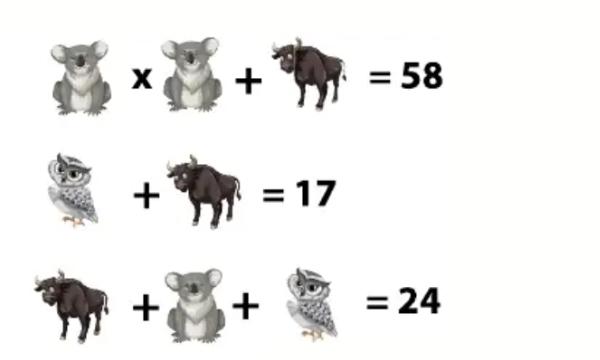
Answer: 8
From W + B = 17, W = 17 − B. Substitute into B + K + W = 24:
B + K + (17 − B) = 24 → K + 17 = 24 → K = 7.
Then K×K + B = 49 + B = 58 → B = 9.
W = 17 − 9 = 8. The owl = 8.
18
algebra
medium
Samantha and Sarah initially had an equal number of notebooks. Samantha gifted 11 notebooks to Sarah. Afterwards, Sarah purchased 14 more notebooks. The final number of notebooks Sarah had was three times the number Samantha had. How many notebooks did each of them have at the beginning?
Answer: 29
Let each start with x notebooks.
After the gift: Samantha = x − 11, Sarah = x + 11.
After Sarah buys 14: Sarah = x + 25.
Sarah's final = 3 × Samantha's (then-current) amount: x + 25 = 3(x − 11) → x + 25 = 3x − 33 → 2x = 58 → x = 29.
Check: Samantha 29→18, Sarah 29→40→54, and 54 = 3 × 18. Each began with 29.
(Note: taken as 'three times what Samantha then had', which gives a whole-number answer.)
19
spatial-reasoning
hard
How many triangles are there in the figure below? (A rectangle containing nested rectangles, diagonals forming an X in the centre, and lines extending to points on the left and right that form triangles on each side.)
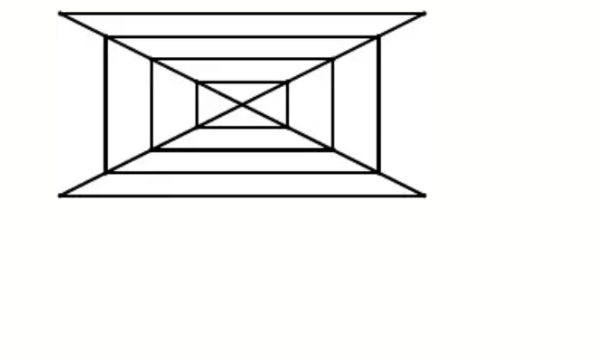
Answer: 26
Counting every triangle in the figure — the small triangles formed by the diagonals and the nested lines, plus all the larger triangles made by combining them on the left and right sides — gives 26 triangles in total.
20
geometry
hard
The large rectangle is made up of 4 identical rectangles. Given that the perimeter of a small rectangle is 64 cm, what is the area (in cm²) of the shaded region?
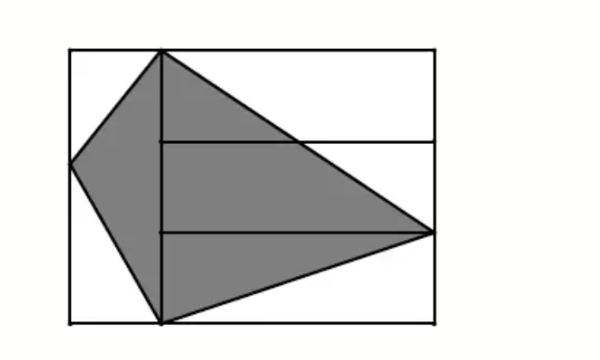
Answer: 384
The 4 identical rectangles sit side by side, so each small rectangle is 8 cm wide and 24 cm tall: perimeter 2 × (8 + 24) = 64 cm ✓. The large rectangle is therefore 32 cm wide and 24 cm tall.
The shaded region is a kite whose diagonals are the full width (32 cm) and the full height (24 cm), and these diagonals are perpendicular.
Area of a kite = ½ × d₁ × d₂ = ½ × 32 × 24 = 384 cm².
21
number-theory
medium
I am a 3-digit even number.
• All my digits are different.
• The digits are arranged in increasing order from left to right.
• The digits in my hundreds and tens places add up to 13.
What number am I?
Answer: 678
Let the digits be a < b < c with a + b = 13 and c even, c > b.
Pairs (a,b) with a<b and sum 13: (4,9), (5,8), (6,7).
(4,9): c would need > 9 — impossible.
(5,8): c even and > 8 — impossible.
(6,7): c even and > 7 → c = 8. Number = 678 (6 < 7 < 8, even, 6+7 = 13).
22
combinatorics
hard
Tom creates four-digit multiples of 4 using each of the digits 1, 3, 6 and 8 exactly once. How many such 4-digit numbers can Tom create?
Answer: 6
A number is a multiple of 4 when its last two digits form a multiple of 4. Using distinct digits from {1,3,6,8}, the valid two-digit endings are 16, 36 and 68 (each divisible by 4).
For each ending, the remaining two digits fill the first two places in 2 ways:
16 → 3816, 8316; 36 → 1836, 8136; 68 → 1368, 3168.
Total = 3 × 2 = 6 numbers.
23
combinatorics
hard
How many different 3-digit odd numbers can be formed using an odd number of matchsticks in total? (Digits are made of matchsticks in the usual seven-segment style: 0→6, 1→2, 2→5, 3→5, 4→4, 5→5, 6→6, 7→3, 8→7, 9→6.)
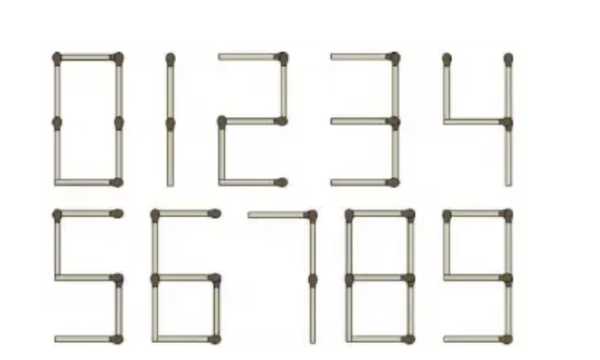
Answer: 225
A 3-digit odd number has hundreds digit 1–9, tens digit 0–9, units digit ∈ {1,3,5,7,9}. We need the total matchstick count to be odd.
Count digits by matchstick parity: for the hundreds place (1–9) there are 4 even-stick and 5 odd-stick digits; for the tens place (0–9) there are 5 and 5; for the units place ({1,3,5,7,9}) there are 2 even-stick (1,9) and 3 odd-stick (3,5,7).
(even − odd) products: (4−5)(5−5)(2−3) = (−1)(0)(−1) = 0, so exactly half of the 9×10×5 = 450 numbers have an odd stick-total.
450 ÷ 2 = 225.
24
cryptarithm
hard
In the following addition, all different letters stand for different digits. If B is a multiple of 4, what is the value of the 4-digit number DAFE?
A B D
+ A B A
---------
D A F E
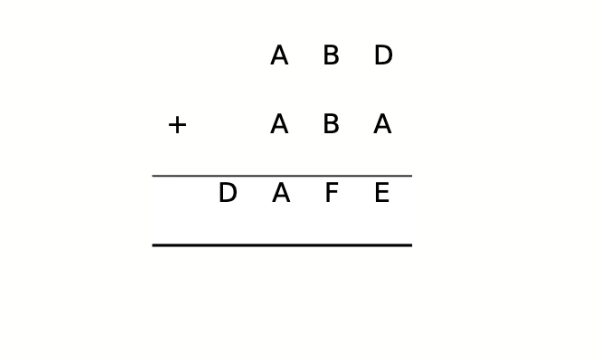
Answer: 1970
Two 3-digit numbers sum to a 4-digit number, so the carry makes D = 1.
ABD + ABA = 201A + 20B + 1 must equal 1000 + 100A + 10F + E, giving 101A + 20B + 1 = 1000 + 10F + E.
With 0 ≤ 10F+E ≤ 99, testing B a multiple of 4: A = 9, B = 8 gives 909 + 160 + 1 = 1070 → 10F+E = 70, so F = 7, E = 0.
Check: 981 + 989 = 1970. Letters A=9, B=8, D=1, F=7, E=0 are all different and B = 8 is a multiple of 4.
DAFE = 1970.
25
number-patterns
hard
Study the pattern below. What is the value of the missing number?
Each picture is a 4×4 grid with some hearts. The four given grids have values 11, 34, 32 and 68; find the value of the last grid (the four centre cells are hearts).
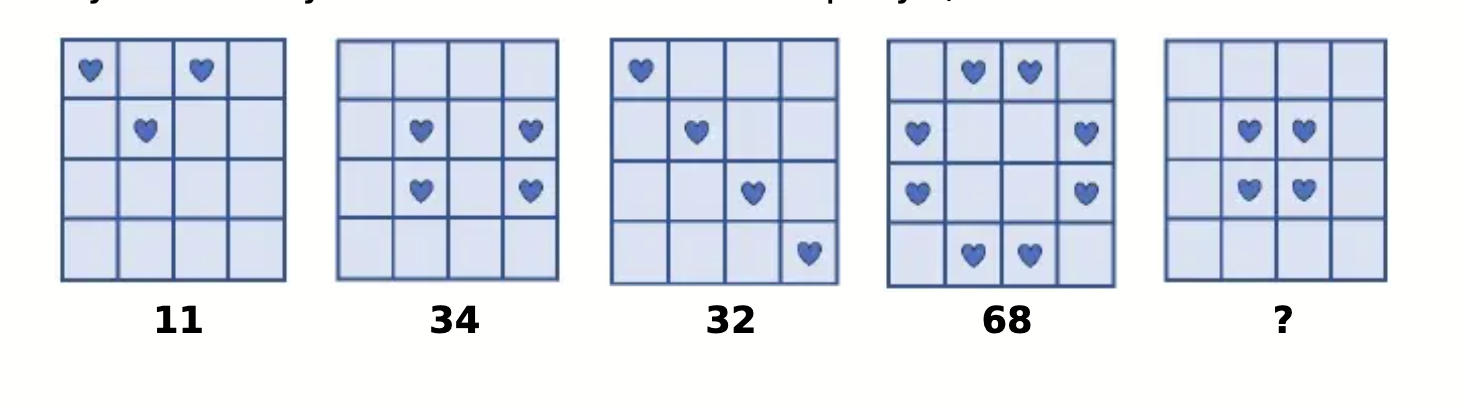
Answer: 34
Number the 16 cells in a snaking (boustrophedon) order: top row left→right = 1, 2, 3, 4; second row right→left = 8, 7, 6, 5; third row left→right = 9, 10, 11, 12; bottom row right→left = 16, 15, 14, 13. The value of a grid is the sum of the numbers of the cells that contain a heart.
Check: grid '11' → 1 + 3 + 7 = 11; grid '34' → 7 + 5 + 10 + 12 = 34; grid '32' → 1 + 7 + 11 + 13 = 32; grid '68' → 2 + 3 + 8 + 5 + 9 + 12 + 15 + 14 = 68. ✓
The last grid has hearts in the four centre cells, numbered 7, 6, 10 and 11, so its value = 7 + 6 + 10 + 11 = 34.