Section A
Multiple Choice — 15 Questions
(+2 / -1)
1
arithmetic
easy
What is the value of the following sum?
902 + 804 + 700 + 609 + 508 + 403 + 307 + 201 + 106
Answer: B
Pair numbers to make tens or hundreds: 902 + 508 = 1410, 804 + 106 = 910, 609 + 201 = 810, 403 + 307 = 710. Sum = 1410 + 910 + 810 + 710 + 700 = 4540.
2
number-sense
easy
Fill in the blank: _____ is 2 tens 8 ones less than 5 tens 5 ones.
Answer: A
5 tens 5 ones = 5 × 10 + 5 = 55. 2 tens 8 ones = 2 × 10 + 8 = 28. 55 − 28 = 27.
3
patterns
medium
Study the pattern below and find '?'.
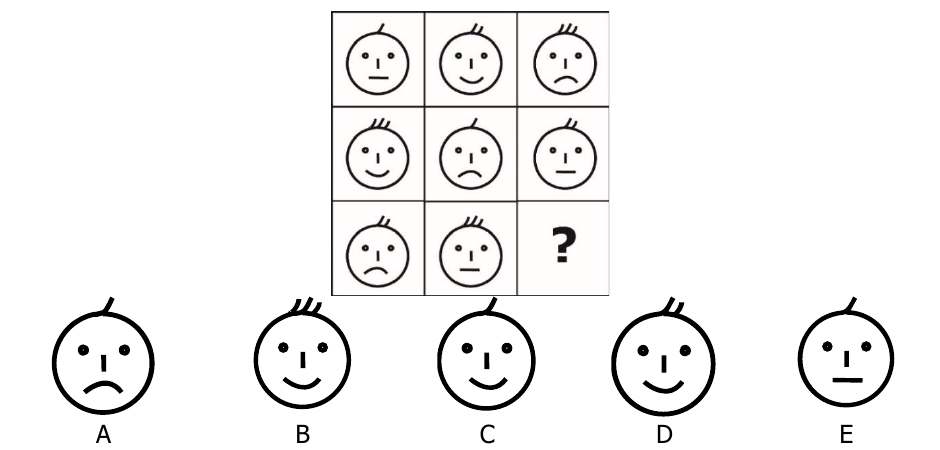
Options A–E are the faces shown in the image.
Answer: C
The same pattern repeats in each row of 3 figures but in a different order: the hair count cycles 1, 2, 3 and the mouth cycles smiley, sad, horizontal. The missing figure should have 1 hair and a smiley face, which is option C.
4
calendar
medium
Alice's first day in Caterpillar Club was Tuesday. She wants to throw a party on her 40th day in the club. If Alice attends the club every day, on which day of the week will the party be?
Answer: B
Every 7 days later returns to the same day. Alice wants the party 39 days after her first day. 39 ÷ 7 = 5 remainder 4, so 39 days later is 5 weeks and 4 days after Tuesday. 5 weeks after Tuesday is still Tuesday, and 4 days after Tuesday is Saturday.
5
number-theory
easy
How many multiples of 6 are there between 14 and 100?
Answer: C
From 1 to 100, there are 16 multiples of 6 (100 ÷ 6 = 16 remainder 4). From 1 to 14, there are 2 multiples of 6 (6 and 12). So there are 16 − 2 = 14 multiples of 6 between 14 and 100.
6
spatial-reasoning
medium
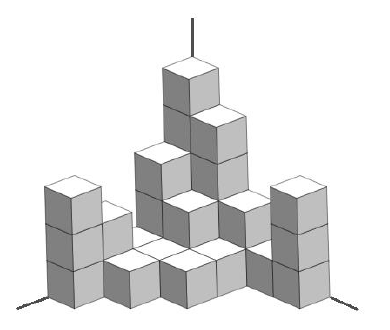
The diagram shows some cubes of the same size stacked at a corner of a room. How many cubes are there altogether? (Note: The floor is horizontal, and the two walls are vertical. There are no gaps or holes behind the visible cubes.)
Answer: B
Counting the cubes in each stack from left to right: 3 + 3 + 3 + 6 + (5 + 4 + 2 + 1 + 3) = 3 + 3 + 3 + 6 + 15 = 30 cubes in total.
7
time
medium
Alicia and Emily agreed to meet at the cinema at 3.55 pm. Emily left her house at 1.47 pm but arrived at the cinema 17 minutes late. How long was Emily's journey from her house to the cinema?
Answer: E
Emily arrived 17 minutes after 3.55 pm, which is 4.12 pm. There are 120 minutes from 1.47 pm to 3.47 pm, then 25 more minutes to 4.12 pm. Her journey was 120 + 25 = 145 minutes, which is not among options A–D, so the answer is 'None of the above'.
8
patterns
medium
What is the missing number in the sequence below?
1, 3, 7, 15, 31, ___
Answer: A
Each addition is twice the previous one: 1 →(+2) 3 →(+4) 7 →(+8) 15 →(+16) 31 →(+32) 63. The next number is 63.
9
divisibility
medium
If the four-digit number 3P78 is divisible by 3, how many possible values are there for P?
Answer: A
3P78 is divisible by 3 when the digit sum 3 + P + 7 + 8 = 18 + P is a multiple of 3. This happens for 18 + P = 18, 21, 24, 27, giving P = 0, 3, 6, 9 — 4 possible values.
10
number-theory
hard
In the fictional "Odd Island", all the numbers contain only odd digits. The order of the counting numbers is as follows:
1, 3, 5, 7, …, 19, 31, 33, …
What is the 31st counting number in the island?
Answer: B
The first 31 counting numbers are: 1,3,5,7,9, 11,13,15,17,19, 31,33,35,37,39, 51,53,55,57,59, 71,73,75,77,79, 91,93,95,97,99, 111. The 31st counting number is 111.
11
logic
medium
The weights of four boys are 45 kg, 48 kg, 52 kg and 53 kg. Mason's weight is an even number. Joshua's weight is a multiple of 5. Christopher is not the heaviest and Mateo is not the lightest. Who is the heaviest among the four boys?
Answer: D
The heaviest weight is 53 kg, which is odd. Mason's weight is even, so he is not the heaviest. Joshua's weight is a multiple of 5, i.e. 45 kg, so he is not the heaviest. Christopher is not the heaviest by the statement. So the remaining boy, Mateo, is the heaviest.
12
ratio
medium
Alex, John and Sam went to buy oranges. Alex paid $20, John paid $15, and Sam only paid $5. They bought 120 oranges altogether. They divided them in proportion to the amount of money each of them had paid. How many oranges did John get?
Answer: C
Together they paid $20 + $15 + $5 = $40 for 120 oranges, so $1 → 120 ÷ 40 = 3 oranges. John paid $15, so he got 15 × 3 = 45 oranges.
13
word-problem
hard
A tank filled with 200 litres of water weighs 350 kg. The same tank filled with 150 litres of water weighs 315 kg. What is the weight of the empty tank?
Answer: D
Tank + 200 litres = 350 kg and Tank + 150 litres = 315 kg. Subtracting: 50 litres of water = 35 kg, so 150 litres = 35 × 3 = 105 kg. Then Tank + 105 kg = 315 kg, so Tank = 315 − 105 = 210 kg.
14
word-problem
medium
A city council decided to put lanterns on both sides of a river. The distance between any two neighbouring lanterns on each side must be 11 metres. The length of the river is 132 metres. The distance between the first and the last lantern on each side must be also 132 metres. How many lanterns will there be in total?
Answer: D
There are 132 ÷ 11 = 12 gaps between lanterns on each side of the river, so there are 12 + 1 = 13 lanterns on each side. In total there are 13 × 2 = 26 lanterns.
15
spatial-reasoning
hard
Which picture below can form the pyramid shown on the right?
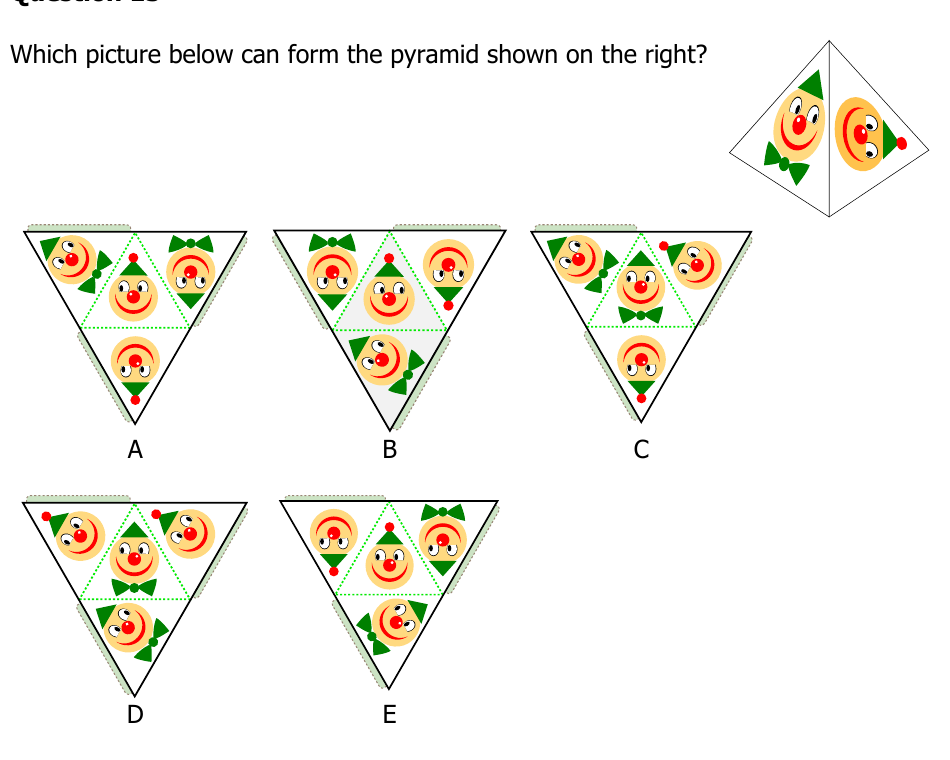
Options A–E are the pyramid nets shown in the image.
Answer: B
One face of the pyramid has a dot on top of its hat, a white dot to the left of its nose, and eyes looking right. The other face has no dot on its hat, a white dot to the left of its nose, eyes looking right, and a bow tie. Only option B's net has both matching faces.
Section B
Integer-type — 10 Questions
(+4)
16
patterns
medium
What is the sum of the first 30 numbers of the following pattern?
50, 49, 48, 47, 46 …
Answer: 1065
The 2nd number is 50 − 1, the 3rd is 50 − 2, and so on, so the 30th number is 50 − 29 = 21. The sum is 50 + 49 + 48 + … + 22 + 21 = (50+21) + (49+22) + … (15 pairs each summing to 71) = 71 × 15 = 1065.
17
geometry-perimeter
medium
If you increase the length of a rectangle by 12 cm, you will get a rectangle with a perimeter of 38 cm. What is the perimeter of the original rectangle?
Answer: 14
A rectangle has 2 lengths and 2 widths. Increasing the length by 12 cm on each of the 2 lengths increases the perimeter by 12 × 2 = 24 cm. So original perimeter + 24 = 38, giving original perimeter = 38 − 24 = 14 cm.
18
counting-figures
hard
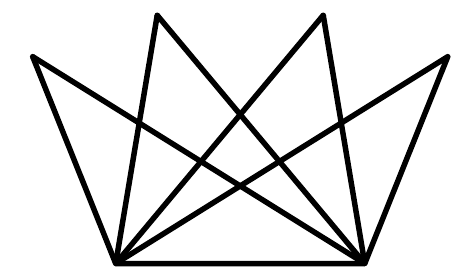
How many triangles are there in the figure below?
Answer: 30
Counting triangles formed by 1, 2, 3, 4 and 6 line segments together: 7 (1-part) + 10 (2-part) + 6 (3-part) + 5 (4-part) + 2 (6-part) = 30 triangles.
19
data-interpretation
medium
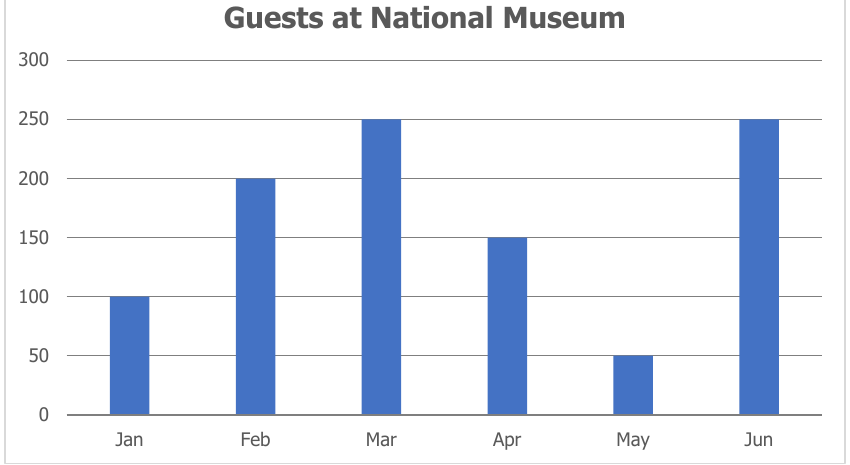
The graph below shows the number of guests who visited the National Museum in the first six months of 2019. How many people visited the museum during the six months?
Answer: 1000
Reading the bar chart: Jan = 100, Feb = 200, Mar = 250, Apr = 150, May = 50, Jun = 250 guests. Total = 100 + 200 + 250 + 150 + 50 + 250 = 1000 guests.
20
logic-arithmetic
medium
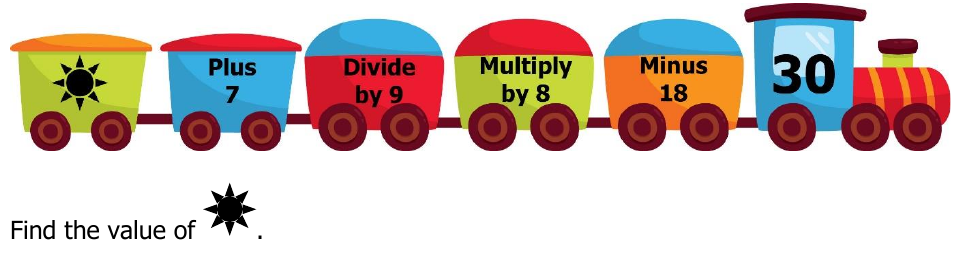
Study the picture below (a number machine: a starting unknown value passes through 'Plus 7', 'Divide by 9', 'Multiply by 8', 'Minus 18', ending at 30). Find the value of the starting number.
Answer: 47
Working backwards from 30, reverse each operation: 30 + 18 = 48; 48 ÷ 8 = 6; 6 × 9 = 54; 54 − 7 = 47.
21
geometry-area
hard
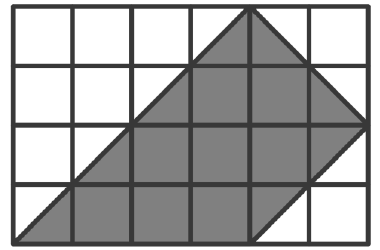
If the area of the rectangle is 96 cm², what is the area (in cm²) of the shaded region?
Answer: 48
The rectangle is made of 6 × 4 = 24 equal squares, so each square has area 96 ÷ 24 = 4 cm². The shaded region comprises 8 full squares plus 8 half-square triangles (equivalent to 4 more squares), so it covers 8 + 4 = 12 squares. Shaded area = 12 × 4 = 48 cm².
22
word-problem
hard
Brad bought 2 boxes of chocolates, 3 packets of sweets and 4 baskets of fruits at $29. A box of chocolates and a packet of sweets cost $4. A packet of sweets and a basket of fruits cost $6. How much does a box of chocolates cost?
Answer: 3
$29 = 2 boxes + 3 packets + 4 baskets = 2 × (1 box + 1 packet) + (1 packet + 1 basket) + 3 baskets = 2 × $4 + $6 + 3 baskets = $14 + 3 baskets. So 3 baskets = $29 − $14 = $15, giving 1 basket = $5. Then 1 packet = $6 − $5 = $1, and 1 box = $4 − $1 = $3.
23
combinatorics
hard
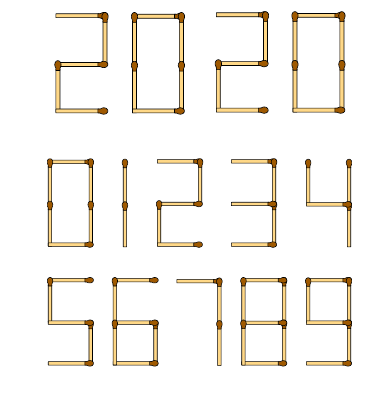
Diana made the number 2020 using 22 matchsticks as shown below. How many digits are there in the largest possible whole number that she can construct using exactly 17 matchsticks? (The figures of all the digits from 0 to 9 are shown below.)
Answer: 8
To get the largest possible number, Diana needs to use as many digits as possible. The digit '1' needs the fewest matchsticks (2), and '7' needs the next fewest (3). Using seven 1's (7 × 2 = 14 matchsticks) plus one 7 (3 matchsticks) uses exactly 17 matchsticks, giving the largest possible number 71,111,111 — which has 8 digits.
24
logic-arithmetic
hard
The numbers 2, 5, 8, 11, 14, 17 and 20 can be placed in the 7 circles below such that the sum along each straight line is the same and each number can only be used once. What is the largest possible value of this sum?
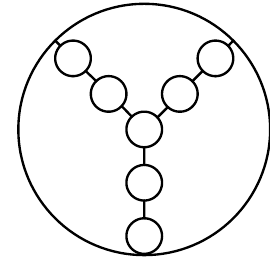
Answer: 39
There are 3 straight-line sums in the figure, all equal, so their total is a multiple of 3. This total also equals the sum of all 7 numbers plus 2 times the middle (shared) number: 77 + 2 × middle. To maximise the line sum, pick the largest middle number for which 77 + 2 × middle is a multiple of 3; the largest number available is 20, and 77 + 2 × 20 = 117 = 3 × 39. One valid arrangement is (2,14,20), (5,14,20), (8,11,20). Answer: 39.
25
cryptarithm
hard
In the following, all the different letters stand for different digits.
P P P
+ Q Q Q
-------
R Q Q R
Find the value of the 4-digit number RQQR.
Answer: 1221
A three-digit number plus a three-digit number can only give a four-digit number starting with 1, so R = 1. In the units column, P + Q ends in 1 with P + Q > 1, so P + Q = 11. In the tens column, P + Q = 11 plus the carry of 1 from the units gives a units digit of Q, so Q = 2. Thus RQQR = 1221.