Section A
Multiple Choice — 10 Questions
(+2 / -1)
1
sequences
easy
Find the missing term in the following sequence: 1, 2, 4, 7, _____, 16.
Answer: B
The differences increase by 1 each time: +1, +2, +3, +4, +5. So the terms are 1, 2, 4, 7, 11, 16. The missing term is 7 + 4 = 11.
2
number-theory
easy
2⁵ means 2 multiplied by itself 5 times, i.e. 2⁵ = 2 × 2 × 2 × 2 × 2 = 32. What is 3⁴ equal to?
Answer: D
3⁴ = 3 × 3 × 3 × 3 = 9 × 9 = 81.
3
logic
medium
An operator ✿ acts on two numbers to give the following outcomes: 3 ✿ 2 = 51, 5 ✿ 3 = 82, 6 ✿ 1 = 75, 9 ✿ 4 = 135. What is 7 ✿ 5 equal to?
Answer: C
The result is the sum of the two numbers written next to their difference: a ✿ b = (a + b) then (a − b). Check: 3 ✿ 2 → 5 and 1 → 51; 9 ✿ 4 → 13 and 5 → 135. So 7 ✿ 5 → (7 + 5) = 12 and (7 − 5) = 2 → 122.
4
geometry
medium
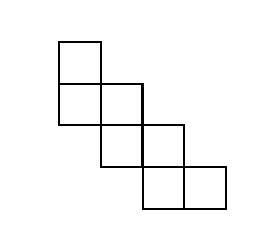
The diagram shows a figure that contains 7 identical squares. The area of the figure is 112 cm². Find its perimeter.
Answer: C
Each square has area 112 ÷ 7 = 16 cm², so its side is 4 cm. The 7 squares form a staircase (a single chain), so they share 6 edges. The exposed edge length is 4 × 7 − 2 × 6 = 16 sides, and each side is 4 cm, giving a perimeter of 16 × 4 = 64 cm.
5
place-value
easy
Fill in the blank: __________ is 4 tens 5 ones greater than 2 tens 7 ones.
Answer: D
4 tens 5 ones = 45 and 2 tens 7 ones = 27. The number that is 45 greater than 27 is 27 + 45 = 72.
6
arithmetic
medium
Which of the following statement(s) is or are correct? Statement A: 7 + (0 × 2) = 7. Statement B: 7 + (0 ÷ 2) = 7. Statement C: 7 + (2 × 0) = 7.
Answer: A
0 × 2 = 0, 0 ÷ 2 = 0 and 2 × 0 = 0. So all three brackets equal 0, and 7 + 0 = 7 in every case. All three statements are correct.
7
combinatorics
medium
There are 4 types of cakes available in a cake shop: chocolate, cheese, blueberry and blackforest. Naomi wants to buy 2 different types of cakes. How many different choices does she have?
Answer: B
Choosing 2 different types out of 4, where order does not matter, gives 4 × 3 ÷ 2 = 6 choices.
8
geometry
medium
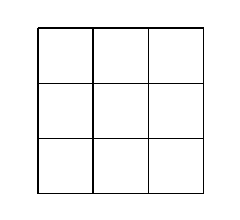
Find the total number of squares in a 3 × 3 square grid.
Answer: D
Count squares of each size: 1 × 1 squares → 9, 2 × 2 squares → 4, 3 × 3 square → 1. Total = 9 + 4 + 1 = 14.
9
number-theory
medium
Find the smallest whole number between 14 and 40 that is divisible by 3 and by 4.
Answer: D
A number divisible by both 3 and 4 is divisible by 12. The multiples of 12 are 12, 24, 36, … The smallest one between 14 and 40 is 24.
10
number-theory
medium
What is the length of the largest square that can be made from 50 one-centimetre square tiles?
Answer: C
A square made from unit tiles uses a perfect-square number of tiles. The largest perfect square not exceeding 50 is 49 = 7 × 7, using 49 tiles. So the largest square has a side of 7 cm.
Section B
Non-MCQ (Free Response) — 10 Questions
(+4)
11
logic
easy
Two numbers are such that the first number is greater than or equal to 5, but less than or equal to 8, and the second number is greater than or equal to 2, but less than or equal to 10. Find the least possible value of the sum of the two numbers.
Answer: 7
To make the sum as small as possible, take the smallest allowed value of each number: the first is 5 and the second is 2. The least possible sum is 5 + 2 = 7.
12
number-theory
medium
If the four-digit number 12N4 is divisible by 3 and N is less than 5, find N.
Answer: 2
A number is divisible by 3 when its digit sum is divisible by 3. Here 1 + 2 + N + 4 = 7 + N, so N can be 2, 5 or 8. Since N is less than 5, N = 2.
13
number-theory
medium
A whole number multiplied by itself will give a special type of numbers called perfect squares. Examples of perfect squares are 9 (= 3 × 3) and 16 (= 4 × 4). What is the smallest number that can be multiplied by 28 to give a perfect square?
Answer: 7
28 = 2 × 2 × 7. To make it a perfect square every prime factor must appear an even number of times; only the 7 is unpaired, so multiply by 7. Then 28 × 7 = 196 = 14 × 14.
14
calendar
medium
Find the day of the week that is 50 days from a Monday.
Answer: Tuesday
Days of the week repeat every 7. 50 ÷ 7 = 7 remainder 1, so 50 days is the same as 1 day after Monday, which is Tuesday.
15
geometry
medium
Amy wants to cut rectangular cards of length 4 cm by 3 cm from a rectangular sheet 32 cm by 21 cm. Find the biggest number of cards that can be cut from the sheet.
Answer: 56
Place the 4 cm side along the 32 cm edge (32 ÷ 4 = 8) and the 3 cm side along the 21 cm edge (21 ÷ 3 = 7). This uses the whole sheet with no waste, giving 8 × 7 = 56 cards.
16
logic
medium
There are 5 items (a ruler, a pen, an eraser, a sharpener and a hole puncher) lying in a straight row on a table. The eraser is next to the hole puncher and the sharpener. The ruler is next to the hole puncher. The sharpener is the first item on the left. What is the order of the items on the table from left to right?
Answer: Sharpener, eraser, hole puncher, ruler, pen
The sharpener is first (leftmost). The eraser is next to the sharpener, so the eraser is second. The eraser is also next to the hole puncher, so the hole puncher is third. The ruler is next to the hole puncher, so the ruler is fourth. The pen takes the last place. Order: sharpener, eraser, hole puncher, ruler, pen.
17
cryptarithm
hard
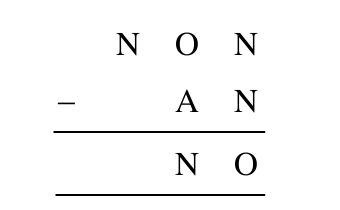
In the following subtraction, all the different letters stand for different digits. Find the two-digit number NO.
Answer: 10
The subtraction is NON − AN = NO. Since a 3-digit number minus a 2-digit number gives only a 2-digit result, N must be 1. Then NON = 1O1 and NO = 1O, so 101 + 10·O − (10A + 1) = 10 + O, which simplifies to 10A − 9O = 90. This holds for O = 0 and A = 9. Check: 101 − 91 = 10. So NO = 10.
18
word-problems
medium
50 cakes are packed in two different box sizes. The small box holds 4 cakes and the big box holds 6 cakes. If less than 10 boxes are used and all the boxes are fully packed, how many big boxes are used?
Answer: 7
Let there be s small boxes and b big boxes. Then 4s + 6b = 50, i.e. 2s + 3b = 25, so b must be odd. Testing: b = 7 gives 2s = 4, s = 2, a total of 9 boxes (less than 10). Other odd values of b give 10 or more boxes. So 7 big boxes are used (7 big + 2 small = 42 + 8 = 50).
19
logic
hard
Alice and Ben are sister and brother. Alice has as many sisters as she has brothers, but Ben has twice as many sisters as he has brothers. How many boys and girls are there in their family?
Answer: 4 girls and 3 boys (7 children)
Let there be G girls and B boys. Alice (a girl) has G − 1 sisters and B brothers, and these are equal: G − 1 = B. Ben (a boy) has G sisters and B − 1 brothers, with G = 2(B − 1). Substituting B = G − 1 gives G = 2(G − 2), so G = 4 and B = 3. The family has 4 girls and 3 boys, 7 children in all.
20
geometry
hard
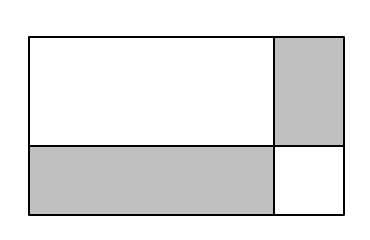
The diagram shows a rectangle being divided into 3 smaller rectangles and a square. If the perimeter of the unshaded rectangle is 16 cm and the area of the square is 9 cm², find the total area of the shaded rectangles.
Answer: 24
The square (area 9 cm²) has a side of 3 cm, so the right-hand column is 3 cm wide and the bottom row is 3 cm tall. The unshaded (top-left) rectangle has length + width = 16 ÷ 2 = 8 cm. The two shaded rectangles are 3 cm × (top height) and 3 cm × (left width), so their total area is 3 × (top height + left width) = 3 × 8 = 24 cm².