Section A
15 Questions
(+1)
1
ages
easy
Jane is 9 years old and John is 5 years old. How old will John be when Jane is 15 years old?
Answer: 11
The age gap is always 9 − 5 = 4 years. When Jane is 15, John is 15 − 4 = 11 years old. (Jane grows 6 years, so John also grows 6 years: 5 + 6 = 11.)
2
number theory
easy
A textbook is opened at random. To what pages is it opened if the product of the facing pages is 110?
Answer: 10 and 11
Facing pages are consecutive whole numbers n and n + 1 with n × (n + 1) = 110. Since 10 × 11 = 110, the book is opened to pages 10 and 11.
3
arithmetic
easy
Find the number B such that the following statement is true: 8 × B = 3 × 9 + 5 × 9.
Answer: 9
3 × 9 + 5 × 9 = 27 + 45 = 72. So 8 × B = 72, giving B = 72 ÷ 8 = 9. (Also 3 × 9 + 5 × 9 = (3 + 5) × 9 = 8 × 9.)
4
defined operations
medium
It is given that a ⊛ b = a × b + a − b. For example, 2 ⊛ 3 = 2 × 3 + 2 − 3 = 5. Find the value of 4 ⊛ 3 − 3 ⊛ 4.
Answer: 2
4 ⊛ 3 = 4 × 3 + 4 − 3 = 12 + 1 = 13. 3 ⊛ 4 = 3 × 4 + 3 − 4 = 12 − 1 = 11. So 4 ⊛ 3 − 3 ⊛ 4 = 13 − 11 = 2.
5
geometry
easy
Jane has a rope of length 23 cm. She wants to cut the rope so that she can form the biggest possible square, where the length of each side, in cm, is a whole number. What is the length of the rope that she must cut to form the square?
Answer: 20 cm
A square uses a length equal to 4 × (side). The largest whole-number side with 4 × side ≤ 23 is 5 cm (4 × 5 = 20 ≤ 23; a side of 6 would need 24 cm). So she must cut 20 cm of rope.
6
sequences
medium
Find the missing term in the following sequence: 1, 2, 6, 24, _____, 720.
Answer: 120
Each term is the previous term multiplied by an increasing whole number: ×2, ×3, ×4, ×5, ×6. So 24 × 5 = 120 (and 120 × 6 = 720). These are the factorials 1!, 2!, 3!, 4!, 5!, 6!.
7
logic / measurement
hard
On National Day, 39 soldiers lined up in a straight row on opposite sides of Stadium Street to welcome Prime Minister Lee. A soldier stands on each end of Stadium Street. The distance between two adjacent soldiers on either side was 20 m. The soldiers on one side were arranged such that each soldier filled the gap between two other soldiers on the opposite side. How long was Stadium Street?
Answer: 380 m
The two rows are staggered, so one side has one more soldier than the other and both ends of the street are soldiers of the longer row. If that row has n soldiers, the other has n − 1, so n + (n − 1) = 39, giving n = 20. The 20 soldiers make 19 gaps of 20 m, so the street is 19 × 20 = 380 m long.
8
logic
medium
A shop sells sweets where every 3 sweet wrappers can be exchanged for one more sweet. Sharon has enough money to buy only 11 sweets. What is the biggest number of sweets that she can get from the shop?
Answer: 16
Buy 11 → 11 wrappers → exchange for 3 sweets (2 wrappers left). Now 3 wrappers + 2 = 5 → exchange for 1 sweet (2 left). Now 1 wrapper + 2 = 3 → exchange for 1 sweet. That last sweet's wrapper (1) cannot be exchanged. Total = 11 + 3 + 1 + 1 = 16 sweets.
9
combinatorics
medium
At a workshop, there are 10 participants. Each of them shakes hand once with one another. How many handshakes are there?
Answer: 45
Each of the 10 people shakes hands with the other 9, but each handshake is counted twice, so the number of handshakes is (10 × 9) ÷ 2 = 45.
10
patterns
medium
Ali uses identical square tiles to make the following figures. If he continues using the same pattern, how many tiles will there be in the 15th figure?
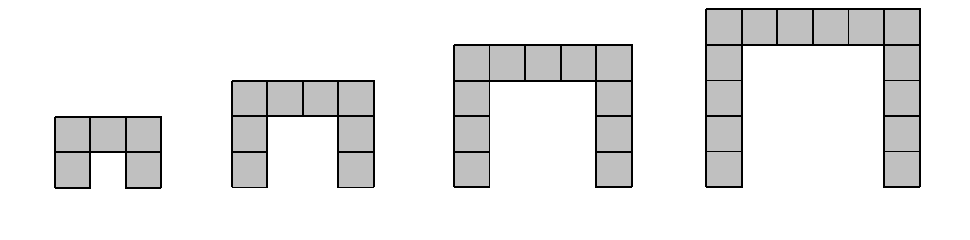
Answer: 47
Each arch has a top row of (n + 2) tiles and two legs of n tiles each, so the nth figure uses (n + 2) + 2n = 3n + 2 tiles. Check: 5, 8, 11, 14 for figures 1–4. The 15th figure has 3 × 15 + 2 = 47 tiles.
11
number theory
hard
What is the least number of cuts required to cut 16 identical sausages so that they can be shared equally among 24 people?
Answer: 16
Each person gets 16 ÷ 24 = 2/3 of a sausage. Since the greatest common factor of 16 and 24 is 8, split the work into 8 identical groups, each sharing 2 sausages among 3 people. In one group, cut each of the 2 sausages into 2/3 and 1/3 (2 cuts): the two 2/3 pieces feed two people, and the two 1/3 pieces combine to feed the third. Each group needs 2 cuts, so 8 × 2 = 16 cuts in total.
12
money / logic
medium
A vending machine accepts 10¢ coins, 20¢ coins, 50¢ coins and $1 coins only. Ivy wants to buy a can of drinks that costs $1.60. She has eight 10¢ coins, three 20¢ coins, two 50¢ coins and one $1 coin. If she wants to get rid of as many coins as possible, what is the combination of coins that she should put inside the vending machine?
Answer: seven 10¢, two 20¢ and one 50¢
To use the most coins, prefer small coins. Seven 10¢ (70¢) + two 20¢ (40¢) + one 50¢ (50¢) = 160¢ = $1.60, using 10 coins. No combination summing to $1.60 uses more than 10 coins.
13
money
easy
The total cost of a pen and a pencil is $2.90. The pen costs 60¢ more than the pencil. How much does the pen cost?
Answer: $1.75
Remove the extra 60¢: $2.90 − $0.60 = $2.30 is twice the pencil's price, so the pencil costs $1.15. The pen costs $1.15 + $0.60 = $1.75.
14
number theory
medium
If the three-digit number 3N3 is divided by 9, the remainder is 1. Find N.
Answer: 4
A number leaves the same remainder on division by 9 as its digit sum. The digit sum is 3 + N + 3 = 6 + N, which must leave remainder 1, so 6 + N = 10, giving N = 4. Check: 343 ÷ 9 = 38 remainder 1.
15
logic
medium
Charles has 16 marbles. He divides them into 4 piles so that each pile has a different number of marbles. Find the smallest possible number of marbles in the biggest pile.
Answer: 6
To make the biggest pile as small as possible, keep the four different pile sizes close together. Four different whole numbers of 5 or less sum to at most 2 + 3 + 4 + 5 = 14 < 16, so the biggest pile must be at least 6. It is achievable: 1 + 4 + 5 + 6 = 16. So the smallest possible biggest pile is 6.
Section B
5 Questions
(+2)
16
cryptarithm
hard
In the following alphametic, all the different letters stand for different digits. Find the three-digit sum SEE.
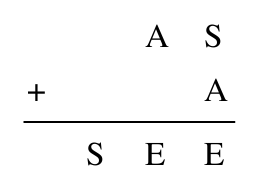
Answer: 100
AS + A is a three-digit number SEE, so S must be 1 (the only possible hundreds carry). Then AS + A = (10A + 1) + A = 11A + 1 = 100 + 11E, so 11A − 11E = 99, giving A − E = 9. Thus A = 9 and E = 0. Check: 91 + 9 = 100, so SEE = 100.
17
geometry / counting
hard
Find the total number of triangles in the diagram.
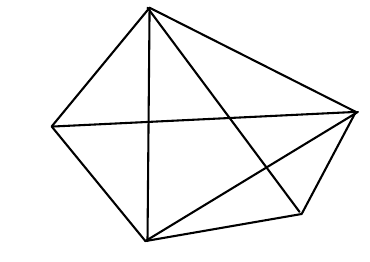
Answer: 18
Count systematically: the smallest triangular regions in the diagram, then every larger triangle formed by combining adjacent regions. Adding them all up gives a total of 18 triangles.
18
algebra / logic
medium
A teacher has a bag of sweets to treat her class. If she gave 5 sweets to each student, then she would have 40 sweets left. If she gave 7 sweets to each student, then she would have 6 sweets left. How many students and how many sweets are there?
Answer: 17 students and 125 sweets
Going from 5 to 7 sweets each uses 2 more sweets per student and reduces the leftover from 40 to 6, i.e. 34 more sweets are handed out: 2 × (students) = 34, so there are 17 students. Sweets = 5 × 17 + 40 = 125 (check: 7 × 17 + 6 = 125).
19
number patterns
hard
What are the last 2 digits of the sum 1 + 11 + 111 + … + 111…111 (the last term has 50 digits)?
Answer: 40
Units column: all 50 terms end in 1, so 50 → write 0, carry 5. Tens column: the 49 terms with two or more digits contribute a 1 each, 49 + 5 (carry) = 54 → write 4, carry 5. So the last two digits of the sum are 40.
20
logic
hard
Alvin tells the truth on Monday, Tuesday, Wednesday and Thursday. He lies on all other days. Doris tells the truth on Monday, Friday, Saturday and Sunday. She lies on all other days. One day they both said, “Yesterday I lied.” When was that ‘one day’?
Answer: Friday
Alvin can say “Yesterday I lied” consistently only on Monday (true: he lied Sunday) or Friday (a lie: he told the truth Thursday). Doris can say it consistently only on Tuesday (a lie) or Friday (true: she lied Thursday). The only day both statements work is Friday.