1
perimeter
medium
Ravi has a piece of wire 46 cm long. He wants to bend it into the biggest possible square, where the length of each side, in cm, is a whole number. How many cm of wire must he cut off before bending it into the square?
Answer: 2
A square has 4 equal sides, so its perimeter is 4 × side. We need the biggest multiple of 4 that is not more than 46. 4 × 11 = 44 and 4 × 12 = 48 (too long). So each side is 11 cm and the square uses 44 cm of wire. Wire to cut off = 46 − 44 = 2 cm.
2
patterns
hard
On Sports Day, 27 students stood in a straight line along both sides of a running track to cheer for the runners. A student stood at each end of the track. On each side, the distance between two neighbouring students was 12 m. The students on one side stood so that each of them was exactly opposite the middle of the gap between two students on the other side. How long was the running track, in metres?
Answer: 156
Because the students on one side face the middle of the gaps on the other side, one side has 1 more student than the other, and that side has the students at both ends. 27 = 14 + 13, so one side has 14 students. 14 students have 13 gaps between them. Length of track = 13 × 12 = 156 m. (Check: the 13 students on the other side stand at 6 m, 18 m, …, 150 m, one opposite the middle of each gap.)
3
logical-reasoning
medium
A shop sells bottles of juice. Every 4 empty bottles can be exchanged for 1 more bottle of juice. Ken has enough money to buy only 20 bottles of juice. What is the biggest number of bottles of juice he can drink?
Answer: 3
Ken buys and drinks 20 bottles → 20 empties. 20 empties → 5 new bottles (no empties left over). Drinking those gives 5 empties → 1 new bottle, with 1 empty left over. Drinking it gives 1 + 1 = 2 empties, which is fewer than 4, so he stops. Total = 20 + 5 + 1 = 26 bottles.
4
money
medium
A vending machine accepts 10¢ coins, 20¢ coins, 50¢ coins and $1 coins only. Ben wants to buy a packet of biscuits that costs $1.30. He has six 10¢ coins, three 20¢ coins, two 50¢ coins and one $1 coin. If he wants to use up as many coins as possible, which coins should he put into the vending machine?
Answer: 3
$1.30 = 130¢. All the 10¢ and 20¢ coins together make only 60¢ + 60¢ = 120¢, which is not enough, so option 1 is wrong. Using one 50¢ coin, he still needs 80¢ from 10¢ and 20¢ coins. To use the most coins, use as many 10¢ coins as possible: six 10¢ = 60¢, then one 20¢ makes 80¢. That is 6 + 1 + 1 = 8 coins. Option 2 uses only 7 coins, and option 4 uses only 4 coins. (Using two 50¢ coins or the $1 coin leaves too little to make up with small coins, so those use fewer coins.) Answer: six 10¢, one 20¢ and one 50¢.
5
patterns
medium
Mei uses identical square tiles to make the following figures. If she continues using the same pattern, how many tiles will there be in the 20th figure?
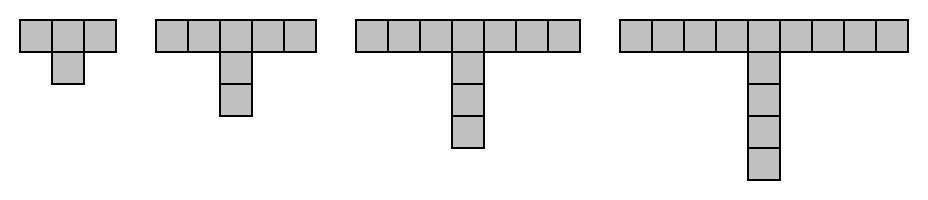
Answer: 61
Count the tiles: Figure 1 has 4, Figure 2 has 7, Figure 3 has 10, Figure 4 has 13 — each figure has 3 more tiles than the one before. Another way to see it: Figure n has a top row of (2n + 1) tiles and a stem of n tiles below the middle, so it has (2n + 1) + n = 3n + 1 tiles. The 20th figure has 3 × 20 + 1 = 61 tiles.
6
fractions
hard
What is the least number of cuts needed to cut 15 identical chocolate bars so that they can be shared equally among 20 children?
Answer: 15
Each child gets 15 ÷ 20 = 3/4 of a bar. Since 15 = 5 × 3 and 20 = 5 × 4, split the bars and children into 5 equal groups: 3 bars shared among 4 children. In one group, place the 3 bars end to end and cut the whole length into 4 equal parts of 3/4 each. The cuts fall at 3/4 (inside bar 1), 1 1/2 (inside bar 2) and 2 1/4 (inside bar 3) — 3 cuts. The pieces 3/4, (1/4 + 1/2), (1/2 + 1/4) and 3/4 give each of the 4 children 3/4 of a bar. Each group needs 3 cuts, so 5 × 3 = 15 cuts in total.
7
logical-reasoning
medium
Priya has 22 stickers. She divides them into 5 piles so that each pile has a different number of stickers. Find the smallest possible number of stickers in the biggest pile.
Answer: 7
To make the biggest pile as small as possible, keep the five different pile sizes close together. If the biggest pile had 6 or fewer, the most the five piles could hold is 2 + 3 + 4 + 5 + 6 = 20, which is less than 22. So the biggest pile must have at least 7. It is possible with 7: 1 + 3 + 5 + 6 + 7 = 22. So the answer is 7.
8
word-problems
medium
A coach has a box of stickers for his team. If he gave 4 stickers to each child, he would have 50 stickers left. If he gave 7 stickers to each child, he would have 5 stickers left. How many children and how many stickers are there?
Answer: 15 children and 110 stickers
Going from 4 to 7 stickers each uses 3 more stickers per child, and the leftover drops from 50 to 5, so 45 more stickers are given out. 3 × (number of children) = 45, so there are 15 children. Stickers = 4 × 15 + 50 = 110 (check: 7 × 15 + 5 = 110).
9
number-patterns
hard
What are the last 2 digits of the sum 3 + 33 + 333 + … + 333…333 (the last term has 30 digits)?
Answer: 60
Add column by column. Ones column: all 30 terms end in 3, so 30 × 3 = 90 → write 0, carry 9. Tens column: the 29 terms with two or more digits each give a 3, so 29 × 3 = 87, plus the carry 9 = 96 → write 6. So the last two digits of the sum are 60.
10
logical-reasoning
hard
Ahmad tells the truth on Monday, Tuesday and Wednesday. He lies on all other days. Bella tells the truth on Thursday, Friday and Saturday. She lies on all other days. One day they both said, “Tomorrow I will lie.” On which day of the week did they say it?
Answer: Wednesday
A truth-teller can say “Tomorrow I will lie” only if tomorrow is a lying day; a liar can say it only if tomorrow is a truth day. So the person must switch between telling the truth and lying from today to tomorrow. Ahmad switches on Wednesday (truth → lie on Thursday) and on Sunday (lie → truth on Monday). Bella switches on Wednesday (lie → truth on Thursday) and on Saturday (truth → lie on Sunday). The only day that works for both is Wednesday.
11
area
easy
What is the length of the largest square that can be made from 60 one-centimetre square tiles?
Answer: 2
A square with side n cm needs n × n tiles. 7 × 7 = 49 tiles (enough, since 49 ≤ 60) but 8 × 8 = 64 tiles (too many, since 64 > 60). So the largest square has side 7 cm, using 49 tiles with 11 left over.
12
factors-multiples
easy
A whole number multiplied by itself will give a special type of number called a perfect square. Examples of perfect squares are 9 (= 3 × 3) and 16 (= 4 × 4). What is the smallest number that can be multiplied by 32 to give a perfect square?
Answer: 1
Break 32 into prime factors: 32 = 2 × 2 × 2 × 2 × 2. In a perfect square, every prime factor must come in pairs. Here there are two pairs of 2s and one 2 left over, so we need one more 2: multiply by 2. Check: 32 × 2 = 64 = 8 × 8, a perfect square. (32 × 4 = 128 is not a perfect square; 32 × 8 = 256 = 16 × 16 and 32 × 32 = 1024 are perfect squares, but 2 is smaller.)
13
alphametics
medium
In the following subtraction, all the different letters stand for different digits. Find the two-digit number PO.
T O T
− P T
———————
P O
Answer: 3
A 3-digit number minus a 2-digit number gives a 2-digit answer, so TOT must be less than 200. So T = 1. Ones column: T − T = 1 − 1 = 0, so O = 0 and TOT = 101. Now 101 − P1 = P0. Since P1 + P0 = 101, and the ones digits give 1 + 0 = 1, the tens digits must give P + P = 10, so P = 5. Check: 101 − 51 = 50. So PO = 50.
14
word-problems
medium
55 cakes are packed in two different box sizes. The small box holds 3 cakes and the big box holds 7 cakes. If fewer than 10 boxes are used and all the boxes are fully packed, how many big boxes are used?
Answer: 7
Try different numbers of big boxes. The cakes left over after filling the big boxes must be a multiple of 3. 1 big box: 55 − 7 = 48 = 16 × 3 → 1 + 16 = 17 boxes. 4 big boxes: 55 − 28 = 27 = 9 × 3 → 4 + 9 = 13 boxes. 7 big boxes: 55 − 49 = 6 = 2 × 3 → 7 + 2 = 9 boxes. (Other numbers of big boxes leave a remainder that is not a multiple of 3.) Only the last way uses fewer than 10 boxes, so 7 big boxes are used.
15
area-perimeter
hard
The diagram shows a rectangle being divided into 3 smaller rectangles and a square. If the perimeter of the unshaded rectangle is 20 cm and the area of the square is 9 cm², find the total area of the shaded rectangles, in cm².
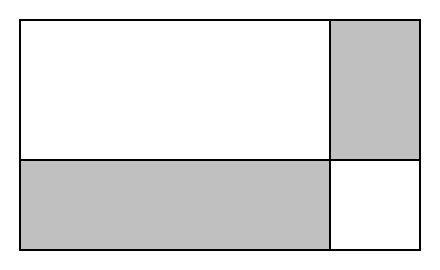
Answer: 30
The square has area 9 cm², so its side is 3 cm. Let the unshaded rectangle have length L and width W. Its perimeter is 20 cm, so L + W = 10 cm. The shaded rectangle on the right has the same height as the unshaded rectangle (W) and the same width as the square (3 cm): area = 3 × W. The shaded rectangle at the bottom has the same length as the unshaded rectangle (L) and the same height as the square (3 cm): area = 3 × L. Total shaded area = 3 × W + 3 × L = 3 × (L + W) = 3 × 10 = 30 cm².
16
time
easy
How many minutes are there in 4 weeks?
Answer: 2
4 weeks = 7 + 7 + 7 + 7 = 28 days. Each day has 24 hours and each hour has 60 minutes. So the number of minutes = (7 + 7 + 7 + 7) × 24 × 60. Option 1 gives hours, not minutes. Options 3 and 5 use 12 hours in a day instead of 24. Option 4 forgets that each week has 7 days.
17
measurement
medium
Points P, Q, R and S are on a line. The lengths of PQ, QR and RS are 9 cm, 15 cm and 20 cm, respectively. What is the shortest distance between P and S, in cm?
Answer: 1
The points do not have to be in the order P, Q, R, S — each step can go either left or right along the line. Start at P. Q is 9 cm from P. R is 15 cm from Q, and S is 20 cm from R. To end up as close to P as possible, go forward 9 cm, forward 15 cm (now 24 cm from P), then back 20 cm: S is 24 − 20 = 4 cm from P. Checking the other ways: 9 − 15 + 20 = 14 cm, 9 + 15 + 20 = 44 cm, and 9 − 15 − 20 → 26 cm. The shortest distance is 4 cm.
18
time
easy
Suppose it is now the month of December. What month will it be 200 calendar months from now?
Answer: 3
Every 12 months brings us back to December. 200 ÷ 12 = 16 remainder 8, since 16 × 12 = 192. After 192 months it is December again, and there are 8 more months to count: January, February, March, April, May, June, July, August. So it will be August.
19
number-patterns
medium
What is the answer to the following?
2 − 3 + 4 − 5 + 6 − 7 + 8 − 9 + 10 − … + 1014 − 1015 + 1016 = ?
Answer: 509
Keep the 2 by itself and group the rest in pairs: 2 + (−3 + 4) + (−5 + 6) + … + (−1015 + 1016). Each pair equals 1. The numbers from 3 to 1016 are 1014 numbers, which make 1014 ÷ 2 = 507 pairs. So the total is 2 + 507 × 1 = 509.
20
factors-multiples
medium
Find an odd number between 900 and 1160 which can be divided by 3, 7 and 11.
Answer: 1155
A number that can be divided by 3, 7 and 11 must be a multiple of 3 × 7 × 11 = 231. Multiples of 231: 231, 462, 693, 924, 1155, 1386, … Between 900 and 1160 there are two: 924 and 1155. 924 is even, so the odd number is 1155. Check: 1155 = 3 × 385 = 7 × 165 = 11 × 105.
21
place-value
medium
Tom wrote the numbers from 1 to 229 on the whiteboard. How many digits did he write?
Answer: 579
1-digit numbers: 1 to 9 → 9 numbers × 1 digit = 9 digits. 2-digit numbers: 10 to 99 → 90 numbers × 2 digits = 180 digits. 3-digit numbers: 100 to 229 → 229 − 100 + 1 = 130 numbers × 3 digits = 390 digits. Total = 9 + 180 + 390 = 579 digits.
22
place-value
easy
Fill in the blank: ________ is 2 tens 8 ones less than 6 tens 3 ones.
Answer: 2
6 tens 3 ones = 63 and 2 tens 8 ones = 28. The number that is 28 less than 63 is 63 − 28 = 35. (45 comes from subtracting the smaller digit from the bigger one in each column without regrouping, and 91 comes from adding instead of subtracting.)
23
time
medium
Lina wrote the following:
International Mathematics Olympiad
She started on Monday and wrote one letter each day. Which day of the week will she finish writing all the letters?
Answer: 2
Count the letters: International = 13, Mathematics = 11, Olympiad = 8, so there are 13 + 11 + 8 = 32 letters. Letter 1 is written on Monday, so letters 1, 8, 15, 22 and 29 are all written on Mondays. Letter 29 is on Monday, letter 30 on Tuesday, letter 31 on Wednesday and letter 32 on Thursday. She finishes on Thursday.
24
logical-reasoning
medium
The following grid can be filled with exactly 4 shapes (star, square, circle and diamond) such that there is no repeated shape in any row or column. What shape should be put in the place of the question mark?
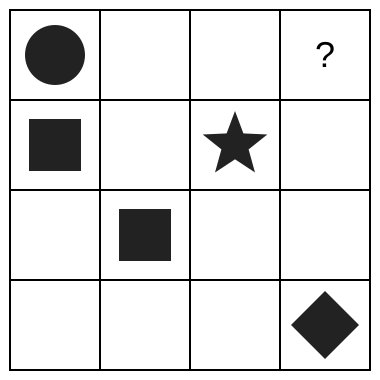
Answer: 3
The ? is in row 1, column 4. Row 1 already has a circle and column 4 already has a diamond, so ? is a star or a square. Look at the bottom row (row 4): where can its square go? Not column 1 (square in row 2), not column 2 (square in row 3), not column 4 (diamond is there). So the square in row 4 is in column 3. Now look at row 1: where can its square go? Not column 1 (circle is there), not column 2 (square in row 3), not column 3 (square in row 4). So the square in row 1 must be in column 4 — the place of the question mark. Answer: square.
25
fractions
medium
Mr Tan bought 5 whole pizzas of the same size: 1 for himself and 1 for each of his 4 students.
Mr Tan sliced his pizza into 6 equal parts and ate 4 slices.
Student A sliced his pizza into 4 equal parts and ate 3 slices.
Student B sliced his pizza into 10 equal parts and ate 7 slices.
Student C sliced her pizza into 5 equal parts and ate 3 slices.
Student D sliced her pizza into 9 equal parts and ate 7 slices.
Who ate less pizza than Mr Tan?
Answer: 3
Compare how much pizza each person left over. Mr Tan left 2 of 6 slices = 2/6 = 1/3 of his pizza. Student A left 1/4, Student B left 3/10, Student C left 2/5 and Student D left 2/9. Whoever left more than 1/3 ate less than Mr Tan. 1/4 < 1/3, 3/10 < 1/3 (since 3/10 = 9/30 and 1/3 = 10/30), 2/9 < 1/3 (since 1/3 = 3/9), but 2/5 > 1/3 (since 2/5 = 6/15 and 1/3 = 5/15). So only Student C ate less pizza than Mr Tan (3/5 is less than 2/3).
26
number-patterns
medium
Observe a pattern and find the value of '?'.
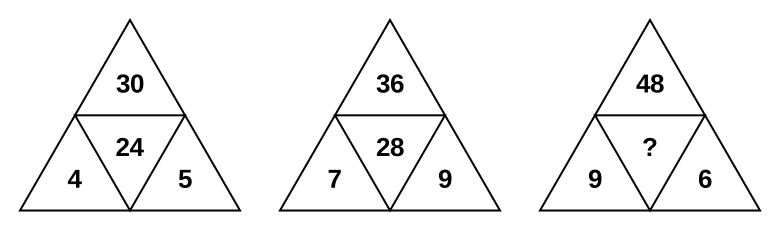
Answer: 72
Look for a rule that links the four numbers in each triangle. In the first triangle, 30 ÷ 5 = 6 and 6 × 4 = 24. In the second, 36 ÷ 9 = 4 and 4 × 7 = 28. So the middle number = (top number ÷ right number) × left number. In the third triangle: 48 ÷ 6 = 8 and 8 × 9 = 72. So ? = 72.