Section A
MCQs — 15 Questions
(+2 / -1)
1
arithmetic
easy
What is the sum of the following numbers?
2017 + 7012 + 271 =
Answer: C
2017 + 7012 = 9029, then 9029 + 271 = 9300.
2
place-value
easy
Fill in the blank: ______ is 3 tens 7 ones less than 4 tens 6 ones.
Answer: A
4 tens 6 ones = 46 and 3 tens 7 ones = 37. So 46 − 37 = 9.
3
logic
medium
Sally wrote the following: "Singapore and Asian Schools Math Olympiad". She started on Sunday and wrote one letter each day. Which day of the week will she finish writing all the letters?
Answer: B
Count the letters: Singapore(9) + and(3) + Asian(5) + Schools(7) + Math(4) + Olympiad(8) = 36 letters.
Day 1 is Sunday. Day 36: (36 − 1) = 35 days after Sunday, and 35 ÷ 7 = 5 weeks exactly, so day 36 is again a Sunday.
4
sequences
medium
What is the next number in the sequence below?
47, 44, 38, 29, 17, …
Answer: D
The gaps grow by 3 each time: −3, −6, −9, −12, so the next gap is −15.
17 − 15 = 2.
5
logic
medium
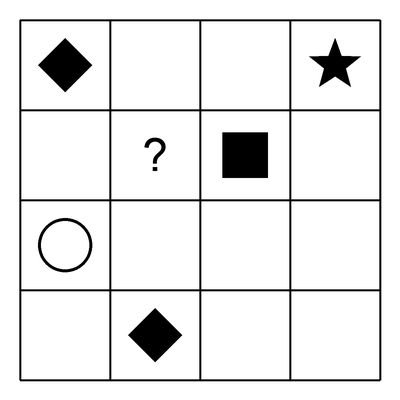
The grid can be filled with exactly 4 shapes (star, square, circle, and diamond) such that there is no duplicated shape in each row or column. What shape should be put in the place of the question mark?
Answer: D
Treat it as a 4×4 Latin square (each of the 4 shapes appears once per row and once per column).
Column 1 already has a diamond (row 1) and a circle (row 3), so row 2, column 1 must be a star or square. Since row 2 already has a square (column 3), row 2 column 1 is the star.
Column 2 already has a diamond (row 4). Row 3 column 2 cannot be a circle (the circle is already in row 3), so it is the star, leaving the circle for the question-mark cell.
The ? is a circle.
6
patterns
easy
The sequence of the five symbols ○ ◀ ⊠ △ ★ repeats to form the pattern:
○ ◀ ⊠ △ ★ ○ ◀ ⊠ △ ★ …
If the pattern is continued, the 23rd symbol in the pattern is:
Answer: C
The block of 5 repeats. 23 ÷ 5 = 4 remainder 3, so the 23rd symbol is the 3rd symbol of the block, which is ⊠.
7
fractions
medium
Hannah bought 5 whole pizzas: 1 for herself and 1 for each of her 4 students. Hannah sliced her pizza into 5 equal parts and ate only 3 slices.
• Student A sliced his pizza into 4 equal parts, but ate only 3 slices.
• Student B sliced his pizza into 8 equal parts, but ate only 7 slices.
• Student C sliced her pizza into 3 equal parts, but ate only 2 slices.
• Student D sliced her pizza into 6 equal parts, but ate only 3 slices.
Who ate less pizza than Hannah?
Answer: D
Hannah ate 3/5 = 0.6 of a pizza.
Student A: 3/4 = 0.75; Student B: 7/8 = 0.875; Student C: 2/3 ≈ 0.67; Student D: 3/6 = 1/2 = 0.5.
Only Student D (0.5) ate less than Hannah (0.6).
8
counting
medium
One day Randy was bored, and he wrote all the whole numbers from 49 to 97 on his paper. How many times did he write the digit "8" on his paper?
Answer: E
Digit 8 in the ones place: 58, 68, 78, 88 → 4 times.
Digit 8 in the tens place: 80, 81, 82, …, 89 → 10 times.
Total = 4 + 10 = 14 (note 88 is counted in both places). 14 is not among A–D, so the answer is None of the above.
9
logic
medium
Andy stays closer to school than Peter but further than Mike. Peter stays closer to school than John but further from Mike. Arrange the boys in order based on the distance from where they stay to school. (Closest to the Furthest)
Answer: B
Mike < Andy < Peter (Andy is closer than Peter but further than Mike). Peter < John (Peter is closer than John). So closest to furthest: Mike, Andy, Peter, John.
10
combinatorics
easy
Nick wants to bake a cake that consists of only 1 flavour and 1 topping. He gets to choose from 3 different flavours and 3 different toppings. How many different kinds of cake can he make?
Answer: C
Each of the 3 flavours can be paired with each of the 3 toppings: 3 × 3 = 9 different cakes.
11
logic
hard
Sally keys in four emojis in her text message. The emojis are Smile, Heart Eyes, Wink and Cry (not in that order). The Smile is not the first and not the last. The Heart Eyes is not the second emoji from the left. The Wink is not next to the Smile, and the Cry is not next to the Wink. What is the order of the emojis on Sally's text?
Answer: D
Smile is in position 2 or 3. Try Smile in position 2: Wink cannot be next to Smile, so Wink is not in position 1 or 3 → Wink is in position 4. Cry cannot be next to Wink (position 4), so Cry is not in position 3 → Cry is in position 1. That leaves Heart Eyes in position 3 (which is allowed, since Heart Eyes only cannot be 2nd).
Order: Cry, Smile, Heart Eyes, Wink — matches option D.
12
geometry
medium
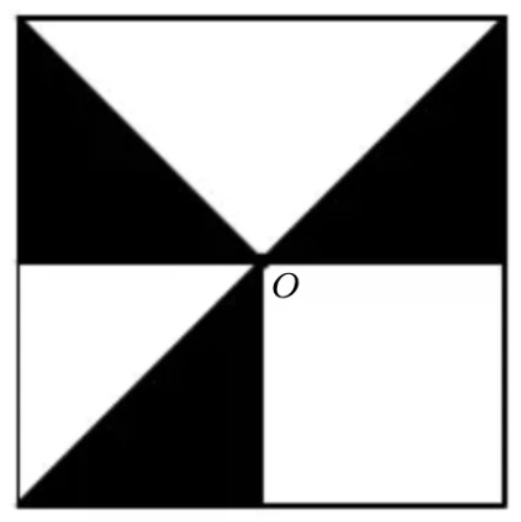
The square below has an area of 40 cm². Point O is the centre of the square. What is the area of the shaded region?
Answer: B
The whole square is 40 cm², so each of the four equal quadrants about the centre O is 10 cm².
The shaded region is made of three triangles, each of which is exactly half of a quadrant (5 cm²):
• the top-left triangle (in the top-left quadrant),
• the top-right triangle (in the top-right quadrant),
• the bottom-left triangle (in the bottom-left quadrant).
The bottom-right quadrant and the central inverted triangle at the top are white.
Total shaded = 5 + 5 + 5 = 15 cm².
13
calendar
medium
Jenny watches the show "Teletubbies" every Monday. If the 1st of January 2018 was Monday and January has 31 days, what was the last date in February in which Jenny watched "Teletubbies"?
Answer: B
January Mondays: 1, 8, 15, 22, 29. Since January has 31 days (29 + 2), Feb 1 is a Thursday. February Mondays: 5, 12, 19, 26. 2018 is not a leap year, so February has 28 days and the last Monday is 26th February.
14
number-theory
easy
An unknown number is an odd number greater than 50 but less than 100. The number is a multiple of 3 and 7. What is the value of the unknown number?
Answer: A
A multiple of both 3 and 7 is a multiple of 21. Between 50 and 100 the multiples of 21 are 63 and 84. Only 63 is odd.
15
patterns
medium
The operator △ acts on two numbers to give the following outcomes:
3 △ 2 = 12
4 △ 5 = 40
5 △ 9 = 90
6 △ 1 = 12
What is 2 △ 7 equal to?
Answer: D
Each result is twice the product of the two numbers: a △ b = 2 × a × b. Check: 3△2 = 2·6 = 12, 4△5 = 2·20 = 40, 5△9 = 2·45 = 90, 6△1 = 2·6 = 12.
So 2 △ 7 = 2 × 2 × 7 = 28.
Section B
Free-response — 10 Questions
(+4)
16
algebra
medium
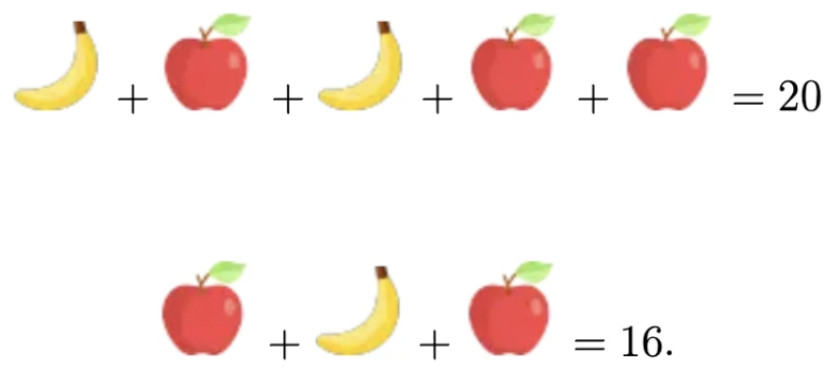
Study the two picture equations below (each banana and each apple stands for the same number). What is the value of apple + banana?
Answer: 4
Let the equations be:
(1) 2·banana + 3·apple = 20
(2) banana + 2·apple = 16
Subtract (2) from (1): (2·banana + 3·apple) − (banana + 2·apple) = 20 − 16, which gives banana + apple = 4.
So apple + banana = 4.
17
geometry
hard
How many triangles are there in the figure below?

Answer: 12
The figure is four diamonds arranged in an X (two on top touching at the centre, two on the bottom), which also creates a fifth diamond in the middle. A vertical line splits each of these five diamonds into 2 triangles.
• Small triangles: 5 diamonds × 2 = 10.
• Large triangles: there are also 2 big triangles, each made of several small pieces — one with corners at the top-left, bottom-left and right-middle points, and its mirror image on the right side.
Total = 10 + 2 = 12 triangles.
18
data
medium
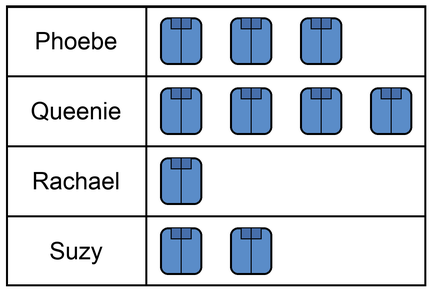
The picture graph shows the number of story books that Phoebe, Queenie, Rachael, and Suzy have. Each bag represents the same amount of books. Altogether, they have 40 books. If Queenie wishes to have twice as many books as Phoebe, how many books does Queenie need to buy?
Answer: B
Total bags = 3 (Phoebe) + 4 (Queenie) + 1 (Rachael) + 2 (Suzy) = 10 bags for 40 books, so each bag = 4 books.
Phoebe = 3 × 4 = 12 books; Queenie = 4 × 4 = 16 books.
Twice Phoebe = 24 books, so Queenie needs 24 − 16 = 8 more books.
19
logic
easy
Jason, Adam, and Tom are siblings. They are 6, 9, and 10 years old. Tom's age is a multiple of 3. Jason is younger than Tom. How old is Adam?
Answer: 10
Tom's age is a multiple of 3, so Tom is 6 or 9. If Tom were 6, no one could be younger than him. So Tom is 9. Jason is younger than Tom, so Jason is 6. That leaves Adam = 10.
20
algebra
medium
In 6 years, Claire will be three times her current age. What will be Claire's age two years from now?
Answer: 5
Let Claire's current age be x. Then x + 6 = 3x, so 2x = 6 and x = 3. Two years from now she will be 3 + 2 = 5.
21
geometry
easy
How many squares are there in the figure below?
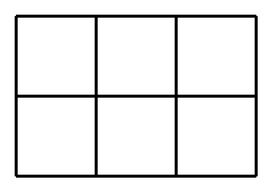
Answer: 8
The figure is a 2-by-3 arrangement of equal small squares. Count 1×1 squares: 6. Count 2×2 squares: they fit in 2 horizontal positions × 1 vertical position = 2. Total = 6 + 2 = 8.
22
counting
medium
The teacher asks Lisa to write all the odd numbers between 0 and 100. How many of the numbers consist of the digit '1'?
Answer: 14
Odd numbers with a 1 in the ones place: 1, 11, 21, 31, 41, 51, 61, 71, 81, 91 → 10 numbers.
Odd numbers with a 1 in the tens place: 11, 13, 15, 17, 19 → 5 numbers, but 11 is already counted, so 4 new ones (13, 15, 17, 19).
Total = 10 + 4 = 14.
23
algebra
medium
Tony bought 25 candies from a grocery shop. He bought 7 more apple candies than orange candies. He bought 3 more apple candies than grape candies. He bought 2 more pineapple candies than orange candies. How many apple candies did Tony buy?
Answer: 10
Let orange = o. Then apple = o + 7, grape = apple − 3 = o + 4, pineapple = o + 2.
Total: (o) + (o + 7) + (o + 4) + (o + 2) = 4o + 13 = 25, so 4o = 12 and o = 3.
Apple = 3 + 7 = 10. (Check: 3 + 10 + 7 + 5 = 25.)
24
cryptarithm
medium
In the following, all the different letters stand for different digits. What is the value of the 2-digit number QP?
PQ
+ Q
————
QP
Answer: 98
PQ + Q = QP means (10P + Q) + Q = 10Q + P, so 10P + 2Q = 10Q + P, giving 9P = 8Q. The only single digits that work are P = 8 and Q = 9.
Check: 89 + 9 = 98. So QP = 98.
25
logic
hard
At least how many of the numbers do we need to change in order that the products of the numbers in the diagonals, rows and columns will be the same?
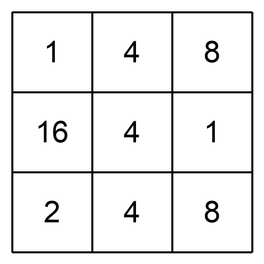
Answer: 1
Products now: row1 = 1·4·8 = 32, row2 = 16·4·1 = 64, row3 = 2·4·8 = 64; col1 = 1·16·2 = 32, col2 = 4·4·4 = 64, col3 = 8·1·8 = 64; main diagonal = 1·4·8 = 32, anti-diagonal = 8·4·2 = 64.
The only lines not equal to 64 are row 1, column 1 and the main diagonal — and all three pass through the top-left cell (the number 1). Change that 1 to a 2: row1 = 2·4·8 = 64, col1 = 2·16·2 = 64, diagonal = 2·4·8 = 64. Now every product is 64, so only 1 number needs to be changed.