Section A
Multiple Choice Questions — 15 Questions
(+4)
1
logic-ordering
medium
A few alphabet blocks were stacked up and made into a tower. If the block 'B' is 17th from the top and 5th from the bottom, how many alphabet blocks are there?
Answer: C
There are 16 blocks above B and 4 blocks below it so, total = 16 + 4 + 1 = 21 blocks.
2
algebra
easy
A number is multiplied by 3 and the product was added to 5. If the final result is 56, what is that number?
Answer: E
Number × 3 + 5 = 56.
56 − 5 = 51, 51 ÷ 3 = 17.
Number = 17.
3
measurement
medium
The perimeter of a rectangle is 144 cm. The length of the rectangle is thrice the breadth. What is the difference between the length and the breadth, in cm?
Answer: E
Perimeter = 2 × (length + breadth).
Length + breadth = 144 ÷ 2 = 72 cm.
Since length = 3 × breadth, 4 × breadth = 72 cm.
Breadth = 72 ÷ 4 = 18 cm.
Length = 18 × 3 = 54 cm.
Difference = 54 − 18 = 36 cm.
4
calendar
medium
If today is Monday, 13th September, what will be the date of the 4th Monday from today?
Answer: D
4 weeks = 28 days later.
17 days remain in September (14th to 30th) + 11 days in October.
Thus, the 4th Monday will be 11th October.
5
arithmetic
medium
Find the sum of 48 + 498 + 4998 + 49998.
Answer: D
48 + 498 + 4998 + 49998
= (50 − 2) + (500 − 2) + (5000 − 2) + (50000 − 2)
= 55550 − 8 = 55542.
6
algebra
medium
Eight notebooks and 10 pens cost $480. One pen costs $15 less than one notebook. Find the price of 5 notebooks.
Answer: A
1 Notebook = 1 Pen + 15.
8 Notebooks = 8 Pens + 120.
8 Notebooks + 10 Pens = 480, so 18 Pens + 120 = 480.
18 Pens = 480 − 120 = 360, so 1 Pen = 360 ÷ 18 = 20.
1 Notebook = 1 Pen + 15 = 20 + 15 = 35.
5 Notebooks = 35 × 5 = $175.
7
counting-digits
medium
If from a book of 300 pages, all the pages with the digit '2' were torn, how many pages does the book have now?
Answer: D
Consider pages 1 to 100: 2, 12, 22, 32, ..., 92 — 10 pages; 20, 21, 23, ..., 29 — 9 more pages (excluding 22, already counted).
Page 100 to 200: 102, 112, 122, ..., 192 — 10 pages; 120, 121, 123, ..., 129 — 9 more pages (excluding 122, already counted).
Page 200 to 299 — 100 pages.
So, the book now has 300 − 10 − 9 − 10 − 9 − 100 = 162 pages.
8
number-theory
medium
A prime number is a whole number that has exactly 2 factors: 1 and itself. For example, 2 and 7 are prime numbers. The sum of two prime numbers is 55. Find the product of these two numbers.
Answer: C
Since the sum is an odd number, one number must be even and the other odd.
As both numbers are prime, one of them must be 2, the only even prime number.
Thus, the other prime number must be 55 − 2 = 53.
Product = 53 × 2 = 106.
9
patterns
medium
If the cells are added in the same pattern, which row will have the number 25?
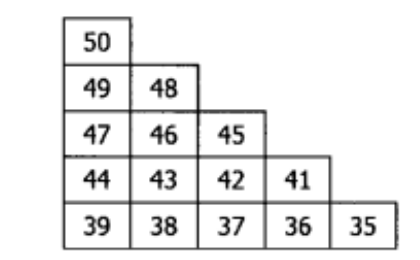
Answer: E
If the 1st number is 50, counting backwards, 25 will be the 26th number in the diagram.
There is 1 number in Row 1, 2 in Row 2, 3 in Row 3, and so on: totals are 1, 3, 6, 10, 15, 21, 28 for rows 1-7.
As there are only 21 numbers up to Row 6 but 28 numbers up to Row 7, the 26th number (25) falls in Row 7.
10
counting-figures
medium
How many rectangles are there of any size?
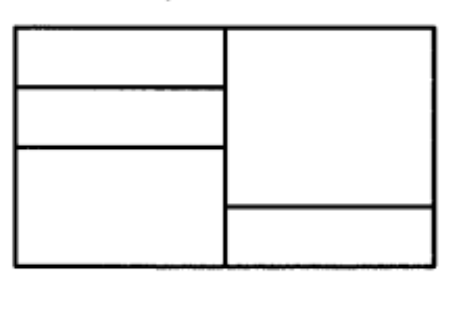
Answer: B
Counting rectangles formed from the grid lines: 1-part rectangles: 5; 2-part rectangles: 3; 3-part rectangles: 1; 5-part rectangle (the whole figure): 1.
There are a total of 5 + 3 + 1 + 1 = 10 rectangles.
11
number-theory
hard
A6B is a 3-digit odd multiple of 15. If the sum of digits is 15, find the product A×B.
Answer: B
Since A6B is divisible by 15, it is also divisible by 5. Thus, B can either be 0 or 5.
Since A6B is an odd number, B = 5.
Also, given that A + 6 + B = 15, so A = 4.
A × B = 4 × 5 = 20.
12
custom-operator
medium
If a∘b = a×5-b×2, what is the value of 8∘9?
a∘b = a×5 − b×2
Answer: A
8∘9 = 8×5 − 9×2 = 40 − 18 = 22.
13
calendar
hard
Brian takes a day off from work every 4th day and David takes a day off on every 5th day. If they have a day off today and their next day off falls on a Monday, what day is today?
Answer: A
Since they take a day off on every 4th and 5th day, every 20th day they will have a day off together.
20 ÷ 7 = 2 R 6, i.e. 2 weeks and 6 days.
So if the 20th day later is Monday, 2 weeks before Monday is still Monday, and 6 days before Monday is Tuesday.
Today is Tuesday.
14
measurement
medium
Several chocolates weigh 1120 grams. If 13 chocolates were removed, the remaining number of chocolates weighs 600 grams. How many chocolates were there at first?
Answer: C
Weight of 13 chocolates = 1120 − 600 = 520 grams.
Weight of 1 chocolate = 520 ÷ 13 = 40 grams.
Original weight = 1120 grams.
1120 ÷ 40 = 28 chocolates were in the box at first.
15
pigeonhole-principle
hard
There are 5 pairs of different colours of socks in a drawer. What is the least number of socks must Jeena take out from the drawer without looking to be sure that she has a pair of the same colour?
Answer: D
In the worst-case scenario, Jeena may take out 5 socks in 5 different colours in the first 5 picks. Therefore, only when the 6th sock is taken out, she will then have a pair of the same colour.
Section B
Open-Ended (Integer) Questions — 10 Questions
(+5)
16
magic-square
medium
Fill the numbers from 11 to 19 in the table so that the numbers in each row and each column add up to 45. What is the value of X+Y?
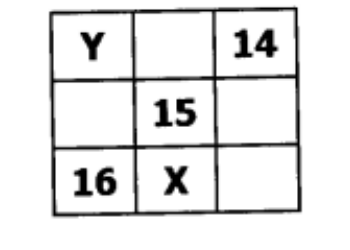
Answer: 35
Solving the grid gives X = 17, Y = 18, so X + Y = 17 + 18 = 35.
(The completed grid is: Row 1: 18, 13, 14; Row 2: 11, 15, 19; Row 3: 16, 17, 12.)
17
number-theory
medium
Frank was arranging his marbles. If he divides them into piles with 4 marbles in each, then one marble will be left out. If he divides them into piles with 7 marbles in each, then 3 marbles will be left out. How many marbles does Frank have if he has more than 20 and less than 70 marbles?
Answer: 45
Consider the table of multiples of 7 less than 70 and check which give a remainder of 1 when divided by 4:
Multiples of 7 less than 70: 63, 56, 49, 42, 35, 28, 21; adding 3 gives 66, 59, 52, 45, 38, 31, 24; remainders when divided by 4: 2, 3, 0, 1, 2, 3, 0.
Only 45 leaves a remainder of 1 when divided by 4.
Frank has 45 marbles.
18
patterns
hard
In the pattern below, how many 'b's appear before the 1000th letter: a a b b b c c d a a b b b c c d ......
Answer: 375
We notice that the pattern repeats after 2 a, 3 b, 2 c and 1 d, a total of 8 letters.
1000 ÷ 8 = 125 sets.
So, 125 × 3 = 375 'b's will appear before the 1000th letter.
19
algebra
medium
In two years from now, John will be twice as old as he was two years ago. How old will he be 10 years from now?
Answer: 16
Let the current age of John be 1 unit.
1 unit + 2 = 2 × (1 unit − 2)
1 unit + 2 = 2 units − 4
1 unit = 6 (current age).
10 years later, John's age will be 6 + 10 = 16 years old.
20
algebra
hard
Three 5-Star, two Kit Kats and one Perk cost $145. Two Kit Kats, one 5-Star and three Perks cost $135. Find the combined price of one each, in $.
Answer: 70
Adding the two given equations:
4 (5-star) + 4 (Kit Kat) + 4 (Perks) = 145 + 135 = 280.
So, 1 (5-Star) + 1 (Kit Kat) + 1 (Perk) = 280 ÷ 4 = $70.
21
number-theory
medium
How many consecutive zeros are there at the end of the following product? 25×25×6×6×36
Answer: 4
Note that every set of 5×2 = 10 gives one zero at the end.
25×25×6×6×36 = 5×5×5×5×2×3×2×3×2×3×2×3×2×3
As there are 4 sets of 5×2, there will be 4 consecutive zeros.
22
logic-puzzle
hard
Zack, Tom and Jim each draw 3 cards from 9 cards numbered 1, 2, 3, ..., 9. Zack: The product of all my numbers is 35. Tom: The product of all my numbers is 96. Jim: The sum of my numbers is 16. What is the second largest number of Jim?
Answer: 4
Zack must have numbers 1, 5 and 7 to have a product of 35.
96 = 3×4×8 or 2×6×8.
If Tom has 3, 4 and 8, then Jim will have 2, 6 and 9 with a total of 17, which is incorrect.
If Tom has 2, 6 and 8, then Jim will have 3, 4 and 9 with a total of 16, which is correct.
Thus, the second largest number is 4.
23
proportion
medium
A car can travel 44 km using 4 litres of petrol. Tom had 6 litres of petrol in the car and used one-third of it on Monday. He travelled another 22 km on Tuesday. How many km can the car travel with the remaining petrol?
Answer: 22
44 km in 4 litres → 11 km in 1 litre of petrol.
So, to travel 22 km, a car used 2 litres of petrol.
Also, one-third of 6 = 2.
Amount of petrol left in the car = 6 − 2 − 2 = 2 litres.
Distance the car can travel now = 2 × 11 = 22 km.
24
proportion
medium
If two-fifth of a juice jug is poured into one glass and 10 such glasses need to be filled, how many jugs of juices are needed?
Answer: 4
2/5 of juice jug = 1 glass.
2 juice jugs = 5 glasses.
4 juice jugs = 10 glasses.
25
ratio
medium
If there are 8 roses for every 5 daffodils in the garden bed, how many daffodils are there if there are 96 roses?
Answer: 60
For every 5 daffodils, there are 8 roses.
96 ÷ 8 = 12 sets of 8 roses.
Thus, there should be 5 × 12 = 60 daffodils.