Section A
Multiple Choice Questions — 15 Questions
(+3)
1
arithmetic
easy
Solve: 100 + 90 − 80 − 70 + 60 + 50 − 40 − 30 + 20 + 10
Answer: B
Work left to right:
100 + 90 = 190
190 − 80 = 110
110 − 70 = 40
40 + 60 = 100
100 + 50 = 150
150 − 40 = 110
110 − 30 = 80
80 + 20 = 100
100 + 10 = 110
2
calendar
medium
Rohit can go home on Diwali which falls on Thursday, 12th November this year. Diwali is 45 days later. What day is today?
Answer: D
Diwali is 45 days AFTER today, so count 45 days BACK from Thursday.
45 = 6 × 7 + 3, so 45 days back is the same as 3 days back (whole weeks don't change the weekday).
Thursday → Wednesday → Tuesday → Monday.
Today is Monday.
3
place-value
medium
What will be the digit in the hundreds place of the sum of the following expression? 40444 + 44044 + 44404 + 44440
Answer: E
Add the four numbers: 40444 + 44044 + 44404 + 44440 = 173332.
The hundreds digit of 173332 is 3.
4
cryptarithm
medium
In the multiplication shown, A8 × 8 = BCC. Find the sum of A + B + C if different letters stand for different digits.
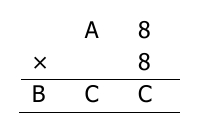
Answer: A
We need a two-digit number ending in 8, times 8, to give a three-digit number of the form BCC (last two digits equal).
68 × 8 = 544 → B = 5, C = 4, and A = 6.
All letters are different (6, 5, 4).
A + B + C = 6 + 5 + 4 = 15.
5
number-theory
medium
Chloe's current age is a multiple of 6. Next year, her age will be a multiple of 5. She is more than 30 years old and less than 70 years old. Find her age 4 years from now.
Answer: E
Multiples of 6 between 30 and 70: 36, 42, 48, 54, 60, 66.
Next year (age + 1) must be a multiple of 5, so the age must end in 4 or 9.
Only 54 works (55 = 5 × 11).
Chloe is 54 now, so 4 years from now she is 54 + 4 = 58.
6
algebra
medium
Given ▼ + 2■ = 26, ■ + 2● = 20, and ● + 2▼ = 17, find the product of ▼, ● and ■.
▼ + 2■ = 26; ■ + 2● = 20; ● + 2▼ = 17
Answer: C
Add all three equations: 3(▼ + ■ + ●) = 26 + 20 + 17 = 63, so ▼ + ■ + ● = 21.
Subtract each original equation from this total:
▼ = 21 − 20 = ... solving the system gives ▼ = 6, ■ = 10, ● = 5.
Check: 6 + 2(10) = 26 ✓, 10 + 2(5) = 20 ✓, 5 + 2(6) = 17 ✓.
Product = 6 × 10 × 5 = 300.
7
counting-squares
medium
The following picture shows a 4 × 4 square. How many squares of any size are comprised of (contain) the one marked with X?
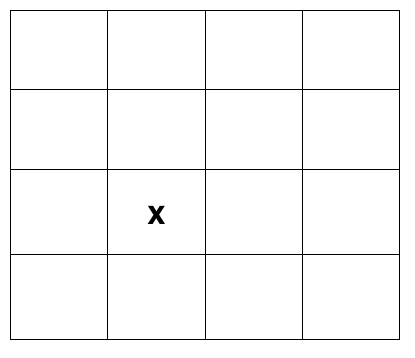
Answer: D
Count squares of each size that contain the X cell:
• 1×1: just the X cell itself → 1
• 2×2: 4 such squares contain X
• 3×3: 4 such squares contain X
• 4×4: the whole grid → 1
Total = 1 + 4 + 4 + 1 = 10.
8
logic-digits
medium
A 5-digit number is a palindrome (reads the same forward or backward). The sum of the first three digits is 14; the 3rd digit is half of the 2nd digit; the sum of the second, third and fourth digit is 15. Find the number.
Answer: E
Write the palindrome as abcba.
Sum of second, third, fourth = b + c + b = 2b + c = 15.
Third is half of second: c = b ÷ 2, i.e. b = 2c. Then 2(2c) + c = 5c = 15 → c = 3, b = 6.
First three digits sum to 14: a + b + c = 14 → a + 6 + 3 = 14 → a = 5.
The number is 56365.
9
logic-ordering
easy
The lamp is more costly than the watch and the candle stand. The candle stand is less expensive than the watch but more expensive than the basket. Which is the second most expensive item?
Answer: E
From the clues: Lamp > Watch, and Watch > Candle stand > Basket.
So the order is Lamp > Watch > Candle stand > Basket.
The second most expensive is the Watch.
10
fractions
medium
Harry brought a few marbles to school. He distributed one-third of the marbles among his friends on the bus. He gave 20 marbles to his classmates. Now he is left with only one-fourth of his marbles. How many marbles did he have at first?
Answer: C
Let the total be x. He gave away 1/3 x on the bus and 20 more, and 1/4 x remained.
So (1/3)x + 20 + (1/4)x = x.
20 = x − (1/3)x − (1/4)x = (12 − 4 − 3)/12 · x = (5/12)x.
x = 20 × 12 ÷ 5 = 48.
11
sequences
medium
In the following picture, every adjacent four cells have a sum of 20. Find the value of X + Y. The row of cells is: [ _ , 6 , 8 , _ , 4 , _ , X , _ , Y , _ ].

Answer: A
If every four consecutive cells add to 20, then sliding the window one step shows each cell equals the one four places later. So the pattern repeats every 4 cells.
Cell 5 equals cell 1, so cell 1 = 4.
Cells 1-4 sum to 20: 4 + 6 + 8 + cell4 = 20 → cell4 = 2.
X is cell 7 = cell 3 = 8. Y is cell 9 = cell 5 = 4.
X + Y = 8 + 4 = 12.
12
clocks
medium
Piyush's clock is not working properly. For every hour it lags 5 minutes behind. He set the clock correctly at 12.00 pm. What time will it be on his clock if the time now is 2.00 am?
Answer: E
From 12.00 pm to 2.00 am is 14 hours of real time.
The clock loses 5 minutes each hour, so it loses 5 × 14 = 70 minutes = 1 hour 10 minutes.
Clock reading = 2.00 am − 1 hour 10 minutes = 12.50 am.
13
algebra
medium
Jack and his father's weight add up to 100 kg. If Jack loses 4 kg, he will be exactly half of his father's weight. What is the difference between their weights, in kg?
Answer: A
Let Jack = J and Father = F. J + F = 100.
After losing 4 kg: J − 4 = F ÷ 2.
Substitute F = 100 − J: J − 4 = (100 − J)/2 → 2J − 8 = 100 − J → 3J = 108 → J = 36, F = 64.
Difference = 64 − 36 = 28 kg.
14
patterns
medium
Identify the pattern in the table (columns A, B, C, D) and find the missing value in the last row.
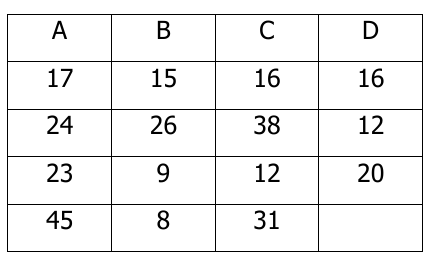
Answer: D
In every row, D = A + B − C.
Row 1: 17 + 15 − 16 = 16 ✓
Row 2: 24 + 26 − 38 = 12 ✓
Row 3: 23 + 9 − 12 = 20 ✓
Row 4: 45 + 8 − 31 = 22.
The missing value is 22.
15
proportion
medium
It takes 10 women to stitch 50 soft toys in 2 hours. How many soft toys will be done by 6 women in 4 hours, assuming all women work at the same pace?
Answer: B
One woman's rate: 50 toys ÷ (10 women × 2 hours) = 2.5 toys per woman per hour.
6 women in 4 hours: 6 × 4 × 2.5 = 60 toys.
Section B
Open-Ended Questions — 5 Questions
(+5)
16
speed-distance
medium
Kevin cycles 10 km in 1 hour and 15 minutes. How many km will he complete in 5 hours?
Answer: 40
1 hour 15 minutes = 1.25 hours.
Speed = 10 ÷ 1.25 = 8 km/h.
In 5 hours: 8 × 5 = 40 km.
17
logic-sets
hard
A basket contains an equal number of balls and pebbles. They are either white or black in colour. The number of white balls is 30 and the total number of black items is 30. If the difference between the number of black and white balls is 20, find the number of white pebbles.
Answer: 20
White balls = 30. The difference between black balls and white balls is 20, so black balls = 30 − 20 = 10.
Total balls = 30 + 10 = 40, so total pebbles = 40 (equal numbers).
Black items total 30, and 10 of them are balls, so black pebbles = 30 − 10 = 20.
White pebbles = 40 − 20 = 20.
18
counting-digits
medium
A book has 250 pages. How many digits are used to print the page numbers of the book?
Answer: 642
Pages 1-9: 9 pages × 1 digit = 9.
Pages 10-99: 90 pages × 2 digits = 180.
Pages 100-250: 151 pages × 3 digits = 453.
Total = 9 + 180 + 453 = 642 digits.
19
sequences
hard
Study the pattern and find the sum of the 9th and 10th term: 50, 53, 56, 61, 66, 73, 80, ...
Answer: 207
The differences are 3, 3, 5, 5, 7, 7, ... (they increase by 2 in pairs), so the next differences are 9, 9, 11.
Continuing: 80 (+9) = 89, (+9) = 98, (+11) = 109.
Terms: t8 = 89, t9 = 98, t10 = 109.
Sum of the 9th and 10th terms = 98 + 109 = 207.
20
proportion
medium
60 potatoes weigh 4 kg. If the cost of 1 kg of potato is $30, what is the price of 2 dozen potatoes?
Answer: 48
2 dozen = 24 potatoes.
24 potatoes weigh 4 × (24 ÷ 60) = 4 × 0.4 = 1.6 kg.
Price = 1.6 × $30 = $48.
Section C
Open-Ended Questions — 5 Questions
(+6)
21
counting-digits
hard
The numbers 20, 21, 22, ..., 63, 64 are written as a 90-digit number: 2021222324 ... 626364. All the odd digits are then removed. How many digits remain?
Answer: 48
The remaining digits are the even ones (0, 2, 4, 6, 8) in the numbers 20 to 64.
Tens digits: 20-29 (ten 2's), 40-49 (ten 4's), 60-64 (five 6's) are even → 10 + 10 + 5 = 25 even tens digits.
Units digits: each full decade 20-29, 30-39, 40-49, 50-59 has 5 even units (0,2,4,6,8) → 20; and 60-64 has 0,2,4 → 3. Total = 23 even units digits.
Even digits remaining = 25 + 23 = 48.
22
measurement
medium
Ten small ropes of the same length were knotted together to form a big rope of 81 cm. If the knotted area was 1 cm for every rope, how long was each rope?
Answer: 9
Joining 10 ropes into one needs 9 knots, and each knot uses up 1 cm.
Total rope length used = 81 + 9 = 90 cm.
Each rope = 90 ÷ 10 = 9 cm.
23
number-theory
hard
Find the value of the digit at the ones place of the following expression: 99 × 101 × 103 × 105 × 107 − 100 × 102 × 104 × 106 × 108.
Answer: 5
The first product is all odd numbers and includes ×105, so it ends in 5.
The second product includes ×100, so it ends in 0.
The ones digit of (…5) − (…0) is 5.
24
patterns
hard
If a number pyramid was built as shown in the picture (row 1: 1; row 2: 2, 3; row 3: 4, 5, 6; row 4: 7, 8, 9, 10; ...), what will be the 10th number in the 12th row?
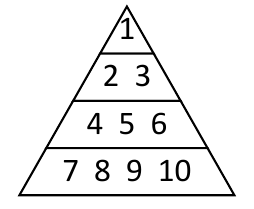
Answer: 76
Row n has n numbers, and the last number of row n is 1 + 2 + ... + n = n(n+1)/2.
The last number of row 11 is 11 × 12 ÷ 2 = 66, so row 12 begins at 67 and runs 67, 68, ..., 78.
The 10th number in row 12 is 67 + 9 = 76.
(Note: the paper's official answer key lists 66, which is actually the total count of numbers in the first 11 rows — an off-by-one. The 10th number in the 12th row is 76.)
25
number-theory
hard
A number has a remainder of 1 when divided by 2, 3, or 6 and has a remainder of 4 when divided by 5. If this number is divisible by 7, find the smallest such number.
Answer: 49
Remainder 1 when divided by 2, 3 and 6 means the number is 1 more than a multiple of 6: 1, 7, 13, 19, 25, 31, 37, 43, 49, ...
It must also be divisible by 7. From the list, 7 and 49 are multiples of 7.
7 leaves remainder 2 when divided by 5 (not 4), but 49 leaves remainder 4 (49 = 45 + 4) ✓.
The smallest such number is 49.