Section A
Multiple Choice Questions — 15 Questions
(+3)
1
counting-position
easy
Ryan stood in a line to ride the roller coaster. He noticed that he was the 10th person counting from the front of the line. He was also the 10th person counting from the end of the line. How many people were in the line?
Answer: B
Ryan is counted once in both the 10 from the front and the 10 from the back, so total people = 10 + 10 − 1 = 19.
2
digit-counting
medium
Kevin wrote all the whole numbers from 1 to 100 once, including 1 and 100. How many times did he write the digit 1?
Answer: C
Digit '1' in the units place: 1, 11, 21, ..., 91 — 10 times.
Digit '1' in the tens place: 10-19 — 10 times.
Digit '1' in the hundreds place: 100 — 1 time.
Total = 10 + 10 + 1 = 21.
3
unit-price
easy
Five ears of corn are sold for $2 at a grocery store. Mom needs to buy 60 ears for a party. How much money does she need to pay at the store?
Answer: C
60 ears ÷ 5 ears per group = 12 groups.
12 × $2 = $24.
4
weight
easy
A box of crackers weighs 1 kilogram (kg). If the empty box itself weighs 50 grams (g), what is the weight of the crackers in the box?
Answer: C
1 kg = 1000 g.
1000 g − 50 g = 950 g.
5
fractions
medium
Jason had seven friends at his birthday party. He cut the birthday cake into 12 equal slices. He and his friends each ate one slice of the cake. What fraction of the cake was left?
Answer: B
Jason plus 7 friends = 8 people, each eating 1 slice = 8 slices eaten.
Slices left = 12 − 8 = 4.
Fraction left = 4/12 = 1/3.
6
place-value
medium
Four-digit whole numbers are to be formed using each of the digits in {0, 3, 6, 8} only once. The left-most digit of the numbers is not allowed to be zero. What is the difference between the greatest four-digit number and the smallest four-digit number that can be created?
Answer: B
Greatest number: arrange digits in descending order: 8630.
Smallest number: leftmost digit must be non-zero, so use the smallest non-zero digit first, then the rest ascending: 3068.
Difference = 8630 − 3068 = 5562.
7
ratio
medium
There are 45 red or green apples in a basket. The number of red apples is two times the number of green apples. How many more red apples are there than green apples in the basket?
Answer: E
Green + Red = 45, Red = 2 × Green, so Green + 2×Green = 45 → 3×Green = 45 → Green = 15, Red = 30.
Difference = 30 − 15 = 15.
8
geometry-perimeter
medium
A rectangular table has an area of 18 square feet. If one side of the table is 3 feet long, what is the perimeter of the table?
Answer: B
Other side = 18 ÷ 3 = 6 feet.
Perimeter = 2 × (3 + 6) = 18 feet.
9
spatial-reasoning
hard
Which of the following shapes cannot be made by folding a rectangular sheet paper once?

Answer: D
A single straight fold of a rectangle can only add one crease, which can cut off or overlap one corner or edge, producing at most one notch or slanted edge. Shape 4 has two separate concave notches (a 'W' outline), which cannot result from a single fold. Shapes 1, 2, 3, and 5 can each be produced by folding one corner or half of the rectangle over.
10
time
medium
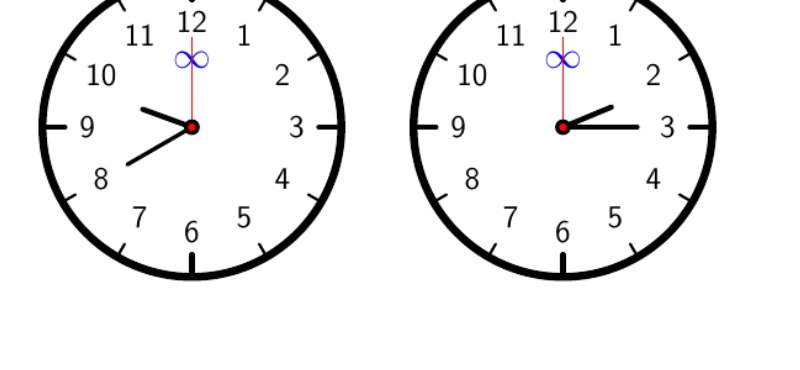
A train left Chicago at 9:40pm and arrived at the next station at 2:15am the following day. How many minutes was the ride?
Answer: D
From 9:40pm to 12:00am = 2 hours 20 minutes = 140 minutes.
From 12:00am to 2:15am = 2 hours 15 minutes = 135 minutes.
Total = 140 + 135 = 275 minutes.
11
algebra-digits
hard
In the following multiplication problem, A, B, C represent different digits from 0 to 9. What is the sum of A, B, and C?
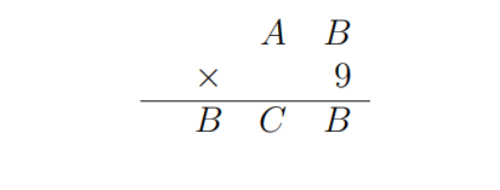
AB × 9 = BCB, where A, B, C are different digits
Answer: E
Testing two-digit numbers AB so that AB × 9 gives a three-digit result whose hundreds and units digits both equal B: 65 × 9 = 585 works, with A=6, B=5, C=8.
Sum = 6 + 5 + 8 = 19.
12
ratio
medium
The amount of water in cup A is one and a half times the amount of water in cup B. If the total amount of water in cups A and B is 1000 ml, how much water does cup B contain?
Answer: C
Cup A = 1.5 × Cup B. Cup A + Cup B = 1000.
1.5×B + B = 1000 → 2.5×B = 1000 → B = 400 ml.
13
algebra-symbols
medium
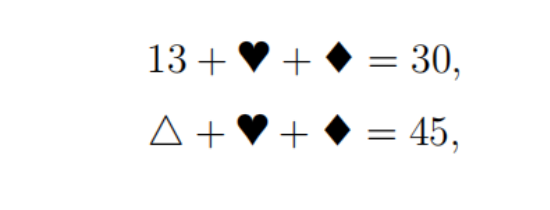
If 13 + ♥ + ♦ = 30, and △ + ♥ + ♦ = 45, then △ is equal to
Answer: E
From the first equation, ♥ + ♦ = 30 − 13 = 17.
Substituting into the second equation: △ + 17 = 45 → △ = 28.
14
bar-graph
medium
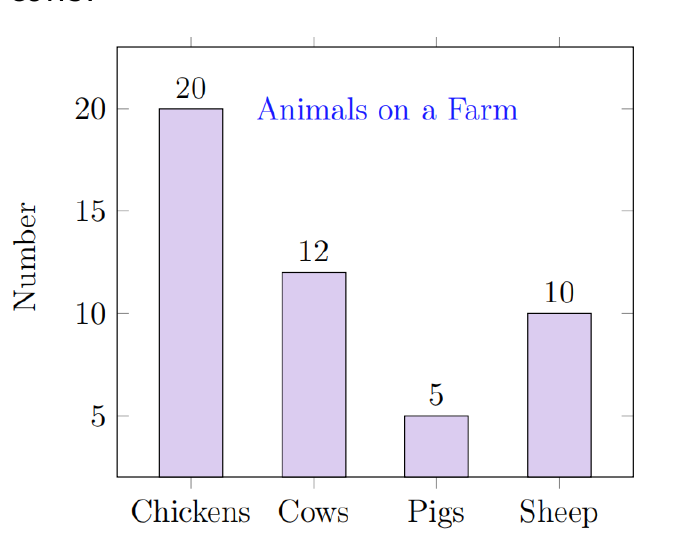
The following bar graph shows the number of different animals on a farm. How many more chickens do we need if we want the number of chickens to be three times the number of cows?
Answer: C
Chickens = 20, Cows = 12.
Target chickens = 3 × 12 = 36.
More chickens needed = 36 − 20 = 16.
15
counting-squares
medium
How many different squares of any size are there in the following 4×4 grid?
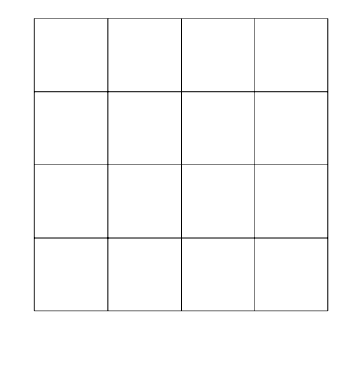
Answer: D
1×1 squares: 4² = 16.
2×2 squares: 3² = 9.
3×3 squares: 2² = 4.
4×4 squares: 1² = 1.
Total = 16 + 9 + 4 + 1 = 30.
Section B
Open-Ended Questions — 5 Questions
(+5)
16
series
medium
What is the value of 1 + 2 + 4 + 8 + 16 + 32 + 64 + … + 512 + 1024?
Answer: 2047
This is 2⁰ + 2¹ + 2² + ... + 2¹⁰, which sums to 2¹¹ − 1 = 2048 − 1 = 2047.
17
age-problems
medium
David's dad is 24 years older than David. How old will David be when his dad is 3 times as old as he is?
Answer: 12
The age gap of 24 years stays constant. When dad's age = 3 × David's age, the gap equals 2 × David's age (since 3×David − David = 2×David).
So 2 × David's age = 24 → David's age = 12.
18
geometry-perimeter
medium
What is the perimeter of the following figure in cm?
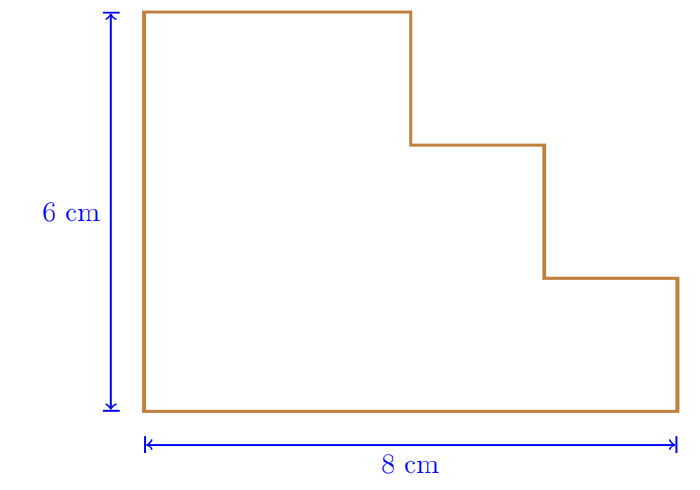
Answer: 28
This is a staircase shape cut from the top-right corner of an 8 cm × 6 cm rectangle. For such a staircase, all the horizontal segments together still total the original width (8 cm), and all the vertical segments together still total the original height (6 cm).
Perimeter = 2 × (8 + 6) = 28 cm.
19
patterns
hard
Bob is building shapes with marbles. In the first shape, he uses one marble. In the second shape, he uses three marbles. The pattern continues and Bob is able to reach the tenth shape. How many marbles does Bob use in total?
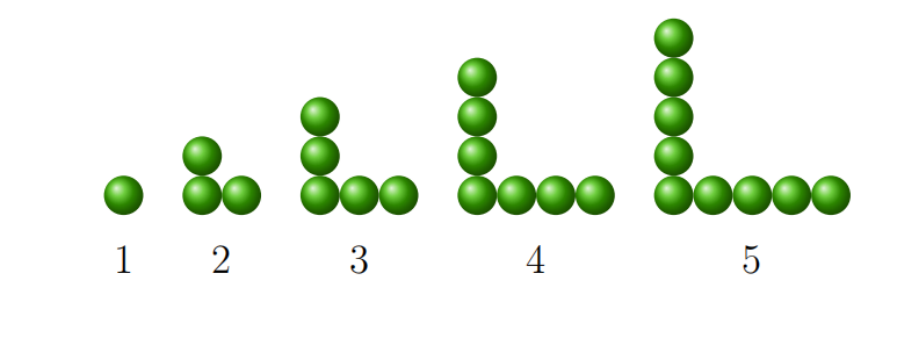
Answer: 220
The number of marbles in shape n is the nth triangular number: 1, 3, 6, 10, 15, ... = n(n+1)/2.
The total marbles used to build shapes 1 through 10 is the sum of the first 10 triangular numbers: 1+3+6+10+15+21+28+36+45+55 = 220.
20
geometry-angles
hard
Two rectangles overlap each other in the following figure. How many right angles are there in the interlocking shape?
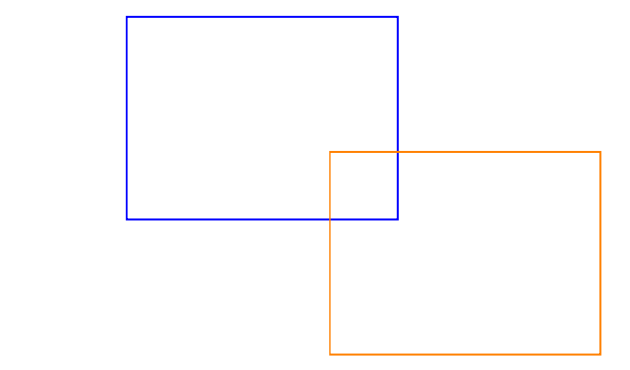
Answer: 6
Tracing the outline of the combined (union) shape gives an 8-sided rectilinear polygon. Two of its vertices, at the inner corner where the rectangles meet, are reflex (270°) angles, not right angles. The remaining 8 − 2 = 6 vertices are right angles (90°).
Section C
Open-Ended Questions — 5 Questions
(+6)
21
linear-equations
medium
Louis cut a 100-foot rope into three pieces. The second piece is 16 feet longer than the first piece, and the third piece is 18 feet less than the first piece. How long is the third piece of the rope?
Answer: 16
Let the first piece = x. Second = x+16, Third = x−18.
x + (x+16) + (x−18) = 100 → 3x − 2 = 100 → 3x = 102 → x = 34.
Third piece = 34 − 18 = 16 feet.
22
coin-problems
medium
Audrey has 16 coins, which are either nickels or dimes. Each nickel is worth 5 cents and each dime is worth 10 cents. The total value is exactly 100 cents. How many nickels does she have?
Answer: 12
Let n = nickels, d = dimes. n + d = 16, and 5n + 10d = 100 → n + 2d = 20.
Subtracting: (n+2d) − (n+d) = 20 − 16 → d = 4, so n = 12.
23
linear-equations
medium
There are two candy jars with the same number of candies. If we take 18 candies out of the first jar and 26 candies out of the second jar, the candies left in the first jar will be three times as many as the candies left in the second. How many candies does each candy jar have at the beginning?
Answer: 30
Let each jar start with x candies.
x − 18 = 3 × (x − 26) → x − 18 = 3x − 78 → 60 = 2x → x = 30.
Each jar starts with 30 candies.
24
algebra
easy
If a number is multiplied by 10, then the result is 63 more than the original number. What is this number?
Answer: 7
10n = n + 63 → 9n = 63 → n = 7.
25
geometry-perimeter
hard
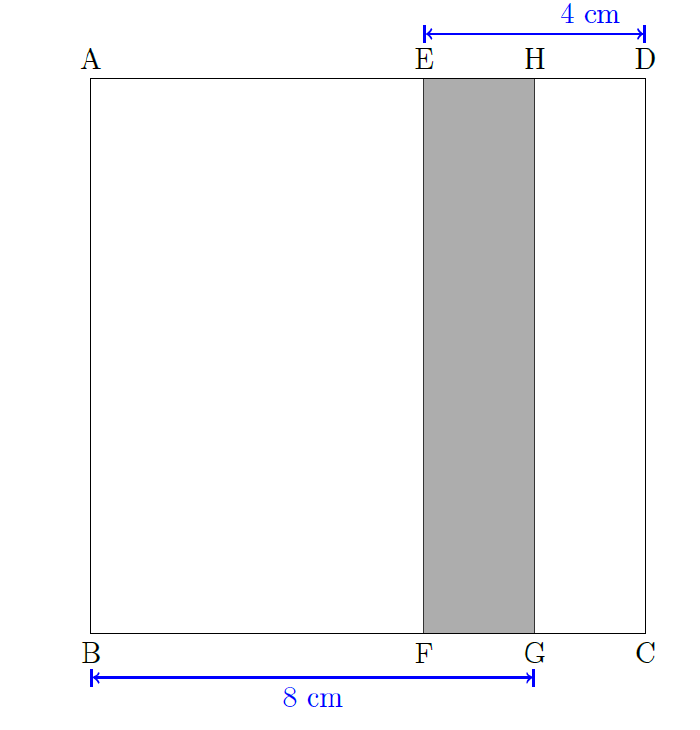
In the following figure, ABCD is a square; the shaded region EFGH is a rectangle. ED = 4 cm, BG = 8 cm. What is the perimeter of the shaded rectangle EFGH in cm?
Answer: 24
Let the square's side be s. E is 4 cm from D along the top, so E's distance from the left edge is s−4. G is 8 cm from B along the bottom, so H (directly above G) is also at distance 8 from the left edge.
The rectangle's width = |8 − (s−4)| = 12 − s, and its height equals the full side s (since E-F and H-G span the whole square).
Perimeter = 2 × (width + height) = 2 × ((12 − s) + s) = 2 × 12 = 24 cm — the square's unknown side length cancels out.